

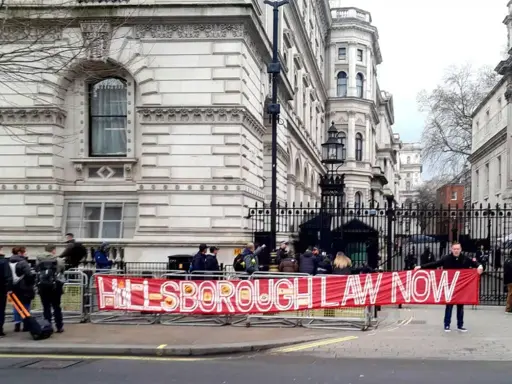
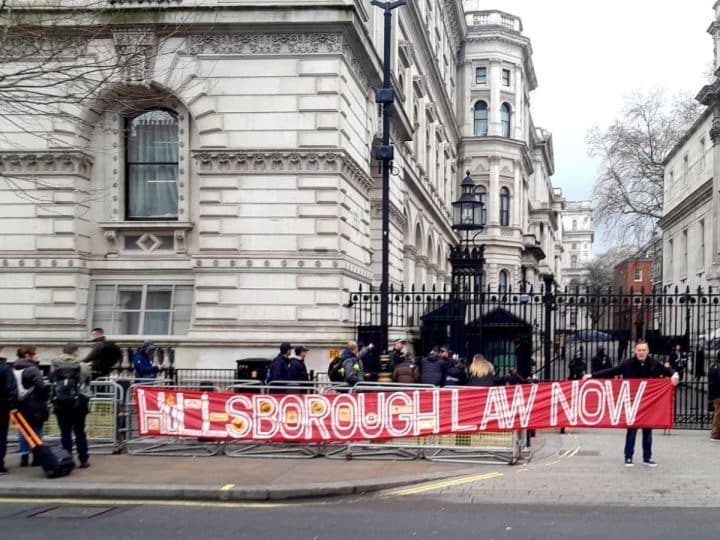
The Public Office (Accountability) Bill passed its third reading in the House of Commons on Tuesday 14 July, and is now moving through the next stages of the legislative process. Also referred to as the Hillsborough Law, it will drastically improve the ability of ordinary people to get justice and accountability from those in power.
In short, its purpose is to ensure the government is accountable for its actions and the very real human impact those actions can have, drawing its nickname from the Hillsborough disaster.
Despite multiple attempts in the courts, none of the police officers or the former chief superintendent Duckenfield have faced justice for their cover-up and negligence, which caused the death of 97 people and injured over 1000.
Decades of campaigning by the Hillsborough families have finally pushed this law into place, giving people a way to challenge those in power when they try to hide their wrongdoing and escape accountability.
This has subsequently been welcomed by the Campaign Opposing Police Surveillance (COPS), survivors of abuse committed by Spy Cops, who say this law:
marks a significant moment in the long struggle to ensure that the state can no longer evade accountability when it harms the people it claims to serve.
The number 96 has been tattooed on my wrist since 2015.
It reminds me every day that I was one of the lucky ones who came home from Hillsborough.
Today, standing in Parliament to speak as the Hillsborough Law passed was one of the proudest and most emotional moments of my life.… pic.twitter.com/IXUn3juYdz
— lan Byrne MP (@IanByrneMP) July 14, 2026
COPS: Hillsborough Law “has the potential to effect real change for us”
COPS have campaigned for years against the police’s track record of spying on political groups, trade unions and justice campaigns, and effectively working as an arm of the state to prevent accountability and justice for ordinary people.
The law, COPS say, honours the perseverance of the Hillsborough victims and their families. Those affected fought for decades to bring it into force despite facing “institutional denial, concealment and abuse”. In a press release, they say they “recognise these patterns all too well”, adding:
For decades, police officers operating undercover deceived women into intimate relationships as they unlawfully spied on political groups, trade unions and justice campaigns.
They stole the identities of deceased children, acted as agent provocateurs, hoovered up personal information on thousands of people, kept illegal employment blacklists and lied in their intelligence reports; while Special Branch commanders avoided discipline for their officers and kept everything in house to cover up corruption.
Those abuses are now being investigated and evidence is coming out. We are ‘core participants’ in the Undercover Policing Inquiry (UCPI), but the Inquiry itself has become an illustration of why this law is so badly needed.
More than ten years since the inquiry was announced, many of us are still waiting for answers, and progress is constantly hampered by institutional resistance, incomplete disclosure and police witnesses who have shamelessly lied, treating the inquiry process with the same contempt they showed the criminal and civil courts during their operations, leading to dozens of miscarriages of justice.
However, as we see with the wilful ignorance of those in government regarding the flagrant breaches of international law by Israel and the US, these laws only have the power to secure justice if the political will is there to make it so. Up to now, the political will has clearly been to shield institutions from reputational damage or real accountability, leaving victims angry and with no closure or remedy for their rage and grief.
Nevertheless, those affected have courageously refused to give up or be fatigued out of making this bill a reality. Now, it will be essential to watch how the government respond to upcoming inquiries and whether they see powerful people held accountable for their abuses against ordinary people that they “claim to serve”.
One thing is certain: anyone who lies or tries to obstruct justice will now face the threat of criminal liability.
Hopefully this will make those in power think twice:
“Under the Hillsborough law public officials are going to have to tell the truth and if they don’t they risk going to prison… It’s about the first step in changing culture within big organizations, especially public bodies.”
Speaking in London, human rights lawyer Elkan… pic.twitter.com/zFOdIRvCph
— Canary (@TheCanaryUK) July 15, 2026
Deborah Coles, executive director of INQUEST, spoke yesterday, saying it was a “momentous day” and pointed out how this finally works to address the huge power imbalance between the state and the British public:
“Bereaved families who are going along to inquests where the state is represented will have access to non-means tested public funding so that they can be represented at those inquests. And that is going to rebalance the power dynamics… where historically all the resources and… pic.twitter.com/ceiWL03f1Q
— Canary (@TheCanaryUK) July 15, 2026
Spy Cops inquiry shows “institutional secrecy has continued right up the chain”
COPS, core participants in the UCPI, spoke further about the ongoing inquiry into the use of spy cops:
Having heard from many former undercover officers, and those who they spied upon, the Inquiry has now turned its attention to the senior officers and government departments who authorised, supervised and oversaw these operations, but the drive to conceal police misconduct behind a wall of institutional
secrecy has continued right up the chain.
As a result, this inquiry gives the public the opportunity to see if the new law will be worth its weight and thus, capable of holding governments, institutions and powerful people accountable so that victims can finally get real justice.
COPS finished their press release stating:
Over the next two weeks the Inquiry will hear from former Metropolitan Police leaders, including former Commissioner Lord Paul Condon, and the key question is no longer what undercover officers did, but who knew, who approved, who benefited from the intelligence gathered on political campaigners and community organisations, and who helped to conceal the truth?
No law can undo the harm already caused, but the Hillsborough Law would make obstructing and lying to this inquiry a criminal offence.
By creating meaningful consequences for those who deliberately mislead or frustrate investigations, this law has the potential to effect real change for us, as the Undercover Policing Inquiry rumbles on. The search for truth should never depend on the persistence or resources of victims and bereaved families.
This legislation strikes a blow against the culture of cover-up and impunity that has characterised so many public scandals, and we congratulate the Hillsborough families on their historic achievement and thank them for the example they have set. Their determination will have lasting consequences for us all.
The next few weeks will show whether those in power are simply using this law to win over voters — or whether they have the courage to enforce it, even when it puts powerful people in the firing line.
Featured image via Linenhall
From Canary via This RSS Feed.