

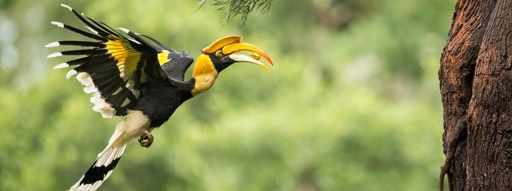
In the villages of India’s Western Ghats, some of the oldest and tallest trees do not grow inside a national park. They grow in sacred groves, small patches of old, mostly untouched forest that local communities have protected for generations, because they believe the trees belong to their deities and ancestors. A new study published in the journal PLOS One found that young trees regenerate far more successfully in these groves. Seeds dropped by fruit-eating birds are much likelier to survive and grow there than in surrounding farms and villages. India has more than 100,000 sacred groves, which are recognized as essential to community-based conservation. The Western Ghats is a mountain range that runs about 1,600 kilometers (nearly 1,000 miles) down India’s west coast, across six states. The study began there by chance. A team from the Applied Environmental Research Foundation (AERF), which runs a giant-tree program, had signed up a man in Vanzole village with a huge Terminalia bellirica (beheda) tree in his yard. Visiting, they saw giant trees all over the village. “It sparked a series of questions,” study co-author Kevin Matteson, associate director of Project Dragonfly at Miami University in the U.S. state of Ohio, told Mongabay in an email. How many giant trees were hiding in plain sight, and were birds like hornbills really using trees in such busy places? To find out, the team walked the whole village with two local experts, Namdev and Anant Shivgan, who mapped the land, identified the trees and led…This article was originally published on Mongabay
From Conservation news via This RSS Feed.