

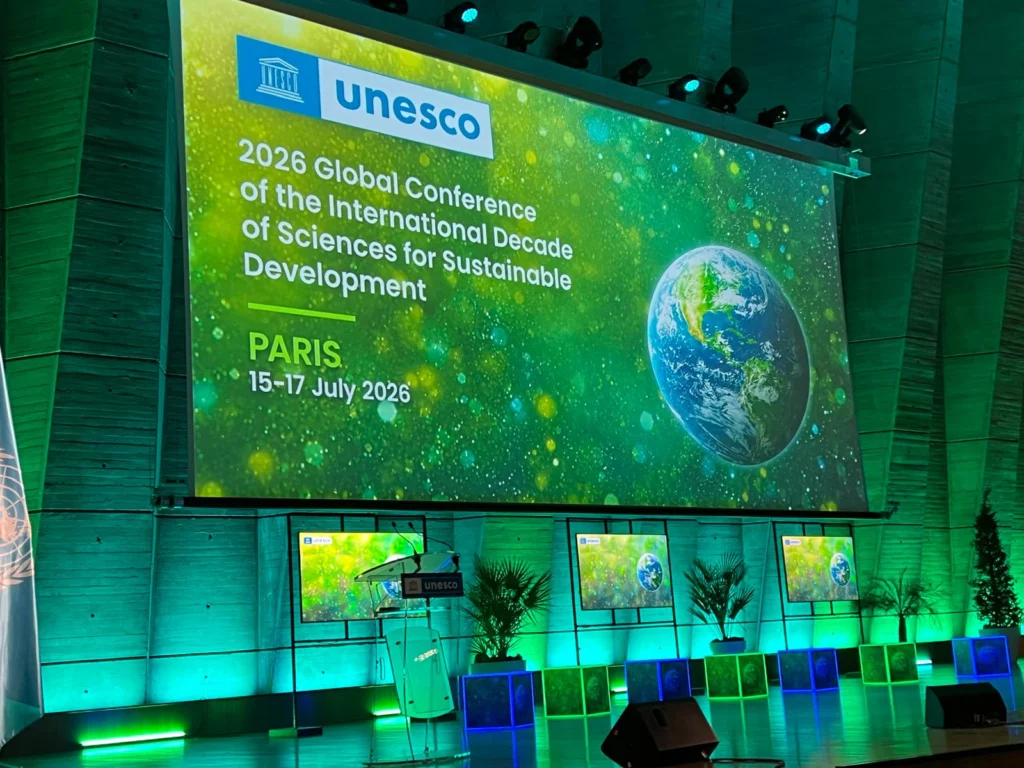
Among the reforms are changes to scientific rewards, expanded equitable access, and connecting science with policy decisions.
On Monday, the United Nations Educational, Scientific and Cultural Organization (UNESCO) presented the report “Science at a Turning Point,” recommending a reform of the reward system for scientific research, which is dominated by a “publish or perish” culture.
RELATED:
L’Oreal-UNESCO Awards Argentine Scientist Raquel Lia Chan
The document was released at the 2026 World Conference of the International Decade of Science for Sustainable Development (IDSSD), held in Paris, with more than 800 leading figures from the fields of science and politics in attendance.
The conference aims to assess the state of global science and its contribution to the Sustainable Development Goals (SDGs), two years after the launch of the IDSSD, with a positive preliminary assessment.
Among the attendees were Karin Herrera, Vice President of Guatemala; Mark Thomson, Director-General of the European Organization for Nuclear Research (CERN); and Olafur Ragnar, former President of Iceland and President of the Arctic Circle.
As the Global Conference of the International Decade of Sciences for Sustainable Development approaches, we’re highlighting initiatives already putting its ambition into action.
In Pretoria, @UNESCO and IEEE brought together 200 secondary school girls for a hands-on bootcamp in… pic.twitter.com/8ifAtkgCUO
— UNESCO (@UNESCO) July 13, 2026
Herrera emphasized that Guatemala is multicultural, multilingual, and multiethnic, and that integrating Indigenous knowledge with scientific research strengthens the capacity to address contemporary environmental, agricultural, and social challenges.
UNESCO reported that since the beginning of IDSSD, US$50 million has been mobilized across 397 initiatives in 79 countries, although imbalances persist, particularly affecting developing countries.
The report recommends five reforms: changing scientific rewards, expanding equitable access, connecting science with policy decisions, restoring public trust through inclusion and integrity, and governing new technologies such as Artificial Intelligence (AI) responsibly.
#FromTheSouth News Bits | UNESCO has warned that education in Cuba is in serious danger due to the energy crisis directly caused by the escalation of the U.S. genocidal blockade. pic.twitter.com/TjbR5M2nwW
— teleSUR English (@telesurenglish) June 2, 2026
teleSUR: JP
Source: EFE
From teleSUR English via This RSS Feed.