


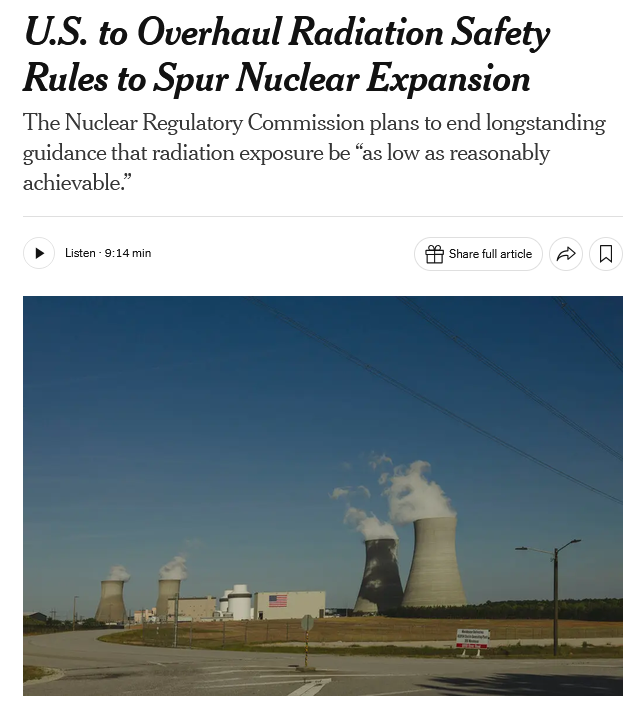
The New York Times (7/3/26) suggests the low doses of radiation may be good for you.
Alfred Meyer, long active in Physicians for Social Responsibility and former co-chair of its Radiation and Health Committee, challenged an article in the July 3 New York Times, headlined “US to Overhaul Radiation Safety Rules to Spur Nuclear Expansion.”
In a July 6 letter to the article’s author, Brad Plumer, Meyer wrote:
When I read the New York Times business page, I assume that there is a high level of investigative journalism being presented so that the news I read will present thorough and well-researched information about the topic at hand. This is not the case with this article.
Plumer began his piece by paraphrasing the Nuclear Regulatory Commission’s proposal on July 1 to overhaul its safety rules for radiation exposure at nuclear power plants. As he put it, the commission was concerned by the cost of the regulations and their tendency to “go beyond what is needed to protect human health.”
The NRC’s proposal asserted that current regulations often incur additional costs “without a measurable safety benefit”—for example, Plumer supplied, when regulators install additional equipment at plants in order to push radiation exposure “far below the legal limits.” Maximum dose limits, the agency said, are already set “well below levels associated with known health effects.”
This was meant to corroborate Plumer’s characterization about costliness, but Meyer noted the lack of substantiation:
You provide no rationale, evidence or citations for these claims, making simple conclusions about a very complex topic. How do you know that human health is indeed being protected, or as you imply, being over-protected? What examples can you provide of radiation exposure being “far below the legal limits”?
Trying to ‘simplify things’
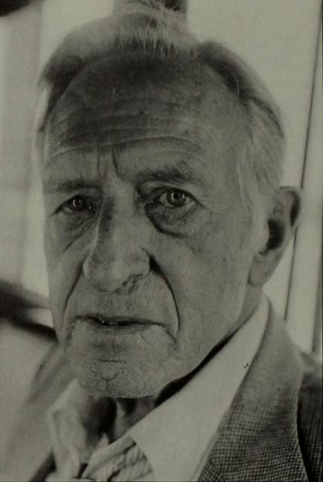
Karl Z. Morgan (from Robert Del Tredici’s At Work in the Field of the Bomb).
Meyer focused on Plumer’s denial of “measurable safety benefits” from nuclear regulations, the premise of the central question Plumer posed in his piece: How much protection against low levels of radiation is worthwhile? Meyer took issue with Plumer’s framing:
For decades, many researchers and regulators have tried to simplify things by adopting what’s known as the “linear no-threshold model,” which says that the effects of radiation scale down linearly with the dose, and that even tiny amounts of radiation can have small negative effects.
Calling the Linear No Threshold (LNT) model an attempt to “simplify things,” Meyer noted, is “a rather pejorative comment in light of the significant scientific evidence at hand”:
The 2006 National Academy of Sciences report on Biological Effects of Ionizing Radiation (BEIR VII) substantiates LNT, as did the 2021 NRC decision to deny a 2015 request to get rid of LNT.
Plumer “never mentions the history and current state of study and knowledge of the health effects of exposure to low levels of ionizing radiation,” Meyer said, pointing to 80 years of research:
The atomic photographer Robert Del Tredici includes a lengthy endnote in his 1985 book At Work in the Field of the Bomb, which recounts Karl Z. Morgan, the father of health physics—aka the study of the health effects of radiation—discussing how the effects of low-level radiation were well-researched in the late 1940s and were found to be significant. As Morgan’s medical perspectives raised public health questions about further expansion of the nuclear enterprise, they were minimized and ignored.
One of Plumer’s unquestioned and unexplored assertions especially stood out:
Experts agree that high doses of radiation are dangerous and can cause various types of cancer. But there’s much more disagreement about the effects of lower doses of radiation, such as the amounts that workers at nuclear power plants might receive in the course of their jobs. Different studies have found that low doses can be harmful, neutral or even beneficial.
The idea that low doses of radiation may be “even beneficial” refers to “radiation hormesis”—a widely dismissed claim of some nuclear promoters that exposure to radiation exercises the immune system and thus is healthy.
‘History of atomic press censorship’

A New York Times book review (8/9/21) called William Laurence “a serial defier of journalism’s mores.”
“This piece,” said Meyer,
serves to promote the current government policies to greatly expand nuclear activities—it is not investigative journalism that thoroughly considers the topics at hand to give the public the information necessary for informed decision-making.
Meyer added: “The New York Times has an uncomfortable history of atomic press censorship.” Meyer cited as “a prime example” William Laurence, who, he noted, helped craft the official military line on Hiroshima while still ostensibly a Times journalist. Laurence was a Times science writer who also worked for the Manhattan Project, for which he drafted press releases and other government statements.
Back at the Times after the war, for years Laurence glorified nuclear technology. As author Beverly Deepe Keever wrote in her book News Zero: The New York Times and the Bomb, Laurence “served as a scribe writing government propaganda” to obscure the deadly and harmful effects of radiation.
More recently, Matthew Wald, who spent 38 years at the Times with a beat including the nuclear industry, left the paper in 2014 and the following year joined the Nuclear Energy Institute, the nuclear industry’s Washington-based trade group, as a policy analyst and communications consultant.
“Is history repeating itself, or can the New York Times cover the whole story here?” Meyer wrote. “The future of our genome is at stake.”
Meyer signed his letter as the treasurer of Physicians for Social Responsibility New York. He was also formerly the chapter’s president, the executive director of PSR Wisconsin, a longtime member of PSR’s national board, and the program director of the Alliance for Nuclear Accountability. He has not yet received a response from Plumer.
ACTION ALERT: You can send a message to the New York Times at letters@nytimes.com or via Bluesky*:@NYTimes.com. Please remember that respectful communication is the most effective. Feel free to leave a copy of your message in the comments thread here.*
Research Assistance: Emily Marie Spencer
From FAIR via This RSS Feed.
Just gonna drop this video from Kyle Hill here.
