

I recently discovered an art form that has not only been incredibly therapeutic, but also given me an outlet for self-expression, especially as a first-time mother who was trying to re-find my sense of self. That art form is collage.
A world on fire
Like many of you, I no longer feel that social media is a safe or enjoyable space to inhabit.
I think about what I have witnessed there over the last six years: from COVID-19 to the far-right storming of Capitol Hill in January 2021, the UK’s anti-immigrant riots of summer 2024 to Israel’s genocide of Palestinians since 2023, as well as the most recent round of Tommy Robinson-fuelled racist anti-Muslim riots – all have been broadcast on my 15cm x 7cm phone screen. It is no wonder that my anxiety has skyrocketed.
While the world caught on fire, I also had my first child and experienced a complete mental health breakdown immediately after childbirth. I also struggled with the massive shift in my identity known as matrescence. Collage has helped me reground myself against all of this uncertainty.
The resurgence of collaging as a hobby
Collaging has recently surged in popularity as many of us have had a reckoning with the mental health impact of being chronically online, driving us to find IRL activities that help us reconnect with ourselves and each other. Alongside knitting, crocheting, and needlepoint, these craft hobbies are being referred to as analogue activities; others are calling them ‘grandma hobbies’. We are increasingly desirous of tactile activities, using our hands to create, in a bid to slow down and live in the present moment.
As the months passed, I witnessed an evolution in my collaging. Unintentionally, the collages moved from being pure whimsy to a craft, via which I was making sense of the world around me in social, political, economic and environmental terms.
My collaging had become both feminist and political, reflecting a world in which ethnic cleansing is livestreamed alongside AI-generated misinformation, phone filters, online misogyny, unrealistic beauty standards, a constant barrage of digital ads, an ever-widening wealth gap and a never-narrowing gender gap. And let’s not forget the floods, the wildfires or the people getting trapped in mines…
Femmage: when feminism met collaging
During a chance visit to London’s V&A bookshop in May, I came across a book that immediately caught my eye: Cut Out: A Feminist History of Photo Collage, Montage and Assemblage, edited by photographer and visual artist Fiona Rogers.
Femmage, says Rogers, is a term that was coined by two American second-wave feminist artists, Miriam Schapiro and Melissa Meyer, in the 1970s to describe ‘the fusion of feminism and collage.’ Schapiro and Meyer are known as the pioneers behind the femmage movement, but as Rogers’s book demonstrates, women and non-binary artists have been making feminist and/or queer collages long before the 1970s.
What was initially viewed as a pastime for aristocratic English women in the 19th century, who cut up black-and-white photographs and arranged them in whimsical and often humorous compositions alongside hand-painted elements, evolved into an accessible and classless art form of provocation and protest in the early 20th century. Women at all levels of society could use whatever they could get their hands on – torn fabric, flyers, newspapers, retail catalogues, even pornography – to create and to be a collagist.
Modernist collage
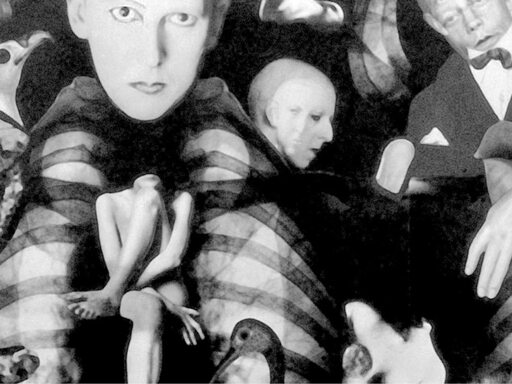
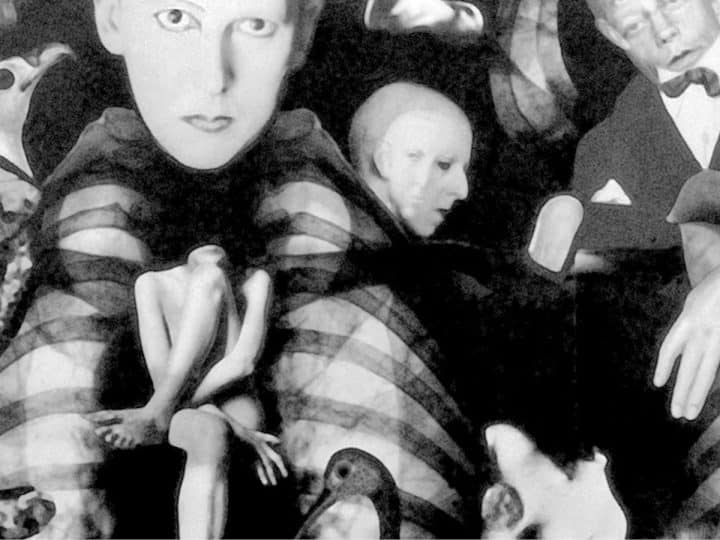
Female and queer Modernist artists agitated the status-quo by creating photo montages and collages that were a social commentary on things like industrialism, women’s suffrage and workers’ rights. A great example is Hungarian artist Elemérné Marsovszky, whose Surrealist collages featured Nazi sympathizers, dismembered limbs, towering buildings and women reaching towards a skull as a way of criticising rising fascism and urbanisation in the 1930s.
For femmagists, says Rogers, collage is a medium through which women can express their worldview, a visual commentary on issues such as the labour of childcare and domesticity, reproductive rights, equal pay and domestic violence. In other words, a:
fusion of the personal and political.
In the latter half of the 20th century, femmage enabled female and queer artists to take the beauty standards imposed on them, the sexual objectification of women through mass media and pornography, the consumerism of adverts and catalogues and flip them all on their head. Liverpudlian femmagist Linder Sterling used a mixture of cookery books, women’s lifestyle magazines, retail catalogues and pornography in the 1970s to:
subvert their original contexts.
Femmage still has a place in the post-digital world
Post-Internet revolution (i.e. today), femmage is still a radically feminist act, which women and queer artists can use to reclaim narratives, subvert the male gaze, decolonise and dismantle patriarchal structures.
We are living in a time of airbrushed celebrities, phone filters and FaceApp, which continue to create unrealistic and deceptive beauty standards. More worryingly, we are living in the era of deepfakes and AI-generated content. Femmaging allows us to not only comment on the absurdity of these things, but to rally against so-called technological ‘advances’ that objectify and sexualise us and distribute our images without our consent.
In addition, by juxtaposing and re-arranging body parts, femmage enables female and queer artists to explore gender identity and to also prevail against the backdrop of increased homophobia and transphobia.
Collage and AI
For me, femmage is a physical craft – I enjoy the cutting and the ripping, the arranging and the sticking – but others have used the same digital tools that are being used against us to create femmage. The same tools used to airbrush celebrities, such as Photoshop, can be used to create a digital collage. Some artists, like London-based photographer Maisie Cousins, have used generative AI platforms like DALL-E.
As an anti-AI writer, I find myself sitting on the fence. Is it really our artwork if something else has created the imagery? One could argue that, in the same way AI uses others’ original imagery without their consent, so too in physical collaging are you using imagery that is not always originally created by you (unless you drew the original images or took the photos). Do we feel the same way about AI-generated art that 19th century portraitists felt when the camera went mainstream?
I am of the opinion that physical collaging can still be futurist, enabling feminist and/or queer artists to reimagine societies and create futures where patriarchal structures are dismantled without the need for generative AI.
Featured image via Thames & Hudson
From Canary via This RSS Feed.