

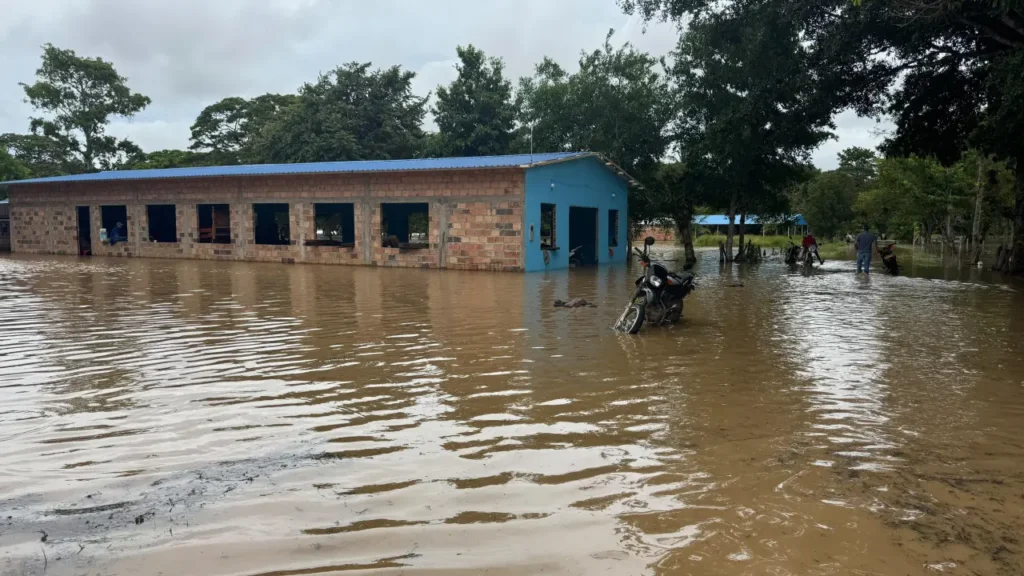
Colombia’s National Unit for Disaster Risk Management reported Tuesday that 16,769 families have been affected and two people are missing across four departments due to heavy seasonal rains that triggered flash floods, landslides and torrential flooding.
The National Unit for Disaster Risk Management of Colombia reported this Tuesday that two people remain missing and 16,769 families have been affected due to the ongoing rainy season that has swept across multiple regions of the Andean nation.
The official report consolidates data from 24 municipalities where intense precipitation has caused severe damage to infrastructure and housing.
RELATED: Severe Flooding in Northeast Colombia Leaves Over 9,000 Families Affected
According to the agency, the recorded events correspond to flash floods, inundations, torrential flooding and mass movements (landslides), affecting 24 municipalities and 298 homes across the affected territories.
The most impacted departments are Arauca, Boyacá, Casanare and Norte de Santander, all of which have officially declared a state of public calamity and deployed their operational capacities for emergency humanitarian assistance.
En las próximas horas se prevé cielo entre parcial y mayormente nublado en gran parte del país. Las lluvias más significativas se estiman en la región Pacífica, amplios sectores de la Orinoquia y zonas de la Amazonia. pic.twitter.com/HO3fQ6GLVV
— Ideam Colombia (@IDEAMColombia) July 14, 2026
Text reads: “In the next few hours, partial to mostly cloudy skies are expected across much of the country. The most significant rainfall is estimated in the Pacific region, large sectors of Orinoquia and areas of the Amazon.”
Persistent rainfall in the Casanare department has caused rivers to overflow their banks, submerging entire communities and destroying crops that represent the primary livelihood for thousands of families. Local authorities have reported that access roads to several rural areas remain blocked, complicating rescue and relief operations.
“We have a consolidated record of the requirements presented to the National Government after listening to the governors of the affected departments,” stated the general director of the National Unit for Disaster Risk Management (UNGRD, in Spanish) Javier Pava. “The departments have already declared public calamity and deployed their operational capabilities, which in some cases have been exceeded. From the National Unit for Disaster Risk Management we are consolidating these needs to begin the displacement of aid and strengthen the response in the territories,” he added.
Aid and Monitoring
The national government has articulated priority interventions, including the rehabilitation of six strategic bridges essential for connectivity on national corridors. These bridges are critical arteries for the transport of goods, medical supplies, and personnel between affected communities and larger urban centers. Emergency crews are working around the clock to restore transit on key roadways that have been either partially or completely washed away by the forceful currents.
Additionally, authorities have coordinated the restoration of essential services such as drinking water, electricity and telecommunications, which were severely disrupted in several municipalities. Technical assistance teams have also been deployed to the agricultural sector, where vast extensions of farmland have been submerged, threatening both food security and the economic stability of thousands of rural families.
Meteorological authorities, in coordination with departmental and municipal councils, have emphasized that they will maintain permanent monitoring of the evolution of the emergency to determine the necessary actions required to provide timely attention to the affected communities. Early warning systems have been activated along major river basins, and evacuation protocols have been implemented in high-risk zones.
In addition to the current rainy season, the South American nation is preparing for potential challenges that the El Niño phenomenon will generate later this year. The combination of heavy rains now followed by possible drought conditions later represents a compounding threat to Colombia’s vulnerable regions.
#FromTheSouth News Bits | Venezuela’s government issued a statement expressing solidarity with those affected by heavy rains in Colombia. pic.twitter.com/fdlNXDTq7A
— teleSUR English (@telesurenglish) July 14, 2026
On July 10, the government of President Gustavo Petro presented strategic priorities to address the impacts of the meteorological phenomenon, which includes strengthening early warning systems, reinforcing river defenses, expanding emergency stockpiles, and establishing rapid-response funds that can be deployed without bureaucratic delays.
The climate crisis has intensified weather patterns across Latin America, with Colombia experiencing increasingly erratic precipitation cycles. Scientists have noted that rising global temperatures are contributing to more intense and concentrated rainfall events, overwhelming drainage infrastructure and natural water absorption systems in regions historically unprepared for such volumes of water in short periods.
As the rains continue and rivers remain at critical levels, authorities have urged residents in low-lying areas to remain vigilant and follow official evacuation orders. The priority remains the protection of human life and the restoration of minimum living conditions for the thousands of families who have lost their homes, belongings, and livelihoods in this devastating climatic event.
From teleSUR English via This RSS Feed.