

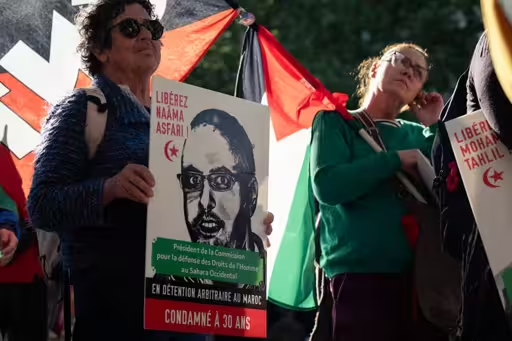

Imprisoned Sahrawi activist Naama Asfari is entering his second month of an indefinite hunger strike, protesting severe prison conditions and demanding his transfer to a detention center in occupied Western Sahara.
The 56-year-old political prisoner, Sahrawi activist Naâma (Enaama) Asfari, was imprisoned since 2010 and he is serving a 30-year sentence in northern Morocco. He initiated his protest last June 8, protesting harsh detention conditions and demanding his transfer to occupied Western Sahara.
The Sahrawi Arab Democratic Republic has issued an urgent international appeal warning that imprisoned Asfari is in critical health after 36 days on hunger strike in Morocco’s Kenitra prison.
RELATED: U.S. Calls for New Round of Negotiations on Western Sahara
Sahrawi authorities and supporters detailed that Asfari’s health condition has been aggravated by prolonged isolation, the alleged denial of urgent medical care and years of separation from his family, urging immediate international intervention to protect his life.
According to an official statement released on July 13, Asfari’s medical condition has reached a critical stag, warning that the activist’s life is at risk after more than a month without food and accused Moroccan prison authorities of refusing him the urgent medical attention his condition requires.
The latest reports on the condition of Sahrawi civilian prisoner Naama Asfari confirm a dangerous deterioration in his health; Asfari has been on an indefinite hunger strike for 36 consecutive days—amidst widespread international and regional solidarityhttps://t.co/FoXflzSwQj pic.twitter.com/HRb8gUBxQY
— Agencia News EspMag_tomorrow we launch (@APNewsZ) July 14, 2026
Sahrawi authorities further alleges that Asfari remains in isolation and that his wife, French national Claude Mangin, has been barred from entering Morocco, preventing her from visiting him for the past eight years**,** which has compounded both his physical and psychological suffering while in detention.
In this sense, the authorities has called for Asfari to receive immediate specialized medical care, unrestricted access to his family, international monitoring of his condition, and his unconditional release.
Asfari’s Long Detention
Naâma Asfari has become one of the best-known Sahrawi political prisioners. He was born in 1970 into a Sahrawi family whose members were deeply affected by the Western Sahara conflict. His father, a prominent Sahrawi activist, was imprisoned by Moroccan authorities in 1975, and Naâma did not see him again until 1991. His mother died while his father remained in prison.
Graduated in International Law and Economics, Asfari later moved to Paris, where he pursued postgraduate studies in International Relations and co-founded the Committee for the Defense of Human Rights in Western Sahara (CORELSO) alongside his French wife. His advocacy has repeatedly led to arrests during visits to his family in Laayoune, with supporters stating that he was detained six times within seven years. In 2009, he reportedly spent four months in prison for carrying a keychain displaying the Sahrawi flag.
The most significant chapter of his detention began on November 7, 2010, following the dismantling of the Gdeim Izik protest camp. Moroccan security forces arrested him in Laayoune, transferred him to an undisclosed location while blindfolded and handcuffed, and held him in custody for more than 27 months before a Moroccan military court sentenced him to 30 years in prison. That sentence was later upheld by the Court of Appeal in Salé on July 19, 2017.
Asfari was transferred to El Aarjat prison in September 2017 , approximately 1,320 kilometers from Laayoune, further limiting contact with relatives. His case has since been referenced in reports presented before the United Nations Human Rights Council, reflecting continuing international attention to his detention.
Asfari is recognized globally as the leader of the Gdaim Izik group and his case symbolizes the broader legal persecution of Sahrawi activists fighting against Moroccan colonial occupation.
A group of 24 Sahrawi political prisoners from the same case remain behind bars. Their families continue to struggle for their freedom and basic dignity inside Moroccan jails. Supporters emphasize that the Gdaim Izik trial violated international fair trial standards, meanwhile the Moroccan State has consistently ignored international calls to review the controversial judicial sentences.
With Asfari now reportedly in critical condition after weeks on hunger strike, Sahrawi authorities insist that immediate medical intervention is essential. They argue that the combination of prolonged imprisonment, alleged denial of healthcare, isolation and family separation has created an increasingly serious humanitarian situation that demands urgent international scrutiny.
We call for the release of Sahrawi human rights defender Naama Asfari. His health is extremely critical after being on a hunger strike since June 8, demanding implementation of UN WGAD’s opinion calling for the release of Sahrawi prisoners. https://t.co/88kIGP4VJj
— Assemblea International (@assemblea_int) July 13, 2026

Global Solidarity Mobilized
The Association of Families of Sahrawi Prisoners organized protests last week outside the Prison Administration headquarters in Rabat to demand the immediate restoration of the inmates’ fundamental rights.
The collective denounced systematic violations of the International Covenant on Civil and Political Rights and they accused Morocco of denying essential medical assistance and using prolonged isolation against prisoners. Relatives described these prison practices as acts of physical and psychological torture, expressing deep concern over the impunity enjoyed by prison guards and administrative staff.
The struggle of the Sahrawi people for self-determination against Morocco’s occupation remains a core focus of anti-colonial solidarity and it highlights the ongoing resistance of the nation fighting for their sovereignty, meanwhile the international community continues to demand a referendum on independence.
From teleSUR English via This RSS Feed.