

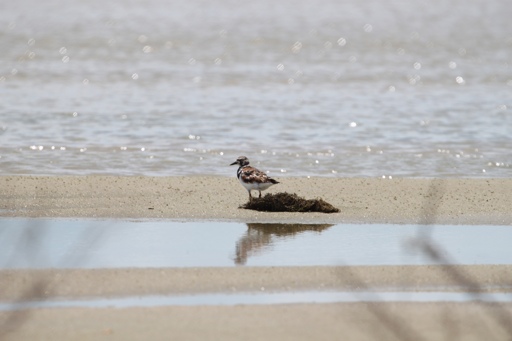
POTIGUAR BASIN, Brazil — On the estuary beaches where the Atlantic Ocean mixes with freshwater rising from mangrove soils, the shorebird known as the red knot has a single goal: to feed. While one member of the flock keeps watch, the others use their specialized, tireless beaks to capture clams, oysters, snails and earthworms that inhabit the muddy soils. Soon the time to migrate will come, and the birds must double their weight to endure the long trip. Each May, after spending the previous eight months in the coastal wetlands of Brazil’s shoreline and in Argentina’s Tierra del Fuego, at the far south of South America, red knots (Calidris canutus) begin a long return flight to the Northern Hemisphere. Their final destination is the cold, desert-like Arctic tundra. It’s there, during the northern summer, between June and August, that they breed. Even before the journey starts, on the beaches of Macau, Guamaré and Galinhos — coastal municipalities dotted throughout Brazil’s Potiguar Basin — observers can see a sign of their preparation: the birds’ chests display a reddish color typical of nuptial plumage. Among migratory birds, the red knot is one of the longest-distance travelers. It flies for about six days and six nights without sleeping, eating or drinking. After leaving Brazil, it will cover roughly 8,000 kilometers (5,000 miles) to its next stop: Delaware Bay, on the northeastern coast of the U.S. From there, the journey continues toward the Arctic; over a year, the round trip may cover 30,000 km (nearly 19,000…This article was originally published on Mongabay
From Conservation news via This RSS Feed.