

From Rajoy’s ethno-nationalist column to Amarilla’s neo-colonial attack on Mbappé
The 2026 FIFA World Cup, co-hosted by the United States, Mexico, and Canada, was promoted as the first edition to feature 48 national teams and as a celebration of global unity, diversity, and multicultural integration.
RELATED:
LaLiga President Tebas Denounces FIFA Lack of Credibility
However, beneath the official marketing campaigns, the tournament has been heavily affected by an alarming escalation of discrimination.
The scale of the problem during the 2026 World Cup is clearly demonstrated. According to data released regarding the initial stages of the tournament, over 89,000 abusive social media posts targeted players, coaches, and match officials during the group stage alone.
This represents a staggering 13-fold increase in recorded digital abuse compared to Qatar in 2022. This massive surge in discrimination has manifested across multiple areas, including public statements made by high-ranking political figures, toxic television broadcasts, and widespread targeted harassment within the global digital ecosystem.
Mariano Rajoy and the Denial of European-African Citizenship
An example of this discrimination occurred within the European discourse of Mariano Rajoy, the former Prime Minister of Spain, just before the anticipated semifinal match between Spain and France.
Mariano Rajoy published a controversial opinion column for the right-leaning Spanish media outlet El Debate. In his written analysis of the upcoming match, Rajoy explicitly targeted the demographic composition of the French national football team.
Rajoy wrote that while the French squad possessed exceptional physical strength and technical skill, “one thing they don’t have is any French players.”
This public statement by Rajoy drew international condemnation for invoking traditional ethno-nationalist tropes. Statistically, Rajoy’s claims were entirely inaccurate, as the vast majority of the French World Cup squad members were born directly on French soil, and the remaining players moved to the country during their early childhood.
Spanish Prime Minister Pedro Sánchez publicly rejected his predecessor’s remarks, emphasizing that the Spanish government firmly supports inclusion and diversity in sports.
Concurrently, French government officials issued an official response to the controversy, stating that “France has no skin color” and reaffirming that civic identity in a modern democracy is defined by legal citizenship and shared values rather than racial heritage.
Former Spanish PM Mariano Rajoy:
“France has a team of VERY HIGH level… but without any Frenchmen.”
Rajoy published an op-ed in a Spanish newspaper in which these statements sparked criticism, with some people accusing him of being racist.
However, many Spaniards have… pic.twitter.com/UPurajbBxK
— Mario Nawfal (@MarioNawfal) July 13, 2026

The “Colonized” Trope: Political Attacks on Kylian Mbappé
The policing of Black identities during the 2026 World Cup was not confined to European political circles; it also manifested in South American political discourse.
Following Paraguay’s 1–0 defeat against France in the Round of 16, Celeste Amarilla, a right-wing Senator from Paraguay, launched a vitriolic public attack against the French team’s captain and forward, Kylian Mbappé.
In a series of highly publicized statements, Senator Amarilla explicitly targeted Mbappé’s African heritage, branding him a “colonized Cameroonian” who was merely “pretending to be French.”
Amarilla’s comments drew immediate international condemnation. The United Nations Human Rights Office issued an official statement strongly criticizing the Paraguayan lawmaker, characterizing her remarks as deeply “racist and dehumanizing.”
Kylian Mbappé utilized his social media platform to respond directly to Amarilla, labeling her a “despicable woman” and calling for greater accountability for public officials who use their platforms to spread racial hatred.
Sociological analysts point out that Amarilla’s rhetoric represents a classic neo-colonial trope often deployed by right-wing elites in Latin America.
Exoticism and Media Bias: The DR Congo Narrative
The focus of global media attention was on the performance of the Democratic Republic of Congo (DRC). Making a highly anticipated return to the World Cup stage, the Congolese national team became a focal point for international spectators.
However, the team’s presence was quickly distorted; numerous Western and international digital influencers reduced the Congolese team’s sporting achievements to reductive and exoticized narratives.
At the center of the actual narrative was the prominent presence of Michel Nkuka Mbola-Dinga, a widely recognized activist known globally by the moniker “Lumumba Vea” or “Lumumba Lives.”
Throughout the World Cup matches, Mbola-Dinga stood motionless in the stadium stands, dressed in traditional attire to deliberately evoke the political legacy of Patrice Lumumba, the legendary anti-colonial leader and the first democratically elected Prime Minister of the DRC, who was assassinated in 1961.
Online content creators frequently attributed the team’s victories to “witchcraft,” African mysticism, and claims that the players were actively using a “bewitch” or magical spell during their matches.
By framing the Congolese team through the lens of primitive superstition and “witchcraft,” digital influencers effectively neutralized the team’s deliberate political expressions.
These sensationalized internet narratives directly obscured the profound political and historical realities being expressed by the Congolese delegation and their supporters.
Congo’s ‘human statue’ honours a murdered national hero at every football match
Michel Nkuka Mboladinga, better known as Lumumba Vea, has gone viral for standing perfectly still throughout DR Congo football matches. Here’s why.
Read more: https://t.co/X8TEgOfGSN pic.twitter.com/kB6W06vRIw
— IndiaToday (@IndiaToday) July 8, 2026
Institutional Silence and the Argentine Border Controversy
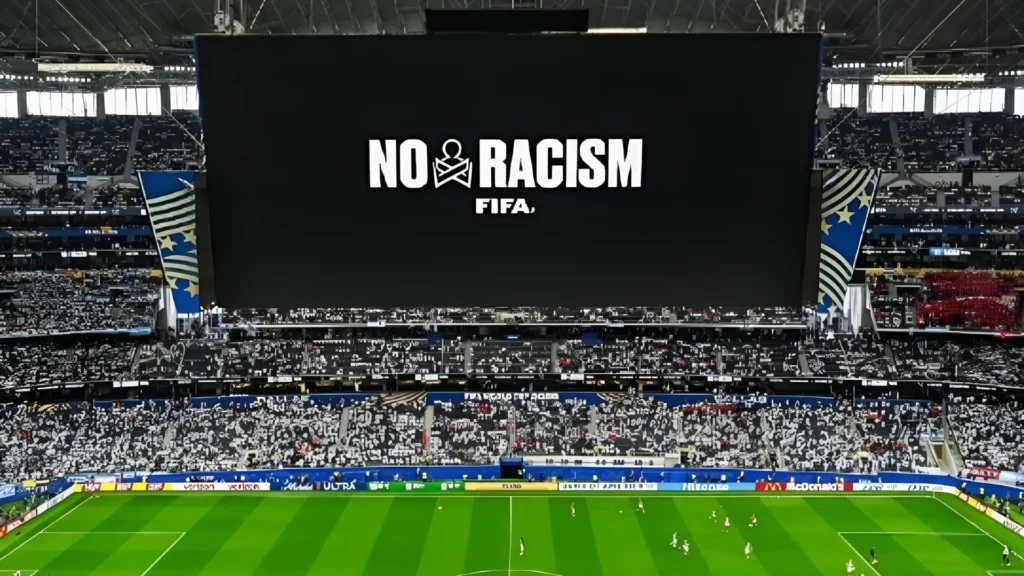
While FIFA promotes public relations campaigns labeled with slogans of equality, the organization’s hyper-capitalist structure treats anti-racism as a brand-preservation task rather than an urgent structural crisis.
A significant instance of this unchecked bias occurred during a live television broadcast featuring prominent Argentine journalist and anchor Eduardo Feinmann.
Following the elimination of the Mexican national team from the tournament, Feinmann launched into a hostile tirade targeted at the entire Mexican population. During the broadcast, Feinmann stated explicitly, “I detest Mexicans, I detest them with my soul,” attributing his remarks to what he termed “the envy they feel for us”.
The broad broadcast provoked an immediate diplomatic response. Mexican President Claudia Sheinbaum issued a public address firmly condemning Feinmann’s language, citing it as an unacceptable normalization of hate speech within modern international sports journalism.
Sociologists focusing on this issue observe that Feinmann’s statements stem directly from a deeply internalized culture of racial hierarchy and exceptionalism within traditional Argentine discourse, which historically minimizes or outright denies its own structural Eurocentrism.
Paraguayan Senator Celeste Amarilla calls Mbappe ‘ugly colonized Cameroonian’ — ‘educated by chimpanzees’
Then threatens to sue him for ‘GENDER-BASED VIOLENCE’ after he responded
Refuses to apologize: ‘from generation where BEATING GAYS & calling people SH*T BLACKS WAS NORMAL’ pic.twitter.com/p1oZ7yc7K6
— RT Intl (@RT_on_X) July 8, 2026
The Digital Architecture of Hate 2026
Far from being neutral spaces, algorithmic social media feeds have functioned as force multipliers for harassment throughout the 2026 World Cup.
The integration of modern internet culture and stadium sports was abruptly illustrated during a widely covered incident involving the popular American online creator Darren Jason Watkins Jr., known globally as IShowSpeed.
While broadcasting live from the stands during Argentina’s highly charged Round of 32 victory over Cape Verde at the Hard Rock Stadium in Miami, Watkins, who is Black, became the direct target of aggressive Argentine fan harassment, explicitly using Spanish slurs to tell him to “go cry to the zoo”.
The immediate public outcry compelled FIFA’s corporate communication offices to issue an official statement confirming that a formal investigation into the Miami stadium incident had been initiated. FIFA explicitly declared that “anyone who acts in a manner that undermines these values is not welcome in our game”.
Throughout the 2026 tournament, unmoderated streaming chats, viral audio loops, and AI-driven recommendation algorithms have actively boosted discriminatory interactions because outrage consistently drives high user engagement.
The 2026 World Cup serves as definitive evidence that until international governing bodies and dominant tech conglomerates implement genuine legal accountability, systematic media reform, and structural penalties, anti-racism in global sports will remain an unfulfilled corporate marketing objective.
Sources: LatAm Journalist Review – The Straits Time – New Line Magazine – The Times Of India – BBC – NYT – FIFA official page – teleSUR
From teleSUR English via This RSS Feed.