


Argentina’s coach, Lionel Scaloni, was asked about the symbolic significance of the upcoming match between his team and England. The coach, who led Argentina to the championship at the 2022 World Cup, tried to defuse the tension and said it was “just a football match.”
However, it doesn’t seem that Argentine fans see it that way – not even the players on the national team, who, after defeating Switzerland in overtime in the quarterfinal match, sang and jumped along with the tens of thousands of Argentine fans who had filled the stadium: “Anyone who doesn’t jump is an Englishman,” knowing that their next opponent would be England. Many might think this is just another chant from the Argentine fans’ vast repertoire, but this one is special.
In total, the two teams have faced each other five times in the World Cup. At the 1962 World Cup in Chile, England defeated the “Albiceleste” 3–1. At the World Cup in England, in a match fraught with controversy due to accusations of unfair play by the South Americans, the English won again, this time thanks to a lone goal; after that, the European team went on to win its only World Cup trophy.
But, despite Scaloni’s statements, this football rivalry has historically been overshadowed by a territorial and political dispute over the Malvinas Islands, or Falkland Islands, located in Argentine waters and 500 kilometers off the South American coast.
A legacy of imperialism
Although Spain, the former colonial power that controlled these territories, declared that it laid claim to the archipelago in 1540, England insists that John Davis was the one who discovered the islands in 1592 and, since then, it asserts, has claimed its right to sovereignty – even though the islands appear on several maps predating that date, a fact used by the Argentines to refute this claim.
Later, in the 18th century, the French attempted to take possession of the islands and even built a fort there; however, years later, France acknowledged that the islands belonged to Spain, which established a governorate there and subsequently succeeded in expelling some English settlers who had, for their part, claimed possession of the islands.
The truth is that England, Spain’s colonial rival, had sought to penetrate the South American colonies to wrest commercial and economic control from Spain and continue its rise as the leading colonial power – a position it would cement during the 19th century. When the territory that would later become Argentina gained independence from Spain, it assumed control of the territories that Spain had claimed for itself, as happened throughout the rest of South America. But in 1833, the United Kingdom evicted the Argentine garrison stationed there and violently seized the archipelago.
British control over the islands remained stable until 1982, when the Argentine military dictatorship attempted to retake control of the archipelago (in an effort to regain some of the popular support it had lost due to allegations of human rights violations), which triggered the start of the Falklands War on April 2. Hostilities lasted 74 days and ended with Argentina’s surrender, resulting in the tragic loss of 649 Argentine soldiers and 255 British soldiers.
Maradona vs. England
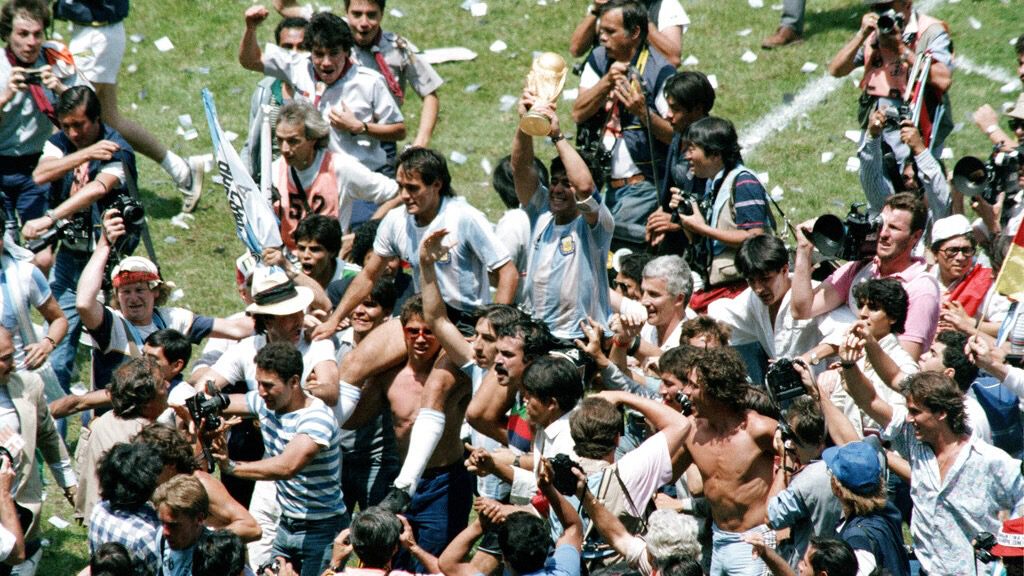
A few years later, Argentina would face England again, but this time on a football field – specifically at the legendary Azteca Stadium – during the quarterfinals of the 1986 World Cup in Mexico. The memory of the military defeat and the alleged acts of war crimes that had been denounced in Argentina against its soldiers had created a tense atmosphere.
The famous Argentine defender, José Luis Brown, nicknamed “El Tata,” recalled the team’s captain at the time – and the world’s best player at that moment – Diego Armando Maradona: “As he stepped onto the field, he walked with his chest out, and his head held high. He didn’t say a word; he was serious, just staring at the English players. When the national anthem ended, this shout was heard: ‘Come on, come on—these sons of b*tches killed our boys, our friends, our neighbors. We can’t lose!”
Although the match wasn’t a final, it became a permanent part of football folklore and history. In the 51st minute, Maradona scored a goal with his hand, though the referee allowed it despite protests from the English players. Years later, Maradona would say that it was “the Hand of God” that scored the goal, forever christening a play that, to this day, most English football fans use to denounce Maradona as a “cheating player.”
But just four minutes later, Maradona did something unthinkable: before the stunned eyes and weary cheers of the English fans, with immense skill, the number “10” managed to run from midfield, dodge several English players – including goalkeeper Peter Shilton – and score a goal that many have called “the greatest goal in history.” Gary Lineker’s goal for England paled in comparison to what nearly 100,000 people had witnessed: Maradona’s consecration as a football legend in a match that ended 2–1 and would pave the way for Argentina’s victory over Germany in the final.
Reflecting on the feeling of victory over England, “Tata” Brown added: “That’s when I understood. Diego was a man focused on his revenge. A year later, the Falklands War veterans said, ‘What Diego did was the closest thing to revenge for us.’ He, with his magic, made it possible.”
And although many English people still claim to this day that Argentina won the match by cheating, the truth is that Argentine culture has embraced the feat of defeating on the football pitch those who defeated them on the battlefield as a form of historical vindication – namely, that in the face of military inequality, the superiority of talent and cunning prevails, even if it’s with a handball.
A history steeped in symbolism
After that, the subsequent matches were shrouded in the mystique left behind by that “battle” in Mexico in 1986. In 1998, Argentina defeated England on penalty kicks in France, and four years later, England would get its revenge at the World Cup in Korea and Japan, beating the “Albiceleste” 1–0 thanks to a penalty kick by David Beckham.
We probably won’t know anytime soon what the Argentine players are telling themselves and each other these days ahead of the match against England. The truth is that, despite the coaching staff’s words, the players can’t erase from their minds a football rivalry that has become so deeply ingrained it’s now part of their national culture.
The English team has put on memorable performances during this World Cup, boasting two great players in its ranks – Jude Bellingham and Harry Kane, each with six goals – while on the other side will be the great Lionel Messi, who is currently tied for the lead in goals scored (along with France’s Kylian Mbappé) and leads the defending champions.
These two teams have never faced each other in a semifinal, though they could very well have met at another stage, and the match would likely still carry all the historical weight we’ll see on July 15. So this isn’t “just a game.” It’s something more – something perhaps ghostly that will run alongside the 11 Argentines wearing the number “10” on their backs and will use the “hand,” if necessary, to revive the past and “take revenge.”
Zoe. , July 14, 2026
From BT News via This RSS Feed.