

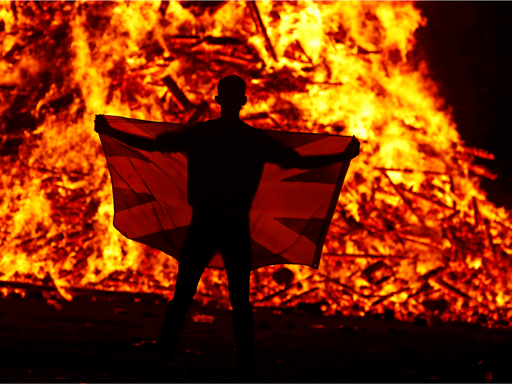
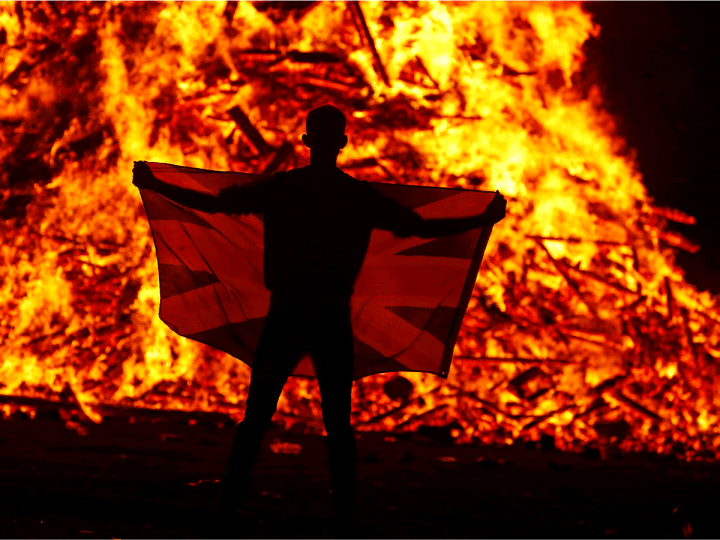
Another 12 July commemoration has now passed in the north of Ireland, leaving behind a trail of bile, death, pollution and charred remains of homes.
The yearly knuckle-dragging is a sectarian festival marking the Battle of the Boyne in 1690, in which Protestant king, William III, defeated Catholic king, James II.
The hate-fest lasted longer than usual, with bonfire groups lighting some pyres on 9 July, and parades not taking place until 13 July due to 12 July falling on a Sunday this year. The first major disgrace was the Moygashel Bonfire Association’s torching of a replica mosque.
Deputy leader of the Ulster Unionist Party, Diana Armstrong, claimed the Police Service of Northern Ireland (PSNI) scaled back its presence prior to the hate crime, in response to her requesting they do so. The PSNI has contradicted this.
Nonetheless, the pattern across the Six Counties is one of near-ubiquitous criminality across the long 12th weekend, almost entirely allowed to proceed by police. That includes incitement to violence through loyalists displaying threatening messages at bonfire sites, to property destruction, including homes burnt to the ground.
The X account, Kulture Watch, conveyed plenty of evidence for that.
12 July bonfires blaze message of sectarian and Islamophobic hate
A bonfire in South Belfast featured both sectarian and anti-migrant hate. The pyre’s creators placed a sign with ‘KAT’ written on it, which is an acronym for “Kill all Taigs”, a slur referring to Catholics.
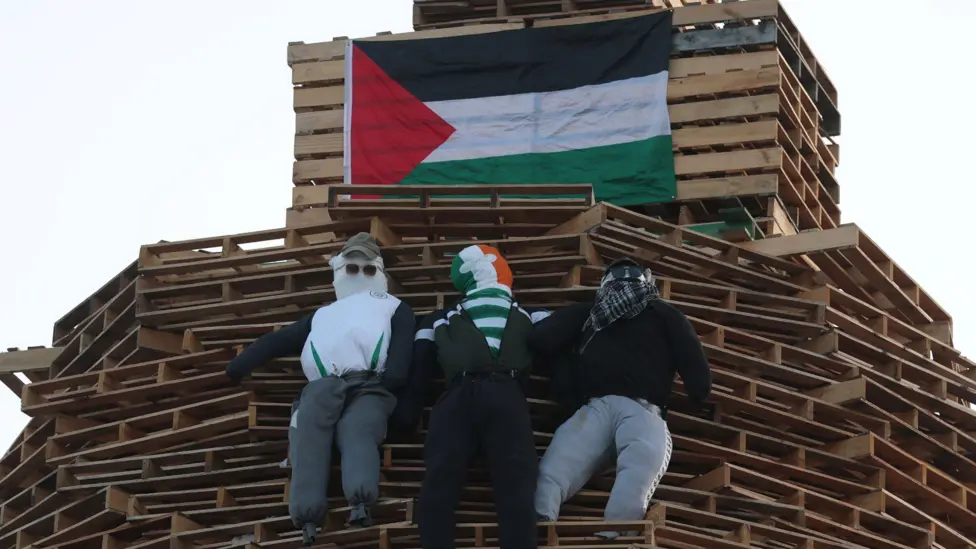
Others were saying, “Stop illegals” and “Stop the boats”. An Irish tricolour flag was placed for burning at the top of the pile of pallets.
Elsewhere in Belfast, bonfire builders burned effigies of republican rap group Kneecap, alongside a Palestine flag. Islamophobia was a common theme, with another bonfire featuring a placard reading, “F*ck Islam”.
In a sign of the absurd leeway authorities grant to the toxic festival, a massive fire featuring a tricolour collapsed as firefighters hosed down nearby properties. At an enormous cost, the Northern Ireland Fire & Rescue Service (NIFRS), attended.
The service logged 303 emergency calls between 6pm on 11 July and 2am on 12 July.
This resulted in firefighters attending 151 operational incidents. 54 of these were bonfire-related.
The NIFRS reported how:
In an isolated incident, firefighters withdrew from a bonfire in the Cookstown area as a result of a hostile crowd.
Such events sometimes occur when firefighters try to intervene early to stop a dangerous blaze, but attendees block the bonfire being extinguished. It’s not uncommon for the heat to melt windows.
Councils, again, effectively subsidise the destructive pyres by paying for boards that people can use to prevent their houses suffering this fate. What they can’t prevent are the inevitable worst case scenarios, like the homes completely destroyed by embers spiralling off the vast blazes.
The Belfast Telegraphreported:
A row of terraced homes caught fire near the bonfire in the Knockleigh Walk area of Greenisland.
David Haighton recounted how in the incident he “lost everything”. He’d lived in his home for more than 50 years.
Tragically, a man also died while helping to construct a bonfire in East Belfast. Warren Lyttle, a father-of-one, fell from the structure in Braniel housing estate. John Steele died in similar circumstances in Larne in 2022.
Time to move beyond toxic ‘culture’ of destruction
Bonfires are a health hazard in other ways, with organisers burning toxic material, harming air quality and contributing needlessly to climate breakdown. Another form of pollution are the piles of rubbish revellers leave in the streets, which sometimes look like an attempt rival the size of bonfires themselves. Taxpayers, again, have to foot the bill for cleaning this up.
All this mess is left by people apparently expressing pride and fondness for their community by littering it, burning it and disgracing it with a torrent of hate. There are increasing calls to “move beyond bonfire sectarianism”, in the words of People Before Profit MLA, Gerry Carroll.
Carroll has called for:
…a movement of working class people, drawn from every background, ready to stand together and challenge sectarianism head on.
Working class Protestants are failed by being perennially dragged into sectarian and racial hate. Such sentiments are a convenient misdirection away from justified hatred for the policies of the British ruling class that impoverish them, alongside working class Catholics, Muslims and migrants.
The grand secretary of the Orange Order, Mervyn Gibson, had some pleasant words about reaching out to those outside unionism. But that means little while his organisation does the minimum to clamp down on mass displays of hate by its own adherents.
He also conjured up a fictitious notion of embracing “true Britishness”, apparently symbolised by “Civil and Religious Liberty for all”. Britain has never represented such a thing, and today the Union Jack unquestionably stands for diminishing freedom and increasing impoverishment.
At some point maybe bonfire revellers and sash-wearing marchers will realise the folly of identifying in a bigoted, exclusivist way with a sinking ship that harbours largely disdain for them. They might then appreciate that the 12th is an act of mass self-harm — from the smouldering homes to the corpses at the foot of stacked pallets, to the toxic bonfire embers that poison the body and entrench a ‘culture’ that poisons the soul.
Featured image via Jason Cairnduff/ Reuters
From Canary via This RSS Feed.