

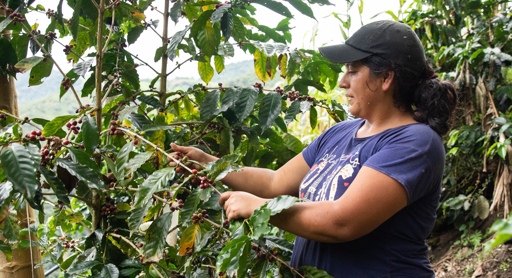
“What motivates us most is being able to say, ‘I take care of the environment, I don’t cut down trees, and my coffee will be valued more highly,’” said Victoria Alverca Peña, a farmer for 25 years and co-founder of APECAP, a small coffee and cacao producers’ association in Zamora Chinchipe, a province in the Ecuadorian Amazon. “I’ll be able to sell it under better conditions, and my work will be much more valued. “In our farms, besides coffee, you’ll find cacao, timber trees, fruit trees and even short-cycle crops,” she added. “When the coffee plants are still young, we can grow crops like corn, cassava or plantains. This helps us a lot with food security.” At the end of this year, the European Union Deforestation Regulation (EUDR) is set to go into force, prohibiting products linked to deforestation from entering the EU market. Coffee is among the target commodities, and here in southern Ecuador, a group of coffee growers has been ahead of the curve in preparing for the EUDR implementation. Since 2019, nearly 400 farmers here have adopted a model that combines forest conservation, traceability, and geospatial monitoring as part of the Deforestation-Free Coffee Initiative, at work in 23 areas across the region. Between 2019-2021, the project developed Ecuador’s first deforestation-free coffee production model. The effort relies on a national protocol developed by the Ecuadorian government and the United Nations Development Programme (UNDP), which uses satellite imagery, traceability systems, and independent verification to track where coffee is grown…This article was originally published on Mongabay
From Conservation news via This RSS Feed.