

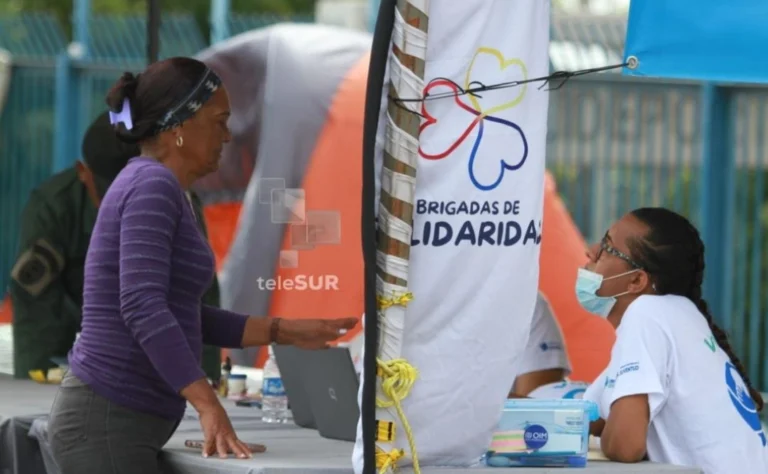
More than 128,000 families have received state assistance as emergency operations continue after the June 24 earthquakes.
Venezan authorities have expanded emergency assistance to 128,324 families affected by the earthquakes that struck the country on June 24, while relief, rescue and recovery operations remain underway.
RELATED: Venezuelan Acting President Reaffirms Government Role’s Post-quake Response: “There’s a State”
Jorge Rodríguez, head of the General Staff for Transitional Camps, reported that as of Monday, July 13, the official death toll stood at 4,561, with 16,740 people injured. Authorities also reported that 17,907 people were displaced by the seismic events.
According to the latest official update, 20,231 people are currently housed in 107 state-run transitional camps, where they are receiving comprehensive assistance, including food, shelter, medical care and other essential services.
Luego del doblete sísmico que afectó a varios estados de Venezuela, la presidenta encargada, Delcy Rodríguez, informó que la cantidad de edificios y viviendas en proceso de intervención e inspección sigue en aumento. Para agilizar estas labores de reconstrucción, la recuperación… pic.twitter.com/sRRsaYV3hC
— teleSUR TV (@teleSURtv) July 13, 2026
Text Reads: Following the double seismic event that affected several states in Venezuela, Acting President Delcy Rodríguez reported that the number of buildings and homes in the process of intervention and inspection continues to rise. To expedite these reconstruction efforts, post-earthquake recovery in the country is being leveraged through the activation of various strategic engines of the Bolivarian Economic Agenda, with the aim of providing a timely response to the structural damage caused by the strong telluric movements.
Rodríguez said rescue teams have pulled 6,462 people alive from beneath collapsed structures since the earthquakes.
Since June 24, the Venezuelan state has distributed 10,063 tons of food and more than 19.6 million liters of drinking water to affected communities.
Emergency medical teams have treated 33,085 patients as part of the response. Operations have been supported by the deployment of 30,989 military personnel, 30,692 civilian volunteers and 2,471 international rescue workers providing humanitarian assistance.
Risk management authorities have also recorded 1,254 aftershocks since June 24. Official assessments indicate that 190 buildings collapsed and another 856 sustained severe structural damage.
From teleSUR English via This RSS Feed.