

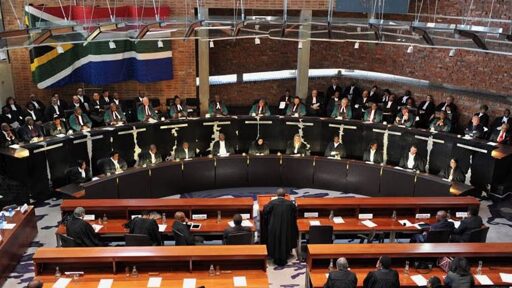
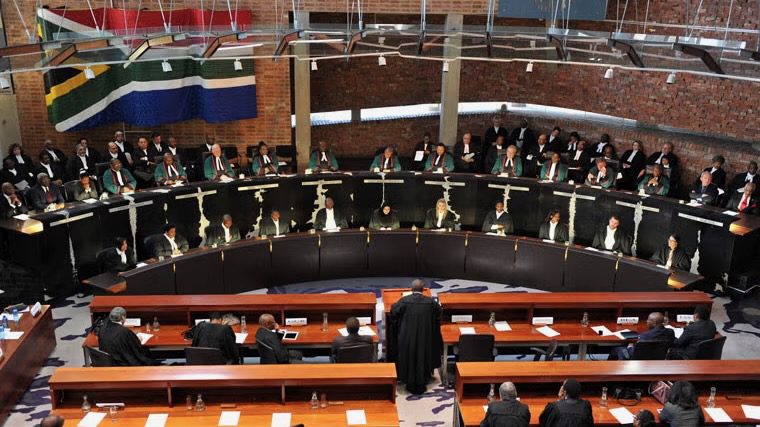
South Africa’s Constitutional Court has struck down sections of the Refugees Act that allowed immigration officials to arbitrarily bar foreign nationals without a valid visa from applying for asylum. In a ruling on July 7, Justice Steven Majiedt called these provisions “an arbitrary exercise of state power” that “subjects vulnerable asylum seekers to yet another bureaucratic step.”
These provisions, introduced through an amendment in 2017, took effect at the start of 2020, prior to which, any person reaching the Refugee Reception Office (RRO) could apply for asylum.
Officials were required to receive and assess the application on its own merits, regardless of whether the asylum seeker had a valid visa to be in South Africa or how long the person had stayed in the country without papers. Pending final determination, the applicant is issued a temporary asylum-seeker visa to remain in the country legally.
“The new provisions and regulations, however, fundamentally altered this position,” noted the judgement. If an asylum seeker’s transit visa, issued at a port of entry and valid for five days, has expired, the applicant must provide “valid reasons” for the delay in reporting at the RRO, where he or she will be interviewed by a Refugee Status Determination Officer (RSDO). The same is required if the applicant never obtained an asylum transit visa, indicating irregular border crossing without going through designated entry points.
However, the impugned sections imposing this requirement provided no guidelines for determining what constitutes a “valid reason.” It was left to the officer’s discretion, “creating a real risk of arbitrary and inconsistent decision-making,” the judgment noted. “It forms part of a legislative framework preventing asylum seekers from entering the asylum process and obtaining a determination on the merits of their claims.”
As a consequence, many have been barred from applying for asylum, detained, and deported to their country of origin. The court found this to be in violation of the “principle of non-refoulement,” which protects an asylum seeker from deportation “as long as the claim to refugee status has not been finally rejected after a proper procedure on the merits.”
Challenging these sections of the law, the Scalabrini Centre of Cape Town won a case in the Western Cape High Court, which delivered a landmark judgement in May 2025, ruling these sections allowing immigration officers to bar asylum seekers from making an application unconstitutional.
South African law requires that when a High Court finds legislation to be unconstitutional, its ruling must be confirmed by the Constitutional Court before it enters into force. Accordingly, the Scalabrini Center, represented by Lawyers for Human Rights, approached the Constitutional Court earlier this year.
In its support, the Helen Suzman Foundation (HSF), Amnesty International, the Global Strategic Litigation Council for Refugee Rights, the International Detention Center, and the UN High Commissioner for Refugee Rights made written submissions as amicus curiae (friend of the court).
Xenophobic rhetoric
Confirming the High Court’s ruling on July 7, Justice Majiedt also criticized the Department of Home Affairs for defending the impugned sections. With “sweeping and unsupported assertions regarding Afghan and Bangladeshi nationals’ involvement in human trafficking in South Africa.”
“Advancing such claims, particularly in the absence of any evidentiary foundation, not only undermined the integrity of the state’s case, but also introduced rhetoric that risks being perceived as xenophobic or racially charged,” he added.
“This is not inconsequential – submissions of this nature, when advanced before this Court, carry the potential to shape broader societal narratives about refugees and may adversely affect the protection of their rights.”
These remarks came amid growing marches, protests, and mob attacks in South Africa targeting poor migrants from other countries on the continent.
Read more: South Africa’s anti-immigrant protests expose a deeper national crisis
“It is the vigilantes and anti-rights groups that are betraying the constitutional values,” said Mpho Makhubela, spokesperson of the Lawyers for Human Rights. The “only way to address this is for communities to organize themselves to hold the state to account,” he added. “This judgement demonstrates the power of collaboration and engagement of the judiciary when the voiceless among us have their dignity trampled on and their basic human rights denied.”
Welcoming the judgement, the Economic Freedom Fighters (EFF) deemed it “a victory for constitutionalism, human dignity, and the principle that justice cannot be sacrificed at the altar of bureaucratic technicalities.”
Pavan Kulkarni , July 13, 2026
From BT News via This RSS Feed.