

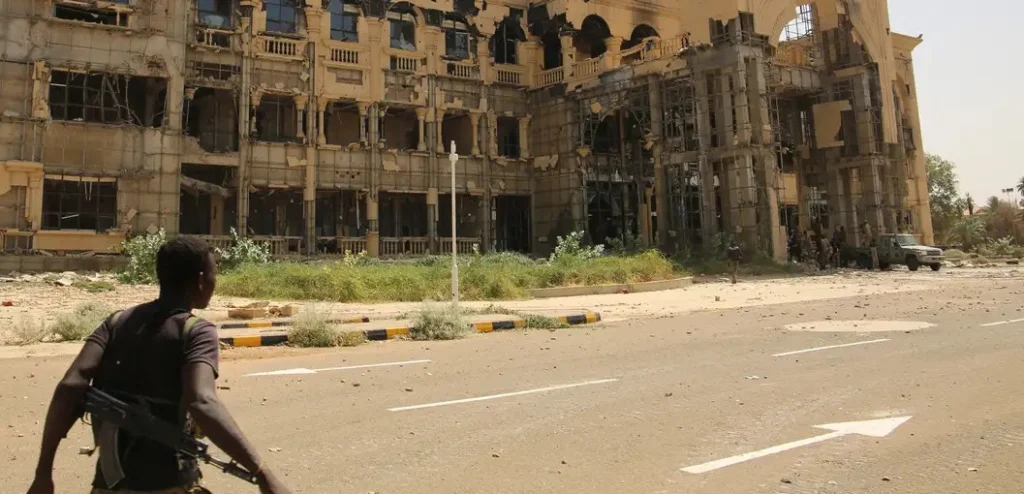
Local sources reported that the Sudanese army used Antonov aircraft to drop barrel bombs on the Jabra area of North Kordofan State, killing and injuring civilians amid mounting U.S. allegations of chemical weapons use by Khartoum.
Local sources said the Sudanese army used Antonov aircraft to drop barrel bombs on the Jabra area of North Kordofan State, killing and injuring civilians in the latest military escalation in a region that has become one of the main fronts of the war.
The incident could not be independently verified, and the Sudanese army has neither claimed responsibility for civilian casualties nor clarified the type of munitions used in the attack.
RELATED:Peace Monitors Condemn Clashes in South Sudan
According to the sources, the airstrikes targeted positions in the area, while bombs also fell on civilian-populated neighbourhoods, damaging homes and sending thick clouds of dust and smoke into the air.
The Sudanese army has a documented history of using Antonov aircraft to drop unguided munitions during previous internal conflicts. In its documentation of army operations in South Kordofan, Amnesty International said the Sudanese Armed Forces had used barrel bombs manually pushed out of Antonov aircraft flying at high altitude -a method that does not allow military targets to be struck with precision.
The organization said the nature of these munitions makes them inherently indiscriminate and that their use in civilian areas may constitute a war crime. It also documented attacks on homes, schools, healthcare facilities and food stores, as well as the killing and injury of civilians, including children.
The European Parliament has explicitly referenced the United Arab Emirates in its resolution on the human rights situation in Sudan, calling on all states, including the UAE, to cease financing, supplying arms to, or otherwise supporting the RSF. Adopted in response to mounting…
— The Sentry (@TheSentry_Org) July 13, 2026
Barrel bombs are typically made from metal containers filled with high explosives and pieces of metal or other fragments, without guidance systems. Their composition varies from case to case, meaning that the contents of any munitions used in the Jabra attack cannot be determined without examining the remnants of the weapons.
The blast wave can destroy buildings and send large quantities of soil, rubble and ash into the air. Dust clouds may contain fine particles and substances produced by the burning of plastics, fuel, paint, furniture and waste.
Health experts warn that exposure to such particles can cause breathing difficulties, eye irritation and respiratory inflammation, and may aggravate asthma and lung diseases, particularly when residents remain close to sites of destruction.
However, claims about the “spread of toxins” require environmental and medical testing, as there are currently no independent findings proving that dust in Jabra contained toxic gases or prohibited chemical substances.
The incident comes amid mounting U.S. pressure on the Sudanese army over allegations of chemical weapons use.
New sanctions adopted by the EU today introduce a ban on:
trade in gold from Sudan
The aim is to curb financing of the conflict and increase pressure on those fuelling the war.
More: https://t.co/tB64Gpyk07 pic.twitter.com/n4qyOiQb9n
— EU Council (@EUCouncil) July 13, 2026
Chemical Weapons Scrutiny Intensifies
The United States told the Executive Council of the Organization for the Prohibition of Chemical Weapons that an independent technical assessment had concluded that the Sudanese Armed Forces used chemical weapons during 2024.
Ambassador Nicole Shampaine, who led the U.S. delegation, said that “the prohibition against the use of chemical weapons is absolute and non-negotiable”, and called for immediate and unrestricted access for international inspectors, as well as a full Sudanese declaration of relevant facilities, stockpiles and programmes.
Reports said the army used containers or barrels carrying chlorine and dropped them from the air in remote areas, taking advantage of its position as the only party to the war with manned aircraft capable of carrying out this type of attack.
Chlorine is a yellow-green gas that is heavier than air and can accumulate in low-lying areas and buildings. When inhaled, it can cause severe pain, coughing, suffocation and lung damage, and exposure to high concentrations can be fatal.
Sudanese authorities have rejected the allegations, saying the United States failed to provide details about when and where the alleged attacks took place or the test results on which its conclusions were based.
The allegations of aerial bombardment and chemical weapons use come amid the growing influence of armed Islamist groups fighting alongside the army, most notably jihadist militias affiliated with the Sudanese Islamic Movement, which is linked to the Muslim Brotherhood.
The U.S. Treasury Department said the Al-Baraa bin Malik Brigade is an Islamist militia that emerged from the Popular Defence Forces of former President Omar al-Bashir’s regime and has contributed more than 20,000 fighters to the war against the Rapid Support Forces. It added that the brigade had received training and weapons from Iran’s Islamic Revolutionary Guard Corps, while its fighters had been implicated in arbitrary detentions, torture and summary executions.
The U.S. Treasury imposed sanctions on the brigade in September 2025, freezing property and interests under U.S. jurisdiction and prohibiting US citizens and institutions from conducting transactions with it.
In March 2026, the U.S. State Department designated the Sudanese Islamic Movement and the Al-Baraa bin Malik Brigade as Foreign Terrorist Organizations, while the Treasury Department also designated them as Specially Designated Global Terrorists.
Washington said the Sudanese Islamic Movement consists of networks associated with the former Islamist regime and that the Al-Baraa bin Malik Brigade represents its armed wing. It also said its members had received training and support from Iran’s Islamic Revolutionary Guard Corps and had carried out widespread killings of civilians.
Human Rights organizations are calling for investigative missions to be sent to Jabra to collect munition remnants, take air and soil samples, and examine the bodies of victims and those injured. They argue that images and residents’ testimonies alone are insufficient to determine whether the attack involved only conventional explosives or other prohibited substances.
From teleSUR English via This RSS Feed.