

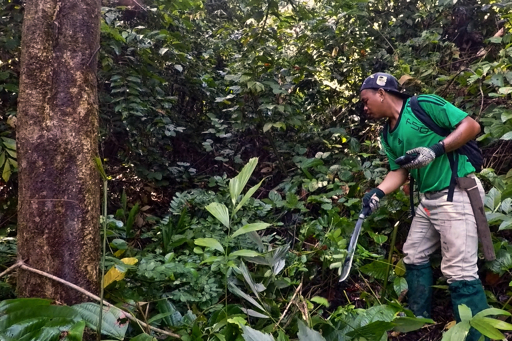
As the world faces the twin crises of climate change and biodiversity loss, researchers are trying to understand how to restore degraded forests to most effectively sequester carbon, benefit biodiversity, and promote sustainable land use. A new study published in Current Biology adds to this endeavor, finding that cutting vining plants called lianas dramatically boosts canopy height in previously logged forests in Borneo. Lianas are a signature part of tropical forests, with their abundant flowers and fruits attracting insects, birds and mammals, and their looping woody vines creating natural bridges in the canopy. But in logged or disturbed forests, lianas can grow out of control — and they aren’t always the most considerate of neighbors. Proliferating in sunlit gaps, lianas use trees as scaffolding to fast-track their way to the very top of the canopy, while their roots pull water and nutrients from the ground. This can smother trees and change the way they grow, inhibiting forest regeneration. A number of studies have found that removing lianas by severing their stems can boost tree growth in disturbed forests; for example, a 2022 meta-analysis in Ecology and Evolution found that removing lianas more than doubled tree growth and biomass accumulation. So far, though, most of this research has been done in Latin America; less is known about tropical forests elsewhere. Dipterocarp forest at the Danum Valley Field Centre. Borneo’s tropical forests, dominated by trees from the Dipterocarp family, have some of the highest canopies in the world, with some trees reaching…This article was originally published on Mongabay
From Conservation news via This RSS Feed.