

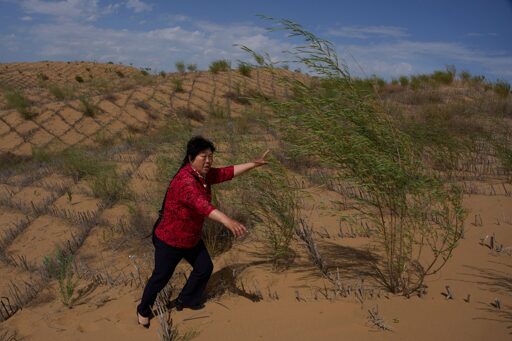
KUBUQI DESERT, China (AP) — For half a century, workers in northern China have been using a technique called “straw checkerboards” to combat desertification. This method stabilizes sand dunes and helps plants take root. The effort is part of the Three-North Protective Forest Program or Green Great Wall, aimed at reversing desertification. Since 2000, desertified land in northern China has shrunk significantly. The program has transformed vast regions, with forests now covering 200,000 square miles. Experts say continued success depends on long-term commitment and community involvement. The initiative has involved over 300 million rural laborers, mostly on a part-time basis. A highway cuts through a desertification control site of the Engebei Ecological Area near Ordos in northern China’s Inner Mongolia province on Friday, June 12, 2026. Image by Ng Han Guan via Associated Press. Desert control worker Yin Yuzhen visits a desertification control site of the Engebei Ecological Area near Ordos in northern China’s Inner Mongolia province on Friday, June 12, 2026. Image by Ng Han Guan via Associated Press. Yin Yuzhen, a sand-control worker, holds up a plant that did not survive because it was not planted deep enough while at a desertification control site at the Engebei Ecological Area near Ordos in northern China’s Inner Mongolia province on Friday, June 12, 2026. Image by Ng Han Guan via Associated Press. By Associated Press Banner image: Desert control worker Yin Yuzhen walks along sand dunes covered by grass checkerboard that’s part of desertification control efforts at the Engebei Ecological…This article was originally published on Mongabay
From Conservation news via This RSS Feed.