

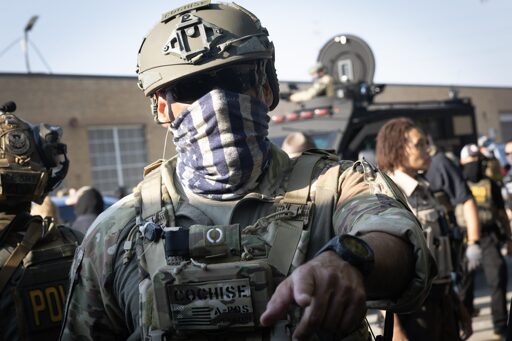
While calls to “abolish ICE” have exploded during the second Trump presidency, critics have been calling out the threats the agency poses to immigrants, US citizens, and democracy itself since it was created just over 20 years ago. In this episode of Rattling the Bars, host and former political prisoner Mansa Musa speaks with author and immigrant justice organizer Harsha Walia about the origins of ICE and what it will take to abolish it and the new American police state.
Guests:
- Harsha Walia is the award-winning author of Undoing Border Imperialism and Border and Rule: Global Migration, Capitalism, and the Rise of Racist Nationalism. She has been involved in community-based grassroots migrant justice, feminist, anti-racist, abolitionist, anti-capitalist and anti-imperialist movements for over two decades, including No One Is Illegal, Defenders of the Land, and the DTES Women’s Memorial March Committee.
Credits:
- Producer / Videographer / Editor: Cameron Granadino
Transcript
The following is a rushed transcript and may contain errors. It will be updated as soon as possible.
Mansa Musa:
Welcome to this edition of Rallying the Bars. I’m your host, Mansa Musa. Everybody know or heard of or got a view on ICE or what ICE been doing, but do we really know what ICE is, where ICE come from? Joining me today is Harsha Walia. Harsha Walia is the author of a brilliant Boston Review article, How Not to Abolish Ice. So today we’re going to unpack how not to abolish ICE, but more importantly, we’re going to educate our audience on what ICE is and try to clear up a lot of misconcept. Welcome to Riding in About Harsh.
Harsha Walia:
Hey, thank you so much for having me.
Mansa Musa:
All right. So first introduce yourself to our audience and tell us a little bit about yourself.
Harsha Walia:
Yeah, so I’m actually based in Canada. And so for me, I have been organizing and writing against the border for about 20 years. I’ve been active in migrant justice movements up here. And I know a lot of times people can be quite surprised that the violence of borders and imigration enforcement extends well beyond the United States, but it does. And it’s a transnational phenomenon. Borders are being militarized everywhere. Immigration enforcement is ramping up everywhere. We’re seeing this, especially in Europe right now with what happened in Belfast just the last
Mansa Musa:
Two days.
Harsha Walia:
The anti-immigrant violence. And so I have been connected to immigration migrant justice organizing for about 20 years.
Mansa Musa:
Okay. Can you take us back to the origin of ICE and explain when and how the demand for its total abolishment came to the forefront?
Harsha Walia:
Yeah. I think for folks who are younger or maybe on social media, abolished ICE may seem newer, particularly a post – 2020 kind of phenomenon. And it has gone viral for sure over the past few years. But ICE was started in 2003 when a lot of immigration enforcement agencies were starting all around the world right after nine eleven. And that’s really important context because nine eleven was a time similar to now when wars abroad and imperialism was escalating and heightening in terms of the occupation of Iraq and Afghanistan and Palestine at that time. And so DHS, the Department of Homeland Security and ICE were really kind of seen as the so – called war at home, the front to establish the war at home and escalate it. And so it was always connected to this narrative of immigration as a national security issue. And
Mansa Musa:
So
Harsha Walia:
That really is the foundation of ICE is really securitizing immigration and thinking about immigrants as security threats, as terror threats, which we see right now, but it really has been going on for 20 years. And some of the first demands to abolish ICE came from immigrant rights organizations and particularly Muslim organizations who saw ICE as connected to this war at home front and the ways in which ICE was part of and continues today to kidnap people, place migrants, particularly Muslims, black and brown Muslims into black sites, into detention centers, this massive vast network of surveillance that was known as the Muslim registration system.
Mansa Musa:
So
Harsha Walia:
Some of the first demands to abolish ICE happened right away as soon as ICE was formed because the kind of ways in which ICE was kidnapping people that we see today started back then over 20 years ago.
Mansa Musa:
Okay. So what other agencies are involved in police and immigrants and why is understanding this entire ecosystem so vital to the broader project of abolition?
Harsha Walia:
Yeah. I think one of the things we have to keep in mind is that ICE is just one agency. It is the one that sometimes we see in terms of the most brutal, horrific, spectacular form of violence. But immigration enforcement is carried out by actually thousands of different agencies. There are hundreds of agencies that have jurisdiction over immigrants specifically. DHS has dozens of departments within it, customs and border patrol at the border of course, all the other aspects of DHS. But there are many other state and local level agencies that have jurisdiction over immigrants and of course policing agencies. And so a lot of times, sometimes there’s a kind of binary created where people see ICE as one singular
Mansa Musa:
Agency agency
Harsha Walia:
Without seeing that actually immigration enforcement, National Guard gets involved, the cops get involved, other immigration enforcement gets involved. So it’s really important to see it, as you said, as part of an ecosystem rather than just one bad paramilitary organization, which of course it is. It’s a horrific organization, but it is supported surveillance, information sharing, boots on the ground. This network that is all part of policing. And so understanding ICE as a method of policing is necessary for abolition because it means that then we’re talking about abolishing the whole system
Mansa Musa:
And not
Harsha Walia:
Just one agency.
Mansa Musa:
Unpack this because we hear about ICE. It’s like it’s in the public conscience. We talk about how it’s been in existence in the so – called liberal Democrats, Obama, Biden, Clinton, whoever else, Democrat, Congress, Senate, how they play into its development and its existence.
Harsha Walia:
Yeah. I mean, it’s exactly that. It’s not as if though the current administration somehow built ICE up from scratch. It’s been getting built up for 20 plus years, which means that every president across party lines, both Republicans and Democrats have poured money into ICE. When ICE was first founded by President Bush, it only happened because the Democrats supported the creation of ICE. And absolutely Clinton, Obama, Biden have all poured money into ICE. And one of the foundations of Democrats’ policy has been to really categorize the so – called bad immigrant versus the good immigrant.
Mansa Musa:
And
Harsha Walia:
So Democrats have really used that division to justify more and more money into immigration enforcement and border militarization by saying, “Hey, the infamous kind of refrained from Obama when he said, I’m just deporting felons, not families.” And so that became their justification for border militarization. And it was actually under President Obama where half of all federal criminal arrests were immigration related. And he really poured money specifically into collaboration between local law enforcement and federal immigration enforcement. That was a big cornerstone of his agenda. And so today when Democrats say abolish ICE or abolish ICE as we know it, they don’t actually mean abolish immigration enforcement. They don’t actually mean we want less border militarization. They just mean we don’t want this particular version of ICE that is so spectacularly and obviously out of control. What they want is a more reigned in ICE, one that supposedly…
Their big matra is always like ICE has to continue to uphold the law. So they
Mansa Musa:
Just want more
Harsha Walia:
Benevolent, a more pleasant looking ICE. And so they’re not actually opposed to immigration enforcement. They’re just opposed to the excesses of ICE today.
Mansa Musa:
Talk about your critique of good cop, bad cop. They’re saying like, well, ICE is a bad cop. And then you have the good cop that choke our United States citizens, put their knee on their neck, but that’s just a cop ran amug.That’s not the police mentality. Talk about that as it relates to this misnomer that’s associated with that and how it plays into the continuation of abuse of minorities.
Harsha Walia:
Yeah. I think there’s been a huge kind of surge in people for good reason wanting to abolish ICE and being opposed to ICE. But sometimes it’s this binary gets created where people say, “Yeah, but bad ICE, good cop.” And
Mansa Musa:
Cities,
Harsha Walia:
For example, are reporting a massive increase in 911 calls where people are calling the cops to protect them from ICE or to protect their neighbors from ICE. And we see these viral videos where people are calling the cops saying, “ICE is here. Can you help me? ” And this is exactly as you said, it completely erases the reality of policing also as a violent gestapo. And immigration enforcement is a form of policing. It is not different. They all have a monopoly on violence, whether it is against immigrants or citizens. The cops beat up on immigrants the same way cops beat up on so – called citizens. ICE picks up citizens as well based on race profiling.
And so there is no difference. They’re all just about, they have the same ideology, which is to control people under white supremacy and racial capitalism. And when Ronald Reagan, who we know really birthed the war on drugs and the so – called war on crime and really increased policing and the prison industrial complex in the ’80s and ’90s, he at the same time actually called INS, which at that time was responsible for immigration enforcement. He called it just another form of the criminal legal system. He saw it as all one and the same. And it’s really important to look back at that era when we had the so – called war on drugs, the so – called war on poverty and the so – called war on immigrants. They all kind of coalesced at the same time in the ’80s and ’90s when we saw this rapid increase in the prison industrial complex, the rapid increase in border militarization and a rapid increase in cops on the block.
And so I think looking at how the state looked at all of these as the same kind of mechanisms, they’re all tentacles of the same system to control people, to manage capitalism, to ensure that more and more people were dispossessed and became cheapened labor for capitalism and justified making massive cuts to public services
By racializing crime and making immigration a so – called criminal issue. That was all part of the same narrative of criminalization. And so making people illegal is the same logic. So once you make criminals, you also make the illegal. And that’s all part of policing people regardless of which uniform is doing it.
Mansa Musa:
And I think for the benefit of that, we need to understand that thinking right there because the power to define once you define or once you label, then the label is almost like going back to what they say in Germany about propaganda. You come up with this narrative and you repeat it over and over again, it become believable. So now you come up with this narrative. You saying like Trump campaign on securing the borders. That was his campaign. His campaign was, I’m going to secure the borders. And then he gave this horrific view of how people coming across the borders, raping, robbing, murdering, child snatching, anything that could come to the top of his head, he threw it out there as to why we need to secure the borders. But the problem that’s seen to be, and this is the movement, the left and people that’s in this space that’s trying to take up this call to stop rounding up people, so – called immigrants undocumented.
The arguments that people are making and it’s creating a wedge in the movement is that they’re not criminals. So when you say, I’m making an argument that they’re not criminals, I’m juxtaposing that to
Other people are criminals. They not like them. As opposed to saying something like this policy and this attitude is passive, racist and people should be given the right to due process according with the lawyers. What’s your views on that?
Harsha Walia:
Yeah, I think this is a failed logic and has been a failed logic for decades to try to appeal to innocence or respectability or the idea of being a good imigrant who’s not a so – called criminal, which then actually just criminalizes people further. And also that yardstick is always shifting. We
Mansa Musa:
Know it’s arbitrary.
Harsha Walia:
Maybe you’re not a criminal today and tomorrow you are a criminal because you were on the street and the fascists pick you up. And I think that’s why it is so important to not fall into that kind of logic of who’s good, who’s bad. And of course abolition teaches us that. And also I think the other piece that’s really important is talking about colonialism and imperialism. That to me is much more powerful as a way to counter who deserves to stay and who doesn’t. Because when people say, well, immigration is a privilege, people don’t get to stay here, then we have to remind them, well, actually it is imperialism and colonialism that is forcing people out of their lands and homes. That is why people are forced to migrate. So people can’t pretend that migrants just happened to arrive at the border. We get to kick them out whenever we want.
We have to be assertive that actually migration is a form of reparations and decolonization that many people articulate. That is how a lot of migrants see themselves. They’re not looking for pity. They’re not looking for charity. They’re actually, one of the most powerful slogans is, “We are here because you are there.”
Mansa Musa:
Exactly.
Harsha Walia:
Which reminds us of imperialism and colonialism. And so I think that is a much more powerful way to counteract fascism and racism rather than constantly trying to appeal to respectability or innocence. And in fact, many migrant justice movements, especially outside of the US frankly, have a much sharper anti-colonial analysis that articulate that, especially of the relationship to Europe where it is very clear the relationship to the continent and to Asia. Across Africa and Asia, there’s a very direct correlation to migration into Europe. But of course that is true for the US as well. And so I think that is the approach that I think we need to have when fighting back against anti-migrant racism is not saying, “Oh, we’re good or we contribute to the economy or we’re not criminals,”
Mansa Musa:
Which
Harsha Walia:
Divides us from social movements. We actually need to have a stronger anti-capitalist, anti-imperialist analysis and articulation.
Mansa Musa:
Yeah, because at the end of the day, that’s exactly right. World bank, you strangle our country, you take our resources and natural minimals, our ability to be productive in terms of being competitive on the world model. You train police to brutalize us. And then when we see the opportunity to get somewhere to get a better life or to have a better life, you tell us, you say, “Oh no, you’re not entitled to it. ” Why? Because we don’t want you to be entitled. But on the same token, you’ll say South African immigrants, you can say with impunity that, oh, they’re being persecuted in their country by Black people. Therefore, they have a right to relocate. It’s almost as if they got the same right as citizens in Israel when they say that of Jewish descent, you got a right to citizenship in Israel. But talk about your definition of borders.
How do you define border in your work and how does it function not just as a physical wall, but as a tool to serve global capital and reinforce racial hierarchy, particularly across Latin America and the Caribbean? How do you look at it in relation to those entities?
Harsha Walia:
Yeah. I mean, I would say not even specific to Latin America and the Caribbean, but overall in the world,
I would define borders really as a system of global apartheid. When you gave that great example of what’s happening with South Africa today and white Africaners being welcomed by Trump and other countries, if we think back to the purpose of apartheid, the purpose of apartheid in South Africa was racial segregation, Patchestans to kep people segregated in order to serve the European settler elite and to maintain racial capitalism by keeping Black South Africans as a reservoir army of labor that served the purposes of capitalism in South Africa to benefit white South African apartheid and the settler elite and making particularly Bontestans completely unlivable, that kind of organized abandonment. And so when I think of borders, I think of them very similarly today. If we zoom out and look at the world, then really the purpose of borders is to maintain the peripheral economies as peripheral economies.
Mansa Musa:
What
Harsha Walia:
Allows the Imperial Corps to still exist as the Imperial Corps is that borders make it so that people can’t move. The vast majority of the global South has to remain in the so – called global South and keep producing, keep working in sweatshops, keep mining, keep having to live under conditions of extraction. And we know that borders don’t work equally. We know that the borders of countries can constantly be violated when the imperial countries decide to bomb other countries, then borders are not respected. When mining corporations decide to go in to South and Central America, to the Caribbean, to Africa, to Asia, then borders aren’t respected. Then borders don’t exist, right?
Mansa Musa:
Right.
Harsha Walia:
And so borders exist to maintain racial capitalism. They’re monetized for the rich and militarized for the poor. And related to that is that then we start to see that the border isn’t just the line on the map. If you look at a globe and the border is the line between countries, that’s not how I define the border. I think of the border as this regime. It’s a method of governance that functions for empire. And we see that because once migrants cross the border, going back to ICE, you can be picked up even once you’re in your school, once you’re in your neighborhood. The border is still acting on you. You’re still dealing with border enforcement. And the other example of how the border is really elastic, it can exist anywhere, is border outsourcing. So we see, for example, now Mexico actually deports more Central Americans than the US does.
And that’s
Mansa Musa:
Because
Harsha Walia:
The US is paying Mexico to build detention centers and enforce against migrants. And this is happening around the world in Latin America, in the Caribbean. Almost every single Latin American and Caribbean country is being paid or forced by the United States to stop migrants. Most kind of obvious example of this was in El Salvador with the Bukelli government, a right wing government who struck a deal with Trump to accept migrants from Venezuela. And then they were incarcerated in the notorious gulag, as Sikot.
Mansa Musa:
But that’s
Harsha Walia:
Not one exception and it’s not just Trump. It’s been going on for decades. Same in Europe. All of the Sahel and horn regions of Africa, Turkey, Ukraine, these are all places that are getting money by the European Union to build border camps and concentration camps to hold migrants. And so even US officials with Department of Homeland Security, they have said for years that our southern border is not with Mexico. It’s actually the Mexican border. That’s our Southern border. Southern Mexico border is our Southern border. And so the border is always shifting. The border is being militarized both within the nation state, but also well outside of it. And so I think for me, that’s how I think of the border is it’s a line that is always expanding in all directions in order to maintain capitalism and empire. And so that’s the way to think I think about the border is it is again, another method of policing.
It is another method of apartheid. And it’s not really just about immigrants. Angela Davis and Gina Dent years ago wrote that the prison is a border. And so again, we can think of all the ways in which borders are not just about imigrants, but it’s about keeping so many different populations subjugated. Gated communities, gentrification, that’s a form of bordering as well. And I think that helps us see the connections between movements. So it’s not just about citizens and migrants. It’s actually about so many people who are being impacted by displacement and dispossession and policing, whether it’s in or across borders.
Mansa Musa:
If we can get in that space in our head that it’s no such thing as a border, but this is designed by imperialism capitalism to maintain control, to explore people’s resources. I think Huey Newton came up with a concept of intercommunalism. And intercommunalism, he said the ability to communicate because of the technology with the same token. When we look at the imperialism and fascism as we know it exists today, everything is up for grass when it comes to exploitation, murder and dehumanization. So I don’t have a board in El Salvador. I have a for sale sign on my country. I’m selling space to whoever want to buy, to house whoever they want to house. It’s about imperialism, fascism and capitalism. Talk about, as we close out, looking towards resistance. What are some of the inspiring examples of grassroots organizations successfully combating these oppressive systems of human capture and imprisonment?
What do you see in terms of the resistance and how people are organized, how people mobilize from your viewpoint?
Harsha Walia:
Thank you for that question. I’m going to just mention one quick thing, just listening to what you were saying earlier, particularly on imperialism and capitalism, is also when we think about how this border, it’s really not about the border as you said, it’s about these systems of oppression and capture. One of the big things the border does too is make undocumented workers as a form of cheapened labor.
Mansa Musa:
Yeah, yeah. Good observation. Yeah.
Harsha Walia:
Without immigration papers forced to work for less than minimum wage whenever they try to unionize, they threaten to call ICE. And so that system of capture also maintains racial capitalism as a form of domesticated imperialism to keep cheapened labor here, like construction work, service work, farm work, et cetera.
And so thinking about that too, again, with the analogy to apartheid. And then resistances, I think there are so many because again, if we think about the border not just as immigration, but we think about resistance to any form of capture and imprisonment, then I think there are so many things. Of course, the ones that are most obvious to us are the resistances to ICE in cities that have had surges of ice. So whether that’s Minneapolis or LA or Chicago and the ways in which people have defended their neighbors. And I think there’s something incredibly important about this new articulation that’s coming, which is about neighbors, which I think again, kind of collapses the idea of migrants and citizens, but is thinking about a kind of localism and I think echoing actually on some of Huey’s work on intercommunalism about how do we think about kinship and each other.
And so I think that’s been quite powerful. I’m also thinking actually right now about resistances to FIFA because FIFA is a form of bordering and how FIFA has displaced people in so many cities in the United States, in Mexico, teachers who are resisting on the opening of the World Cup, that is also resisting bordering. So there’s the more obvious ice out of FIFA, which is about immigrant rights, but I think the ways in which people are… And all fights to stop displacement against gentrification. Every city has a fight to stop prison expansion, jail expansion. These are inspiring. Because I talked about Belfast earlier
And the anti-immigrant violence that has been happening there. It has also been inspiring to see right away immediately protests and rallies and support of immigrants happening in Belfast and across Northern Ireland and the Republic of Ireland. Also, people setting up community watch to defend their neighbors and basically pledging to fight back if more violence comes to neighborhoods and setting up roles. And the idea of community defense in support of migrants is happening literally in countries around the world. And oftentimes, of course, these kinds of community defenses are not a match to the heavily militarized state violence of immigration enforcement. But I do think every time we get together and we fight back and we assert our presence, it is incredibly powerful. And so I am 100% always a believer that we always have to organize. We always have to come together. And even in a moment if we don’t think we’ve won, we have changed the terrain of struggle.
Mansa Musa:
We
Harsha Walia:
Become braver for the next time. We learn there’s no such thing as failure. There’s only things that we learn for next time. And also I think the most powerful resistance to the border is people who still continue to be ungovernable and cross that
Mansa Musa:
Fucking – That’s right. That’s
Harsha Walia:
Right. People who are getting in those boats, people who are steering their own boats,
People who are taking their children and saying, “Even though there is a multi-billion dollar industry that is trying to keep me from moving, I am still going to move and I’m still going to be free in whatever way that looks like. ” And so I think the ungovernable power of migrants who are defying this fascist agenda every day and still living, still moving, still resisting, still being so – called illegals and undocumented and making community, getting to know their neighbors, those are all forms of resistance. And But I do think every tentacle of resistance that is anti-fascist that is fighting back against the fascist agenda is a part of dismantling the border.
From The Real News Network via This RSS Feed.