

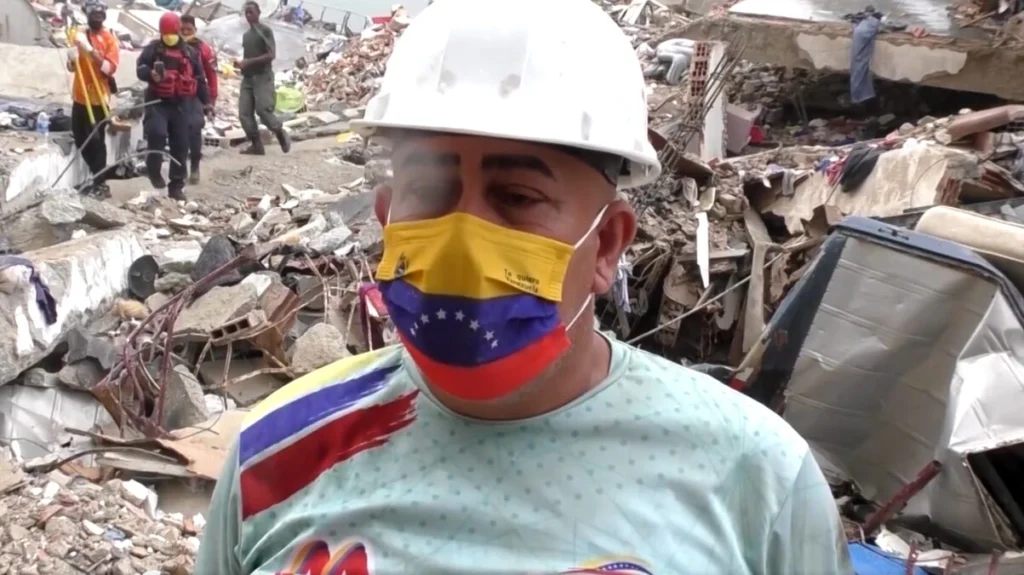
Cooperation and solidarity are paramount in post-earthquake recovery efforts.
During the weekend, Venezuelans actively participated in post-earthquake recovery efforts in the Los Corales sector of La Guaira, the state hardest hit by the two earthquakes recorded on June 24.
RELATED:
Structural Engineer Rates Venezuela Quake World’s Third Most Complex Disaster Since 2008
International relief workers, volunteers, Red Cross members, firefighters and police officers are using heavy machinery to remove debris in areas where experts have already ruled out the presence of human remains.
As in other affected areas, debris removal is being carried out in an organized and technical manner, prioritizing careful manual work before bringing in heavy machinery.
Among those assisting is Cristobal, a Macuto resident who lost his home and has one of his grandsons buried beneath the rubble. Despite his personal circumstances, he has been working alongside rescue teams because of his knowledge of the area.
“Wherever we are needed, we are there. We all work together. We are one family,” said Cristobal, who founded the Emmanuel Rescue and Medical Emergency Unit more than 15 years ago.
He is sometimes accompanied by his 10-year-old grandson, Sebastian, who hopes to become a firefighter and has already helped protect pets in the community. The experience of local rescue workers has been essential in guiding emergency personnel from other regions to areas that are difficult to access.
Cristobal alerted emergency teams to the possible presence of people buried in the Caribe sector after noticing signs on the surface, then accompanied authorities to help direct the search.
Conditions in higher-elevation areas, such as the Renacer III sector in Los Corales, present additional challenges because assistance takes longer to arrive due to the large number of emergency sites and the remoteness of the area. Residents of these communities, who also experienced the 1999 landslides, are assisting with debris removal efforts.
Updated Disaster Figures
On Sunday, Venezuelan authorities released a new assessment of the impact of the recent earthquakes, which caused destruction in Caracas and the states of La Guaira, Aragua and Miranda.
So far, the death toll stands at 4,490, while the number of injured has reached 17,740. Rescue operations have resulted in 6,462 people being rescued in the areas affected by the twin earthquakes, which have now generated 1,222 aftershocks.
Residential infrastructure sustained severe damage, with 856 buildings damaged and 190 buildings completely destroyed. As a result, 17,907 people have been left homeless. Authorities also reported that 19,583 people are currently being sheltered in 108 temporary camps established to respond to the emergency.
So far, 30,535 volunteers have participated in community assistance efforts. Through this deployment, medical care has been provided to 32,401 patients, while comprehensive assistance has reached 120,794 families. Authorities have also distributed 9,995 metric tons of food and 18,507,166 liters of drinking water.
Proper Debris Management
On Monday, the Ministry of Ecosocialism said it continues to monitor the authorized disposal sites established to manage debris from damaged buildings and warned that dumping such waste into the sea carries penalties.
“Authorized sites and controlled landfills have been designated and must be used without exception. Coastlines and bodies of water are not waste disposal sites,” the Ministry of Ecosocialism said, emphasizing that anyone who dumps debris into the sea or natural areas could face fines or even criminal prosecution.
More than 6,700 metric tons of solid waste and debris have been collected and safely disposed of in La Guaira, the Ministry of Ecosocialism said following reports alleging that debris had been dumped into the sea.
In La Guaira, the disaster generated an estimated 1.2 million metric tons of debris in the hardest-hit areas, according to a preliminary assessment conducted by the United Nations Development Programme (UNDP) with data through June 29.
Approximately 915,000 metric tons came from damaged buildings, while 332,000 metric tons consisted of household items and residents’ personal belongings.
teleSUR/ JF
Sources: Ecosocialism Ministry – EFE
From teleSUR English via This RSS Feed.