

Make a one-time donation to The Ditch
Five years ago a friend and I visited Belfast on 12 July. She was researching a potential book about a united Ireland. I was interested in writing about loyalism. We walked around the city, went to Sandy Row, saw the KAT graffiti and heard the sectarian chants. Our visit came the morning after organisers of a bonfire in Tiger’s Bay set alight an Irish tricolour on top of the pyre.
Bonfire night has again passed and we saw the same hatred. In Moygashel loyalists put an effigy of a mosque on top of a bonfire alongside placards reading SECURE OUR BORDERS and END THE THREAT OF RADICAL ISLAM. Organisers said they were engaged in a demonstration opposing “government ideology” and “mass migration” rather than targeting individuals.
Even if we accept this claim to be true – which it isn’t – the bonfires are part of an environment that features real violence against real people. In June loyalists did more than set fire to an effigy, burning migrants out of their houses in north Belfast. The paramilitary-directed mobs behind the attacks claimed, as such mobs often do, to be protecting women and children.
Sectarianism is part of the architecture of Northern Ireland, integral to the institutions of the statelet itself. During the conflict the British government covertly outsourced counterinsurgency to paramilitary groups like the UVF while at the same time publicly denouncing them. Today Westminster blocks investigation that would expose this collusion, including an inquiry demanded by the family of Sean Brown, a GAA coach and father of six murdered by the LVF with the assistance of British state agents.
Politicians who support the state’s continued existence but wish to be perceived as respectable distanced themselves from the open racism in Tyrone.
“Bonfires are an important cultural tradition for many within the unionist community, and there will be many peaceful and respectful bonfires across Northern Ireland over the coming days,” Ulster Unionist Party Leader Jon Burrows said, as reported by RTÉ . “However, that tradition is undermined when bonfires are used to intimidate, provoke or demean others.”
There is however one group that seemingly has no issue with loyalism and its prejudices – they share the same contempt for foreigners. They refer to themselves as Irish Patriots but we will call them by a more accurate name: Free State Nationalists.
Free State Nationalism: a slop ideology
Free State Nationalism surfaced during the Covid-19 anti-lockdown and anti-vaccination protests. At its core is a politics of grievance centred on migration. It perceives Irishness as under attack from a cabal of migrants, shadowy LGBT-run NGOs, Sinn Féin and a government of what it calls traitors. Perhaps its most famous proponent is MMA fighter Conor McGregor who used his social media platform to declare “Ireland, we are at war" during the Dublin riots in 2023.
Not long after Belfast families had been burnt out of their homes a crowd of Free State Nationalists gathered on Dublin’s O’Connell Street in support of the arsonists responsible. They said they were protesting against “invasion”. I happened to be in the city. I walked past the demonstration and saw the same thing from other protests like it: flags saying IRELAND IS FULL and hooded young lads looking for trouble and people.
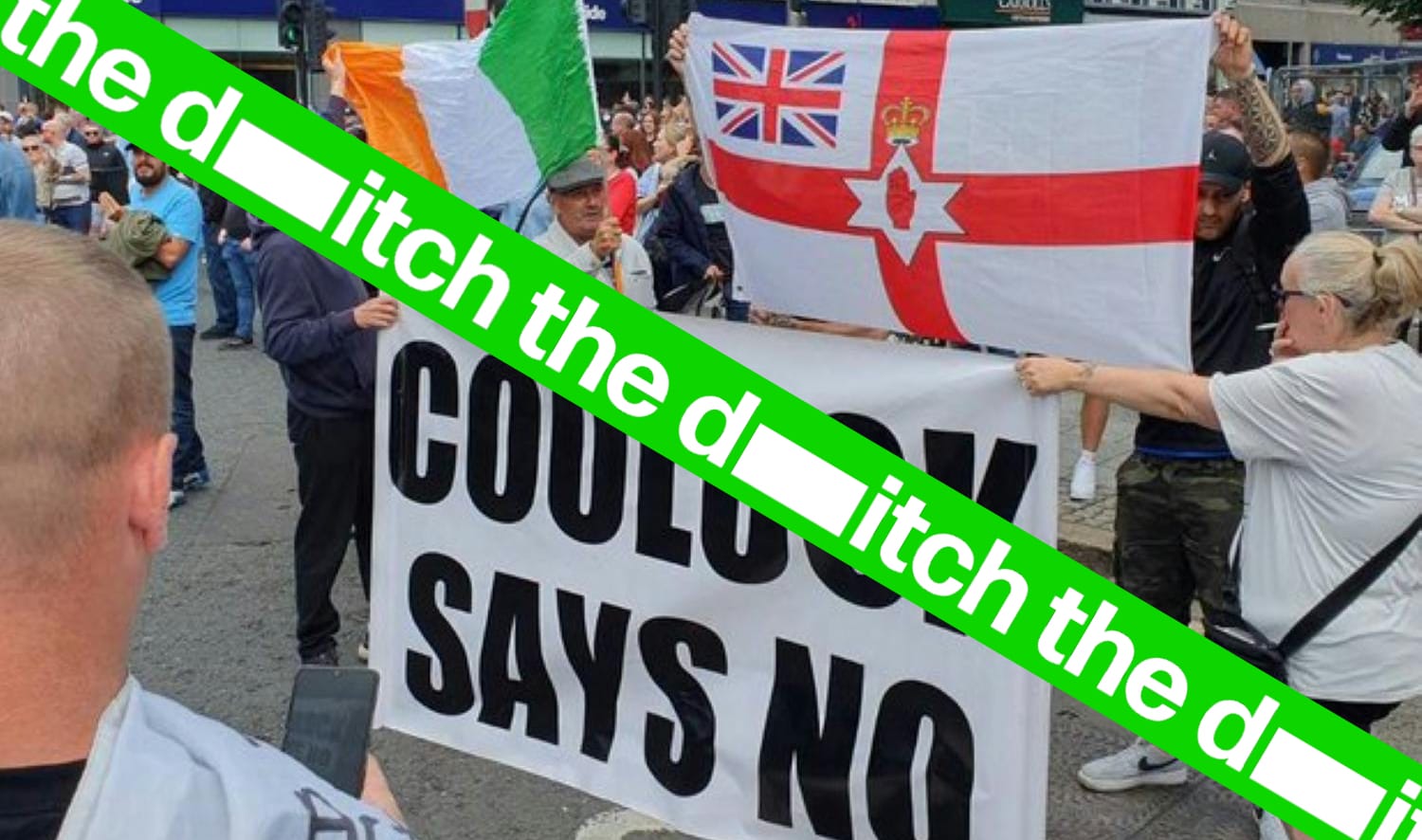
This wasn’t the first time Free State Nationalists aligned themselves with loyalism. In August 2024 a group from Coolock travelled to Belfast to march with loyalists at an anti-immigration rally. Some of the Dubliners draped themselves in tricolours as they stood next to Glen Kane, who was jailed for nine years over the sectarian killing of a Catholic man in 1992.
If your aspirations involve cleansing your nation of undesirables – Muslims in particular – and you believe republicanism is one of the parties responsible for their presence here, there’s a logic to what the Coolock Says No gang did. They want the same thing as loyalists – a return to an imagined pre-modern homogeneity, a civilisation consisting of people who belong in it. That’s why they’re Free State nationalists: they have little interest in the republic, with equal rights for all, that was actually fought for, only the truncated, reactionary entity in its place.
There’s another commonality. Free State Nationalist figureheads – founder of the National Party Justin Barrett, say, or Irish Freedom Party head Hermann Kelly – have a coherent, if repugnant, understanding of Irish history, and say they wish to end partition. The broader movement doesn’t. Their conception of Irishness, the identity they believe is under threat, rests on a narrow set of popular symbols, many of them tied to consumer products and marketing campaigns aimed at tourists: pints of Guinness, Old Mr Brennan, leprechauns and pots of gold. It’s a reductive idea of Irishness, one akin to anti-Irish cartoons produced in the 19th century, that could’ve been articulated by a loyalist.
Little wonder that so much of the material informing the movement is AI slop, shared on Facebook pages like Ireland - Rising from the Ashes. A 2024 story published by The Journalfound admins of the page – a favourite among Free State Nationalists – had posted tens of thousands of times, much of it AI-generated and racist. It now has 193,000 followers. Those who engage with it have expressed support for loyalists inciting hatred against Muslims in Tyrone. “How can it be a hate crime when it’s only acknowledging the diversity in Ireland,” wrote one woman. “ … Now stick a few thousand Qurans on top just to keep the heat in,” wrote another.
That reliance on AI is revealing. The technology has a documented tendency to degenerate over time in exactly the way this movement’s idea of Irishness has. A 2024 paper in Nature found that large language models trained repeatedly on their own output experienced, in the authors’ words, “a degenerative process", forgetting the true underlying data with each iteration until nothing remained but the most generic output possible. So too with this Free State Nationalism: it feeds on, and is energised by, its own caricature of Irishness – degrading that caricature further with each feed until the word Irish has no content at all.
Loyalists and Free State Nationalists are natural allies because they both serve the capitalist class. Their ideologies care more about sectarian interests than class.
James Connolly saw how loyalists contributed to their own oppression. Writing on 12 July pointed out that Ulster’s Presbyterian planters never actually owned the land they’d settled. It belonged to English landlords. The planters were tenants. Within a generation those same planters were being fined and imprisoned by their rulers. So Protestant and Catholic workers wouldn’t notice they had a common enemy, the British ruling class decided to “pervert history, and to inflame the spirit of religious fanaticism”.
In the north the “peace dividends" working-class communities were promised in 1998 never arrived. Two decades after the Good Friday Agreement the stagnation associated with the conflict euphemistically called the Troubles persists. In 2024/25 twelve percent of people in the north – around 232,000 – were living in relative poverty before housing costs, according to figures published by the Northern Ireland Statistics and Research Agency in March.
Connolly said he hoped Catholic and Protestant workers would combine against “their common spoilers”. But loyalists don’t march against those in power. If they did they’d cease to be loyalists.
Free State Nationalists – who live in a vassal state with a housing market run for the benefit of international investment funds, a comprador government that takes orders from DC and Brussels and that builds infrastructure to serve foreign capital, not the public – could also learn from Connolly. He understood Irish history and the forces that had shaped it. Irish nationalism, if it is to mean anything at all, has to be emancipatory, freeing everyone – Catholic, Protestant, and yes, Muslim – from the structures of domination that profit from our division.
Its purpose must be to free all of us on this partitioned island.
Make a one-time donation to The Ditch
From The Ditch via This RSS Feed.