

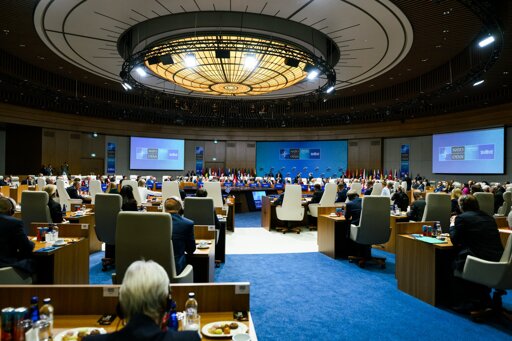
Like the Hague summit in June 2025, the most recent NATO summit, held in Ankara on July 7 and 8, is marked by the same paradox: a summit dedicated to organizing the United States’ withdrawal from an alliance that has been the cornerstone of the pax americana in Europe for decades. U.S. Defense Secretary Pete Hegseth summed it up well when he explained that the United States wants to “ensure that NATO is moving fast and irreversibly toward Europe leading, stepping up to take primary responsibility for the defense of Europe.”
In 2024, while “Genocide Joe” still occupied the Oval Office, the alliance’s member states took note of a new strategic logic of U.S. imperialism. To carry out its pivot to Asia, Washington needed to rely more heavily on its European allies, hence the need for a partial redefinition of NATO’s missions in favor of “breaking down the barriers between fronts”: in exchange for increased intervention by Atlanticist states in containing China in the Indo-Pacific, Washington would maintain its presence in Europe and its support for Ukraine. A year later, the “Trump effect” is in full swing: in the face of a policy of unilateral disengagement, European imperialist powers and other member states have agreed, in a state of panic, to massively increase their military spending to 3.5 percent of GDP by 2035.
Militarist Euphoria
The Ankara summit did not call this strategic direction into question, even as the White House decided, in late May, to scale back the number of U.S. forces allocated to European defense by cutting the number of fighter jets by one-third and strategic B-52 bombers available to member states by half. On June 18, Pete Hegseth announced a review of U.S. presence in Europe within six months. However, the U.S. withdrawal remains highly contradictory, given that Europe has been one of the pillars of U.S. hegemony since 1945. One need only look at the central role of U.S. bases in Europe for the projection of U.S. power in the war in Iran to be convinced of this. Rather than a moment of strategic redefinition, the Ankara summit was instead an ultra-militarist milestone presided over by the obsequious Mark Rutte, the Alliance’s secretary general, who never ceased to tout the member states’ positive results to “Daddy Trump.”
At this spectacle of a summit, European imperialist powers first and foremost patted themselves on the back for increasing their military budgets, which amounts to 121 billion euros in additional military spending for the year 2025 alone. Rutte also announced new defense contracts, worth 43 billion euros, signed between member states.
Airbus emerged from the summit with the prospect of a lucrative order for about ten A400Ms, while Canada selected the German shipbuilder TKMS to deliver a dozen submarines. As for the U.S. “death giant” defense companies, Northrop Grumman is expected to supply Germany with five Triton drones, while Berlin has announced its intention to build a maintenance center for U.S. Patriot systems and a joint project between Rheinmetall and Lockheed Martin to produce ATACMS, a short-range missile system. As lobbyist Camille Grand summarizes, “the most interesting development, beyond the orders for weapons systems, remains the move by European allies to acquire strategic capabilities that their armies have sorely lacked, as these were previously provided by the United States.”
The Shadow of Defeat in the Middle East
But beyond the jubilation of the arms dealers, the celebrations were somewhat dampened by the arrival of Donald Trump, who reiterated his grievances against the other member states: “I’m not happy with NATO because of what they did with Greenland, and I’m not happy with NATO because of the fact they didn’t want to help us with the No. 1 state sponsor of terror — that’s Iran,” This criticism amounted to an admission of weakness, as — for the first time in decades — the United States failed to rally its historic allies behind one of its imperialist ventures, yet another symptom of the crisis in transatlantic relations. In fact, unlike last year, a post-hegemonic atmosphere prevailed in Ankara as the defeat in Iran took center stage.
On July 8 Trump unilaterally declared that the ceasefire was “over” as the U.S. Air Force carried out new airstrikes against Iran, after Tehran struck several ships. Insulting the Iranian negotiators, Trump retaliated againstthis latest demonstration of Iranian control over the Strait of Hormuz, which is one of the most striking consequences of the military-strategic defeat of Israel and the United States in their imperialist war. While the risk of further escalation cannot be ruled out, there is, as Ali Vaez points out, nevertheless “no alternative more attractive than this agreement, however frustrated Trump may be.” In any case, the world’s leading power arrived at the summit as a wounded imperialist power, whileIran reminded the entire world and the financial markets that it no longer has the strength to match its naval and geopolitical ambitions.
The summit thus represents yet another partial manifestation of the shifting regional balances in the Middle East. The region is undergoing a process of tripolarization, with a third axis beginning to form between Turkey, Qatar, Pakistan, and Saudi Arabia, all seeking to maintain a balanced position between a weakened Israel and a strengthened Iran. In that sense, the fact that the summit was held in Ankara underscores Turkey’s increasingly important role in regional dynamics. While Erdogan chose to forge closer ties with Russia following the failed coup of 2016 — a move that provoked the ire of the United States — the regional crisis that began on October 7, 2023, has allowed Turkey to assert its influence.
Taking advantage of the blockade of the Strait of Hormuz, Turkey has thus consolidated its role as a logistics hub for energy flows from the Gulf to Europe, a position also coveted by Israel. It has also offered increasing overtures to Trump. Consequently, after Erdogan renounced the Russian S-400 missiles, Trump paved the way for Turkey’s reinstatement into the F-35 program — a threat in the eyes of Israel, which fears losing its technological superiority in the region — and for the lifting of sanctions against the Turkish defense procurement agency. Trump’s visit thus marks a new rapprochement, as no U.S. president has visited Turkey since 2015.
While U.S.-Israeli relations are severely strained and the colonial state is increasingly isolated on the international stage, the imperialist powers are strengthening their ties with other actors such as Turkey, a provider of markets serving the major powers (as it did in Syria). During the summit, Trump met with Ahmed al-Chaara, while Macron — the first Western president to visit the country since the fall of Bashar al-Assad — was on an official visit to Damascus a few days before the summit, to seal the major return of French multinationals to Syria.
Ukraine, a Ticking Time Bomb
But Trump’s weakened position has above all allowed the Europeans to put the war in Ukraine — which was virtually overlooked at the Hague summit — on the agenda. In yet another about-face, Trump announced his intention to grant Ukraine a license to produce Patriot missiles. This marks a radical reversal, given that Washington had previously refused to supply these air defense systems to Kyiv: “We need them too, and we supply Israel,” he declared in The Hague. “We’re going to give a license to you to make Patriots. This way, you can’t complain that we’re not giving them enough. We haven’t told the company yet, but it’ll work out.” Currently, only Germany and Japan hold licenses allowing them to co-produce this munition — Tokyo produces the PAC-3, while Berlin produces the PAC-2 version as part of a joint venture between Raytheon and MBDA.
Still, this new development could be short-lived, as the structural contradictions of the war in Ukraine have shifted slightly. Amid the “diplomatic yo-yo” that has been going on for more than a year and a half, Trump faces a twofold problem: faced with the risk of a military collapse of the Ukrainian army, Trump is seeking at all costs to avoid a major military-strategic defeat — even as U.S. military credibility has already been undermined in Iran. To this end, he has at times sought to offer concessions to Putin — without being able to go too far, lest he concede an equally disastrous victory on the diplomatic front — and at other times sought to pressure him. In this context, the negotiations have put the U.S. administration on a collision course with the continent’s major powers, which are seeking to strengthen their grip on Eastern Europe while using the war to justify the race toward militarization and austerity.
However, Trump now has fewer levers of pressure over his allies — another paradox of disengagement. While Washington could previously threaten to suspend military support for Ukraine to pressure Zelensky, it has now partially lost this means of pressure, as the majority of arms deliveries are now provided by the continent’s imperialist powers. According to the Kiel Institute, in 2025 alone, European countries increased their financial and humanitarian support by 60 percent and their military assistance by 67 percent, allocating more than $80 billion. Europe has financed the continued delivery of U.S. weapons to Ukraine using a NATO mechanism and extended a loan of more than $100 billion. Under these conditions, the European countries’ ultra-warmongering and maximalist agenda was able to unfold with greater leeway throughout the summit, as the summit approved a dual loan to Ukraine totaling 70 billion euros for 2026 and 2027.
On the military front, the imperialist powers are thus supporting Ukraine’s increasingly adventurist maneuvers, which aim to sever the Russian army’s supply lines by massively bombing Crimea while striking strategic energy infrastructure deep within Russian territory — even launching direct attacks on Moscow. At the same time, Putin’s reactionary regime has responded by intensifying its bombardment of Ukrainian cities. This reactionary escalation, carried out by both sides, is leading to an extremely dangerous situation. While the increasingly widespread use of drones has, in a sense, frozen the front line, creating a thick no man’s land — sometimes more than 10 kilometers wide — resuming a war of movement is particularly difficult, as each offensive is brought to a screeching halt by intense attrition. While vertical escalation is becoming increasingly difficult, the conflict is undergoing a dynamic of horizontal escalation and potential expansion — endorsed by the European imperialist powers — which could have disastrous consequences for the workers and the working classes of the continent, starting with Russian and Ukrainian workers. But there is no guarantee that U.S. imperialism will not change its position once again in the face of the conflict’s structural contradictions and the specter of a potential NATO debacle.
Two Spectres Haunting NATO
The defeat in Iran, its economic consequences, and the crisis of credibility surrounding the U.S. security umbrella — already undermined by the trade war, threats regarding Greenland, and U.S. disengagement — are above all fueling militarist dynamics and rivalries among the major powers in Europe. The Ankara summit thus heralds an extremely troubling militarist outlook, as Europe’s ruling classes — far beyond Russia — fear that their allies of today may become their enemies of tomorrow. As Jo Inge Bekkevold noted after the 2024 NATO summit:
U.S. abandonment will leave behind a multipolar power structure within Europe—where Germany, France, Britain, and perhaps Italy will act as regional powers in addition to Russia. There is no guarantee that the European Union will continue to function in the same way in a multipolar power structure, which is generally less stable and more prone to conflict than a unipolar or bipolar system.
Today, this scenario is even more palpable. As Liana Fix writes in Foreign Affairs:
Germany has pledged to use its outsize armed power to help all of Europe. But left unchecked, German military dominance might eventually foster divisions within the continent. France remains uneasy about the fact that its neighbor is becoming a major military power […] In the worst-case scenario, competition might return. France, Poland, and other states could attempt to counterbalance Germany, which would divert attention away from Russia and leave Europe divided and vulnerable. France, in particular, may seek to reassert itself as the continent’s leading military power and “grande nation.” This could prompt outright rivalry with Berlin and place Europe at odds with itself.
While the German defense industry secured lucrative contracts during the summit, a genuine competition has begun between French and German imperialism, as evidenced by the failure of the the Future Combat Air System (SCAF/FCAS). While Berlin aims to build the “continent’s leading conventional army” by reviving a military capable of conducting expeditionary offensives beyond its borders, Macron has stepped up his bellicose proposals, putting forward a new strategic doctrine: “forward deterrence.” This would allow France to disperse its nuclear forces across several countries — and proceed with a massive increase in the military budget, confirmed by the update to the Military Programming Law (LPM). Ultimately, one of NATO’s hegemonic functions is beginning to crumble, even though the alliance was intended to establish U.S. preeminence on the European continent and prevent the resurgence of German power.
But alongside militarism, another specter haunted Donald Trump’s speech in Ankara: that of “international communism,” which, according to him, poses a more deadly danger than “Pearl Harbor.” As history would have it, Trump may be doubly right. While reactionary powers such as China and Russia offer no alternative to the working class — contrary to the logic of “campism” or “Third Worldism,” which presents them as a potential solution to NATO’s plans — it is through the methods of class struggle and workers’ internationalism that we will be able to thwart the reactionary objectives of European and U.S. imperialists.
Internationalist solidarity with oppressed nations against imperialism must serve as our compass, while maintaining complete political independence from their leaderships — whether in Palestine, Iran, Cuba, Venezuela, or Greenland, which is oppressed by Danish colonialism and once again in Trump’s crosshairs. In the face of militarism and the war plans of our ruling classes, we must build an internationalist and anti-militarist movement to put an end to the arms race and austerity, demand the expropriation of the arms industries, their conversion under workers’ control to civilian production, and the full transfer of military budgets to public services. In a particularly turbulent interregnum and faced with the “triangle of fire” formed by the wars and genocides in the Middle East, the conflict in Ukraine, and the Sino-U.S. rivalry, tendencies toward class struggle are also intensifying and pointing the way forward — from the anti-colonial strikes in Italy, to Minneapolis, and to the worker, indigenous, and peasant uprisings in Bolivia.
This article was originally published in French on July 11 in Révolution Permanente.
The post NATO in Ankara: Lessons from the Summit appeared first on Left Voice.
From Left Voice via This RSS Feed.