

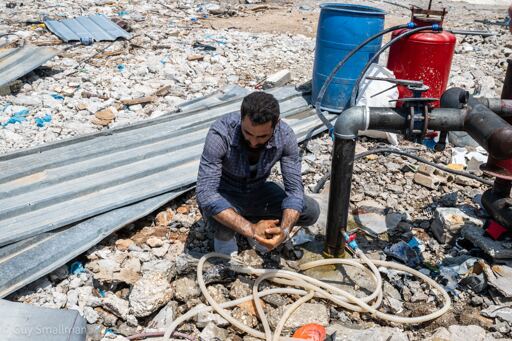
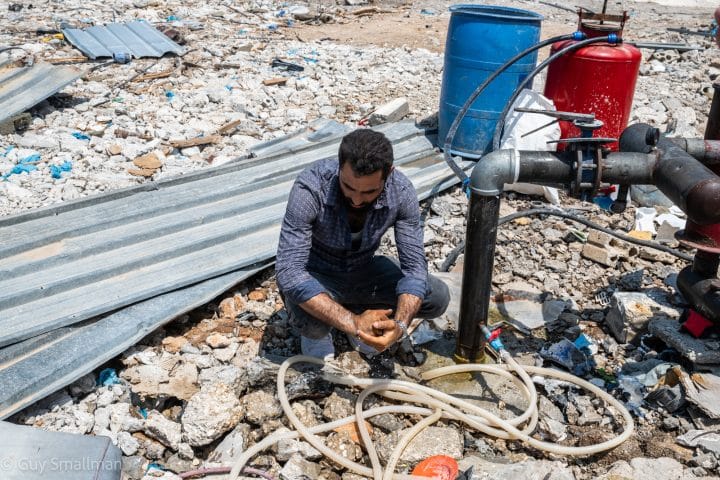
Much of the economy south of Lebanon’s Litani river is generated by some of the most fertile and productive land in the region. It is famous for olives, avocados, bananas and citrus fruits. It is also the area most torn apart by fighting with the Israelis since 1982.
The district of Sour is particularly rich in agricultural resources. It was here that we met with Mohammed el-Hussaini, a spokesman of the Syndicate of South Lebanese Farmers.
He explained how the latest war, which started in October 2023, derailed the end of the olive harvest and made preparations for the following year impossible. He also described how the IOF are embarking on an orgy of thieving, vandalism and intimidation, causing deliberate, vindictive and long-lasting damage to the rural economy.
Chemical warfare
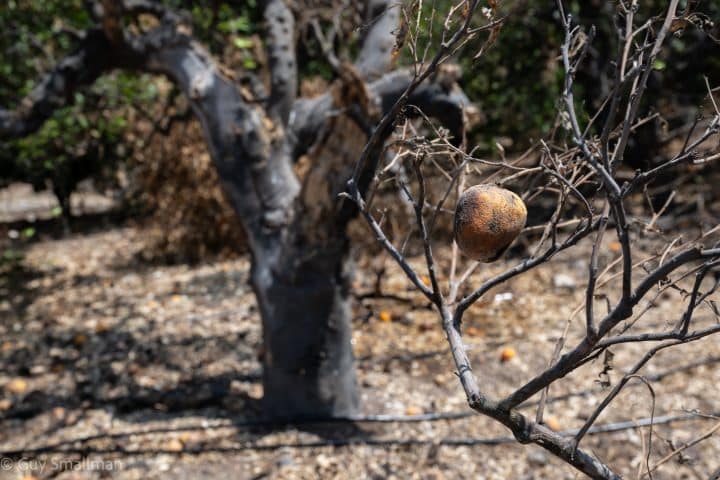
One such tactic, which is illegal under international law, is the use of white phosphorous. It is a chemical compound used by the Israelis to burn crops, dwellings and wooded areas within the zones where they operate. It also has a lasting environmental impact on the land where it is deployed.
In a more sinister development, it was recently used as a chemical weapon against agricultural labourers. A video of the workers fleeing the trademark white clouds that this compound produces has gone viral across the region.
Mohammad said:
Those farmers were hit by white phosphorus during the harvesting of watermelons. They were a few hundred metres from an Israeli checkpoint, and they were outside their line of control. The IDF saw them collecting the watermelons and they attacked them.
https://www.thecanary.co/wp-content/uploads/2026/07/Video1.mp4
The Israelis are well known for deploying this illegal weapon across areas where they are being held back by local fighters. But using it against labourers, harvesting their produce during a ceasefire, represents a new low.
Another tactic of the occupiers is the deployment of herbicides to clear the vegetation in their so-called buffer zone. Mohammad continued:
They have used glyphosate – the herbicide that kills weeds by stopping the photosynthesis. The density that they used was 30 times more than is allowed, to ensure that they killed everything that is green – the plantations and the forests, including the areas where wild animals live. We have videos showing how they used planes to spray this herbicide.
https://www.thecanary.co/wp-content/uploads/2026/07/Video2.mp4
The use of glyphosate in such a concentrated way amounts to ecological terrorism. It is a chemical agent that is already controversial when deployed within its recommended guidelines, and its use is heavily restricted in some countries and banned outright in others.
Studies suggest that it causes cancer, and contaminates the environment. Its use, in illegal doses, is a tactic that has long been witnessed in the border areas of Gaza where the IOF claim to be terraforming the land for security reasons. But in reality, they are trashing the food security of the Palestinians. A genocidal tactic that is now being imported to south Lebanon.
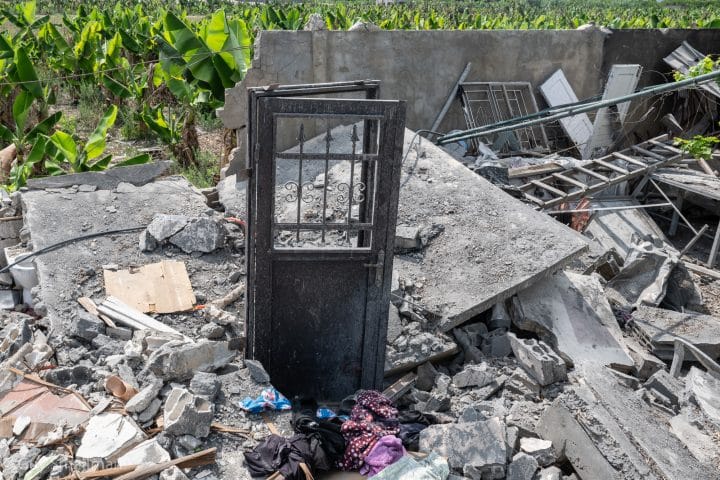
Aside from the chemicals, more familiar means have been used to destroy Lebanese land and inhibit the return of its people. The infamous D9 Bulldozers have been deployed into IOF controlled zones to destroy homes and plantations. There is also a growing body of evidence to suggest that non-military contractors from Israel are being commissioned for this and other tasks.
Wholesale demolitions
It is already confirmed that Israeli civilian companies are involved in the demolition of border villages. There is also verified evidence of systematic looting from residential south Lebanese properties by IOF soldiers.
Mohammed says there are now multiple testimonies saying that other outside contractors are being used to steal the resources of occupied rural areas:
We have olive trees that are hundreds of years of old, which they remove using excavators, and are then taking into Israel. They are worth thousands of dollars each. Typically, they end up in the gardens of newly built settler homes. They are also transporting livestock and other valuables from the areas they control behind their yellow line.
When the war restarted in March 2026, the Israeli line of control extended yet further into the south. At present, well over 600 square miles of south Lebanese territory is effectively off limits to the local farmers.
Aside from the burning, poisoning and bulldozing, the pausing of irrigation will kill the trees. This will render plantations fruitless for long into the future. Replanted citrus and olive trees need seven years of uninterrupted growth before they can start yielding. Avocados require five and bananas at least two.
Economy in ruins
Recently published figures by the World Bank estimate the cost of lost revenue up until 2025 at $1.2 billion. But this could just represent a fraction of the damage to livelihoods for years to come.
Satellite imagery seen by the farmers union confirms that over 7,000 hectares of farm land have been actively destroyed, with other occupied areas withering from neglect.
Along with the crops, the Israelis are also destroying the farmhouses and other infrastructure. Mohammad continued:
Around the border they are demolishing entire villages. Places like Bint Jbeil, Aitaroun and Aita Shaab are flattened. But they are forgetting the history of this area. Since 1982, the farmers have refused to leave this land. They have even stayed in tents, so that they can replant when they have had no homes. The people will return like they did in 2000 and 2006. They have beaten these occupations before.
All the time we are getting reports of farmers being shot at by the IDF when they approach their land. Yesterday, they dropped sound bombs on farmers in Nabatieh. Using their AI and facial recognition, the IDF can easily distinguish between civilians and fighters. Their cameras can recognise faces and connect to open sources like social media. They know that these people are non-combatants, but they attack them anyway. They just want to eliminate everyone. To make this an empty zone.
Threats and intimidation
Mohammad shared a recent experience of his own with me:
Before the ceasefire, I was 20 kilometres away from the yellow line harvesting bananas. They called me, ordering me to leave. They use some kind of machine that calls our mobiles with a recorded message, spreading the threat that we should move away from the area. The calls come from European and international phone numbers. My call came from Serbia.
The following day, we were heading south through miles of fields and plantations. Some of the bridges we crossed were temporary structures, placed by the army above the ruins of the original ones. Most farmhouses along our route were reduced to rubble.
When we reached our destination, Fadel Soufan, a member of the citrus growers association, took us on a tour of one of the local orchards to inspect the damage. A drone hummed overhead.
The area was vast with groves stretching for miles in every direction. Oranges and lemons worth millions of dollars lay rotting under the trees. Many of the trees were clearly dying. He explained that everyone had fled the area after six workers were killed in a drone strike:
It was night and they were getting ready to sleep in their tent when the drone came for them. None survived. They were from Syria and Palestine. They were innocent and had nothing to do with this war.
Much of Lebanon’s rural economy depends on migrant labour from poorer communities in neighbouring countries, or from refugee camps within its borders. The heat-sensitive cameras of the drone that murdered those people did not differentiate between people holding scythes or those who carry guns.
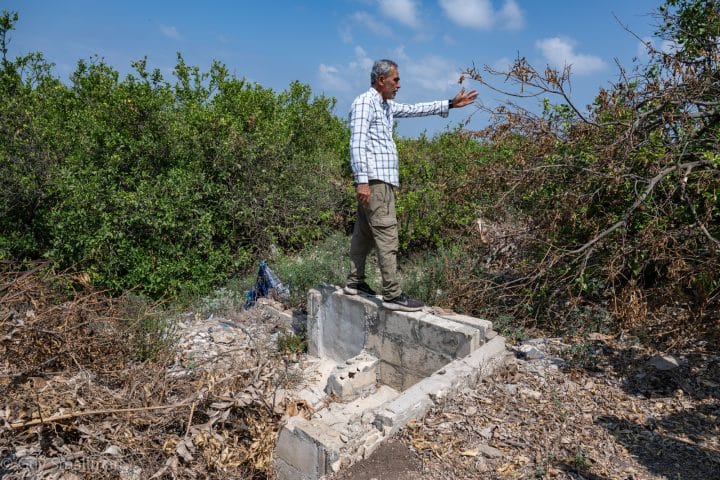
Artillery strikes on agricultural infrastructure
Fadel took me away from the track to show me an area targeted by the IOF:
This is where they shelled the plantation with their artillery.
A series of craters marked the places where the shells had landed among the trees, which were scorched and lacerated by shrapnel. Some of them were snapped in two nearest to where the explosions had detonated. The area was clearly of no military significance, but the object of the assault lay destroyed in the centre of the targeted area.
A twisted heap of metal and thick rubber pipes lay in a clearing. It had been the pumping facility that connected the nearest well to miles of smaller pipes that irrigated the orchards. The generator, which powered it and similar appliances, had also been destroyed by shelling a hundred yards away.
The bombing was a deliberate and calculated act of vandalism that would condemn the plantation to die in the unforgiving sun, unless it was repaired in the very near future.
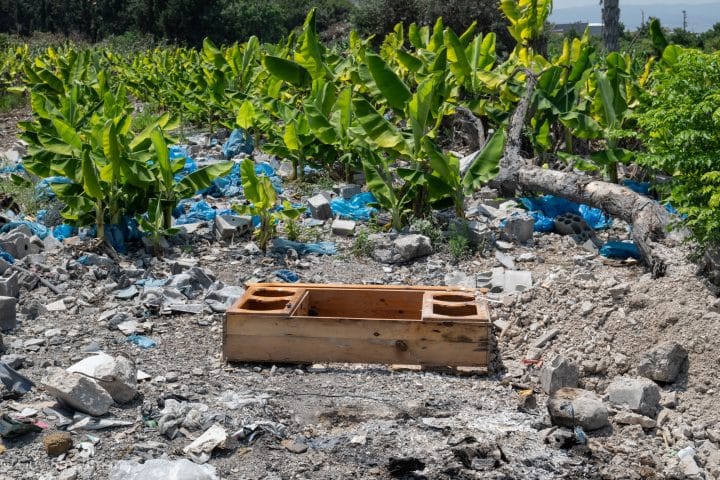
For as long as the Israelis remain, the farmland of south Lebanon and its associated infrastructure will continue to degrade.
The present dynamic is different to previous occupations as no locals remain behind the so-called yellow line of control. For the local fighters intent on removing the IOF, this is both a blessing and a curse. They can engage their enemy without putting civilian lives at risk, but moving around this area undetected by modern military technology is now a lot harder.
All images and videos courtesy of the author
By Guy Smallman
From Canary via This RSS Feed.