

Football betting scandal worth $11.6 billion sparks concern over illegal gambling, match-fixing and its social impact worldwide.
Related: 3 Painful Blows: Thibaut Courtois Injury Casts Doubt on Belgium Future
Football betting scandal raises alarm over illegal gambling and global football integrity
The football betting scandal has once again come under scrutiny following strong criticism aired on the TeleSUR program La pelota no se mancha, where analysts denounced the growing influence of illegal gambling in the sport. The issue, described as a multi-billion-dollar industry worth approximately $11.6 billion, continues to operate alongside professional football with what commentators called a “silent coexistence”.
Veteran journalist Víctor Hugo Morales warned that the football betting scandal is not only a financial issue but also a deep social and ethical problem, affecting players, institutions and fans worldwide. According to the program, the normalization of betting practices—particularly illegal ones—has created a climate where corruption risks are increasingly difficult to contain.
The discussion emphasized that the football betting scandal extends beyond isolated cases, forming part of a broader system that threatens the integrity of competitions and the credibility of football as a global sport.
Football betting scandal and its impact on players and institutions
The football betting scandal has already led to disciplinary actions against players involved in illegal gambling activities. Authorities and sports bodies have imposed sanctions in multiple cases, reflecting growing concern about the direct participation of athletes in betting networks.
Analysts highlighted that the problem is compounded by the involvement of high-profile figures in sports and media, who often promote betting platforms through advertising campaigns. Critics argue that these endorsements contribute to the normalization of gambling, especially among younger audiences.
The program also referenced statements by French star Kylian Mbappé, who has publicly criticized the spread of betting culture, warning about its destructive impact on families, particularly in economically vulnerable communities. The football betting scandal, in this sense, is seen not only as a sporting issue but also as a public health concern linked to addiction and financial instability.
Football betting scandal intersects with match-fixing concerns
A major dimension of the football betting scandal involves allegations of match-fixing and manipulation of results, which undermine fair competition. Reports cited during the program pointed to ongoing investigations and suspicions surrounding irregular match outcomes in various leagues and tournaments.
The discussion noted that illegal betting networks often exploit vulnerabilities within football systems, including financial pressures on players, referees and clubs. These conditions can create opportunities for manipulation, particularly in lower-tier competitions or regions with weaker regulatory frameworks.
Experts emphasized that combating the football betting scandal requires coordinated efforts between sports organizations, governments and international agencies. Strengthening monitoring systems, enforcing stricter regulations and promoting transparency are considered essential steps to protect the sport.
External references for integrity monitoring:
Match analysis and ongoing tournament context
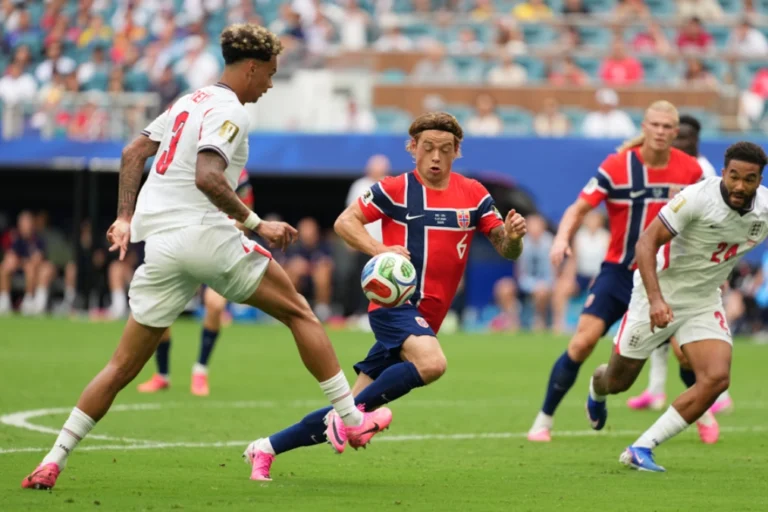
Beyond the broader issue of the football betting scandal, the TeleSUR program also analyzed recent World Cup matches. Commentators discussed the clash between England and Norway, noting that both teams had realistic chances of advancing to the semifinals.
The match outcome, however, was influenced by a controversial moment involving Norwegian goalkeeper Örjan Nyland, whose error proved decisive. Additionally, analysts pointed to a disputed play in which the ball may have struck a camera before England’s opening goal, raising questions about officiating and match conditions.
Individual performances also drew attention, particularly that of Jude Bellingham, who was praised for his technical quality and influence on the game. Meanwhile, Norway’s development model was highlighted as an example of talent cultivation without excessive financial barriers, offering a contrast to more commercialized systems.
Another point of debate involved Belgian goalkeeper Thibaut Courtois, who left the field due to injury but reportedly did so against his own wishes, sparking discussion about player autonomy and team decision-making.
Spain’s victory over Belgium extended its unbeaten streak to 37 matches, placing it close to Italy’s historic record and setting up a highly anticipated semifinal against France.
Geopolitical context
The football betting scandal reflects broader global dynamics where sports, economics and regulation intersect. The rapid expansion of betting markets—both legal and illegal—has been fueled by digital platforms and cross-border financial flows, making oversight increasingly complex.
In many regions, regulatory gaps and economic inequality contribute to the vulnerability of players and institutions, while powerful commercial interests continue to promote betting as entertainment. This creates a tension between economic profitability and ethical responsibility, particularly in a sport with massive global influence.
The issue also highlights the need for international cooperation, as illegal betting networks often operate across jurisdictions. Addressing the football betting scandal requires coordinated policies, stronger enforcement mechanisms and a commitment to preserving the integrity of sport as a public good.
From teleSUR English via This RSS Feed.