

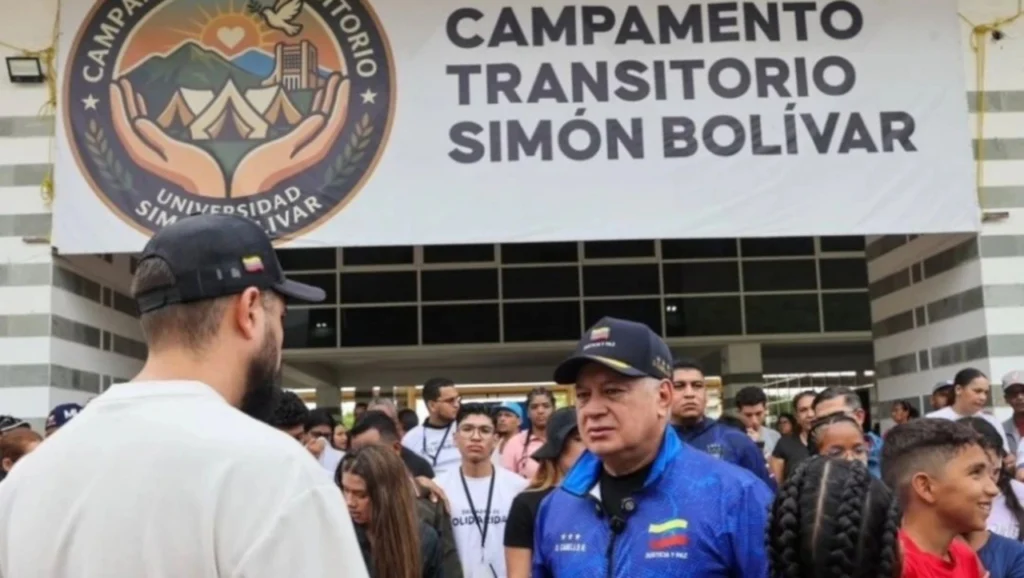
Venezuela earthquake camps rise to 94, sheltering over 18,000 people as authorities expand capacity after devastating June quakes.
Related: Venezuela to Deliver First 200 Quake-Affected Homes Next Week
Venezuela earthquake camps expand to shelter thousands after devastating quakes
The Venezuela earthquake camps network has expanded significantly as authorities respond to the humanitarian impact of the powerful earthquakes that struck the country in late June. Officials confirmed that 94 temporary camps are now active, providing shelter and comprehensive care to 18,437 displaced individuals across the central region.
The Venezuela earthquake camps initiative reflects a large-scale logistical effort aimed at protecting families who lost their homes or were forced to evacuate due to structural damage. According to the latest official report, the government has established a total capacity of 24,129 spaces, strategically distributed across the most affected areas.
Authorities emphasized that the Venezuela earthquake camps system is designed not only to provide immediate shelter but also to ensure access to food, healthcare, and basic services, forming a critical pillar of the national emergency response.
Venezuela earthquake camps distribution and capacity across regions
The Venezuela earthquake camps are concentrated in three key regions, with La Guaira, Caracas and Miranda accounting for the largest share of facilities and assisted population. La Guaira leads with 10,981 people sheltered across 28 camps, making it the area with the highest number of affected citizens receiving assistance.
Authorities confirmed that six camps in La Guaira are currently being expanded, reflecting the ongoing need to increase capacity as recovery efforts continue. The coastal state remains one of the hardest-hit zones following the seismic events.
In Caracas, the capital hosts 40 active camps, with an installed capacity of 11,086 spaces and a current population of 6,133 sheltered individuals. The Venezuela earthquake camps in the capital play a central role in coordinating aid distribution and medical services.
Meanwhile, the state of Miranda operates 26 camps, offering 3,244 spaces and currently assisting 1,323 displaced residents. These facilities complement the broader national network, ensuring coverage across the central region.
Conditions and services inside Venezuela earthquake camps
The Venezuela earthquake camps provide more than basic shelter, functioning as integrated support centers for affected populations. Authorities reported that residents receive regular food distribution, healthcare services, and psychosocial support, particularly for vulnerable groups such as children and the elderly.
At the Simón Bolívar University (USB) facility in La Guaira, for example, 628 people are currently housed, receiving comprehensive assistance including meals, medical attention and safe living conditions. This reflects the broader operational model of the Venezuela earthquake camps, which prioritize dignity and stability during displacement.
Government officials stated that maintaining these spaces is essential while infrastructure recovery and reconstruction efforts continue, ensuring that families remain protected until permanent housing solutions are available.
Ongoing recovery and institutional response
The Venezuela earthquake camps system is part of a wider institutional strategy aimed at addressing both immediate and long-term impacts of the disaster. Authorities continue to coordinate logistics, expand facilities where necessary and monitor conditions within camps to ensure adequate service delivery.
The government has also launched complementary initiatives, including housing registries and reconstruction planning, to support the eventual transition of displaced families back into permanent residences. The camps are expected to remain operational as long as needed, depending on the pace of rebuilding efforts.
Officials highlighted that the Venezuela earthquake camps represent a dynamic system capable of adapting to changing conditions, including fluctuations in the number of displaced individuals and evolving humanitarian needs.
Geopolitical context
The expansion of the Venezuela earthquake camps underscores the broader challenges faced by countries responding to large-scale natural disasters, particularly in regions with existing economic and infrastructural constraints. The situation has drawn international attention and support, reinforcing the importance of multilateral cooperation in disaster response.
The Venezuelan case also illustrates how humanitarian crises can influence political and diplomatic dynamics, as governments engage with international partners to secure aid and technical assistance. At a regional level, the response highlights the need for stronger disaster preparedness mechanisms across Latin America, where seismic and climate-related risks are persistent.
The effectiveness of the Venezuela earthquake camps system may shape future approaches to emergency management and social protection in similar contexts.
From teleSUR English via This RSS Feed.