

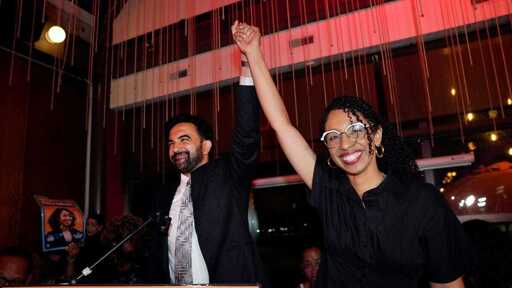
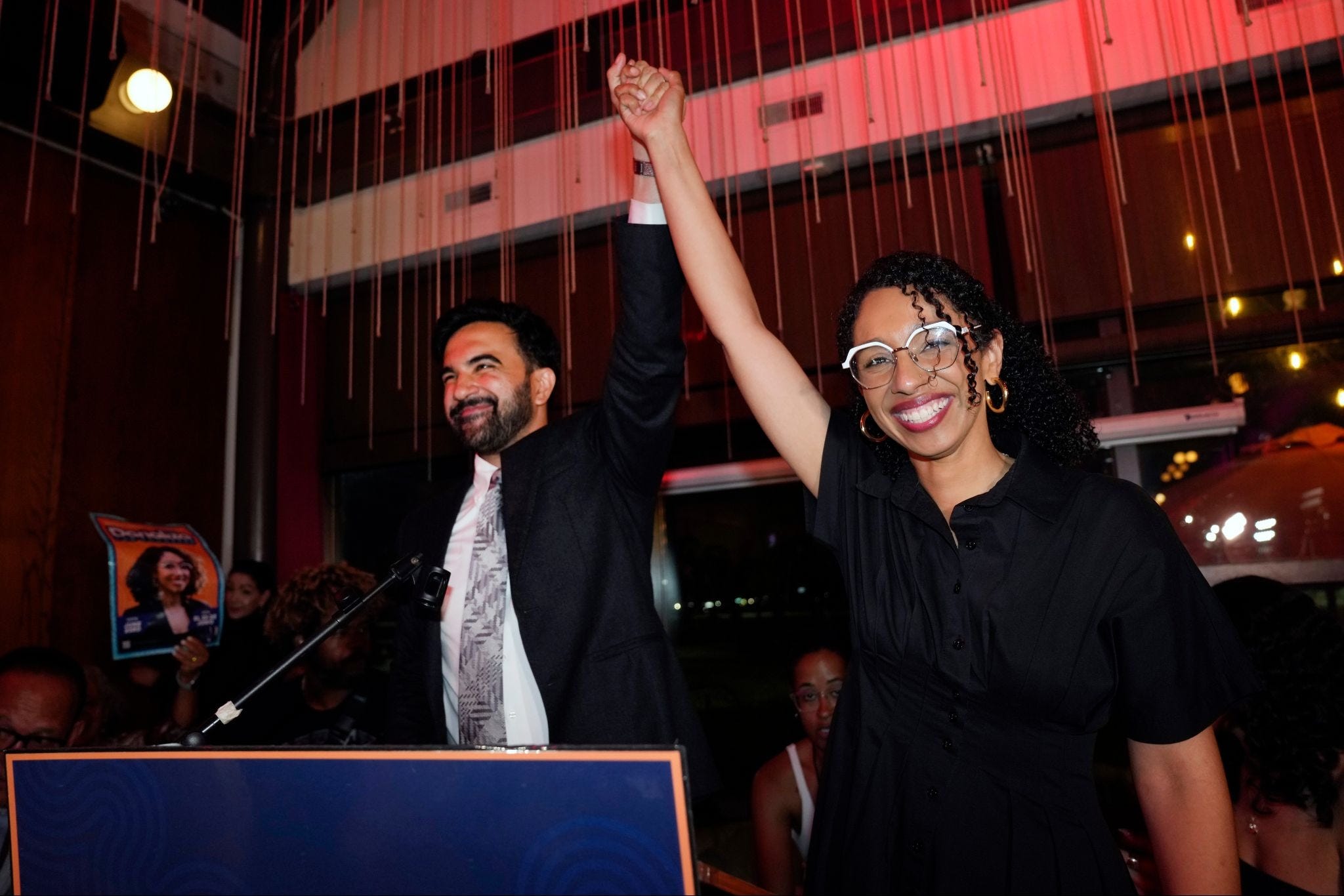
Zohran Mamdani celebrates with congressional candidate Darializa Avila Chevalier during an election night watch party. (AP Photo/Seth Wenig)
It was the second week of May, and the Darializa Avila Chevalier campaign had just experienced its fourth consecutive session of extreme flaking (90%+) for our phonebanks. RSVPs across the board were “stable” in a key time we needed growth to meet our goals. Yet, it was in these moments—looking at a 20k list and wondering how we were going to call them all in 30 days—that one realizes the value a single person can bring, and the amount of effort required to get that person to take action and then come back to do it again.
Darializa was an exciting candidate in many ways and had firm political principles which extended beyond her recent DSA membership. Both in and beyond her endorsement forum people recounted their stories of her as a Zohran campaign field lead, and how she made them feel motivated to come back. She was an organizer during the Columbia University encampments, and months before her congressional candidacy she was using her position to advocate on behalf of Mahmoud Khalil.
NYC-DSA committed to 12 races, including Darializa and Claire Valdez’s congressional campaigns. This was ultimately a bet on whether the chapter could immediately tap into the base that propelled Zohran’s mayoral primary victory. Right up until election day, there were many signs that this bet was wrong. Campaigns across the organization competed to meet goals and recruit new volunteers. During Get Out the Vote, many leads reported being outnumbered by their opposition.
NYC-DSA leadership’s unilateral decision to block national DSA endorsement for the slate—which would have brought additional fundraising and volunteers from outside the city—compounded that struggle. DSA is not one chapter alone, but a national organization of over 120,000 members. This lack of engagement effectively meant that the other 105,000 DSA members—which had already turned out in the hundreds for Melat Kiros, Oliver Larkin and Chris Rabb—could not be directed to aid campaigns struggling just to get people on the phones.
Of course, 11 of our 12 races ended in victory, though not through “typical” means. Our membership had doubled in size, but our slate had also quadrupled since 2024 (when we ran 3 races for NY Assembly and lost 2 of them). Ultimately, I believe that we benefited from the broader pro-Palestine, leftward drift in national public opinion that delivered victory to Chris Rabb, Janeese Lewis George, and Melat Kiros.
As the coordinator for both Phonebanks and Volunteer Recruitment, I spent months putting together calls to plug people into our events, canvasses, and phonebanks. I also developed the weekly recruitment and phonebank scripts, organized and created lists, trained and onboarded leads, and recruited new members to the team to make more calls. Throughout the campaign about 20-25% of RSVPs were directly linked to recruitment calls, made while over the phone. Many more signed up via the text we sent out to missed calls.
Over time, we saw that people began to navigate to our website and RSVP on their own, which became common late in the campaign. As this paradoxically lowered the RSVP rate of our ongoing phonebanks, we shifted toward holding “power hours,” where we gathered everyone together to call a mega-list of non-RSVPs and push them toward a big canvass or event. These were successful, but also didn’t expand the volunteer list.
On May 28, Zohran Mamdani endorsed Darializa on an evening show of MS NOW. This was a breath of fresh air for the campaign. Even as previous polls showed NY-13 had no love for Adriano Espaillat, many more did not know Darializa. Zohran’s endorsement helped fill in the gaps in terms of not having enough people to make our case to the voters. The endorsement by the honeymooned Mayor also provided a sense of credibility and momentum to Darializa, who had never held a local office before her congressional run. Zohran also did a number of videos and appearances as well as joint canvasses and phonebanks.
Because of this we were able to recruit and mobilize growing numbers of volunteers to specific actions. Endorsements from other organizations, and their volunteer commitments, started rolling in. New York Progressive Action Network, which endorsed Espaillat as the “progressive” candidate early in the primary, switched their endorsement to Darializa over a lack of commitments on Palestine. In just a few days, there were dozens of phone bankers clearing calls by the thousands, and the canvassers to knock hundreds more doors per shift.
Darializa ultimately beat Espaillat by a 5-point margin. She won AD-70, the district where we ran Conrad Blackburn for State Assembly, by 15 points; the most of any Assembly District inside NY-13. While this paints a positive picture for another Conrad run in 2028, his loss underlines the importance of unified endorsements across the DSA slate. If Zohran had endorsed and included Conrad in the many Zohran-Darializa events he was iced out of, there’s good reason to believe that our slate would have had a clean sweep.
I write all of this in the context of several major events within NYC-DSA: the Anti-War Working Group (AWWG) OC elections, and the AOC re-endorsement earlier this Spring. In each case, Marxist Unity Group in NYC has had to fight against the anti-democratic tendencies demonstrated by our chapter leadership, in particular the sectarian belief that DSA would be better if political opponents were out of the organization.
Within AWWG, a few dozen abstainers led NYC-DSA’s Steering Committee to invalidate the Working Group’s elections and run an unprecedented citywide campaign to install their own approved candidates. Some Steering members even floated the word “decharter,” despite the fact that AWWG has been among the most active and fastest growing working groups in NYC-DSA.
During the re-endorsement discussion on AOC, I recall one alternate for the Citywide Leadership Committee saying: “I would rather 10,000 members quit over AOC being endorsed if it means there’s a chance she signs an arm shipment executive order.” This statement swirled around my mind as I scrapped for volunteers. If I and many of my comrades are purged, ejected through anti-democratic maneuvers, or were part of this hypothetical 10k that quit overnight, how many would be left to push our campaigns? The impact of just 1 canvasser often means 70 doors and 7 conversations each week. But as the AWWG episode demonstrated, the contributions of each member comes second to their perceived political value.
We need people, but what keeps them around? What kept dozens of DSA members burning the midnight oil as the work increased and volunteers plateaued on campaigns across the city?
The first is a feeling of ownership, which is dramatically increased through member democracy. When we are able to debate and discuss, the result is a culmination of efforts. When we endorse someone or launch a campaign, we should want to see these things through. Democracy is the lynchpin of our political project, and gives members control of the fate of DSA. A snapshot of this is found in the high attendance of endorsement meetings—the only major decision made by and large by members themselves—when compared to other meetings in the chapter.
The second factor is having candidates that embrace the platform and vision of DSA. We have to fight each and every election cycle to ensure that candidates we endorse identify as Democratic Socialists and embrace DSA’s platform. We also require that they endorse the slate. These commitments tie the fate of our candidates’ campaigns, and DSA as a political organization, together.
The Darializa campaign was an opportunity to elect a Socialist, and a seasoned organizer from the Palestinian Liberation movement, to national office. Yet it is not enough to simply rest on our laurels and assume that Darializa in office will represent an extension of our politics. Elected officials, especially within the halls of Congress, face incredible pressure from the Democratic Party to capitulate on their principles, including both threats and incentives: denial/revocation of committee seats, rejection of district funding, and obstruction of getting bills out of committee or amendments passed.
The only cure, the only way to ensure that DSA representatives continue to represent DSA, is through coordination with national DSA, the local chapter, and the rest of the DSA bloc in office, alongside the freedom of criticism. Our membership, the force that drove these candidates to victory, must also be the force that ensures they remain representatives of our program, willing and able to organize the working class into the Socialist movement. Fundamentally this means members should have a sense of how these relationships are going, which will allow them to apply support or pressure with the strength of 120,000 as opposed to this or that well-connected individual leader.
The success of our slate should serve as a reminder that these campaigns are ours; they belong to the DSA members that made them. We don’t just need people to run and staff campaigns. We need members in control who are ready to implement our political will and use the socialists we’ve elected to office as an extension of that will.
Unified endorsements, principles, and standards have all proved crucial to Darializa’s victory, and by extension, the victory of DSA. Socialism and democracy are the defining lines between us and the standard Democratic Party apparatus. Socialism commits us to the liberation of the working class, as opposed to the bribery of the capitalists. And through Democracy, where DSA members organize around collectively agreed-upon principles and are given a window into the rationale behind the actions of our elected officials, we create the opportunity for the working class to mold their own destiny through the Party; an opportunity which doesn’t exist anywhere else.
From The Socialist Tribune via This RSS Feed.