

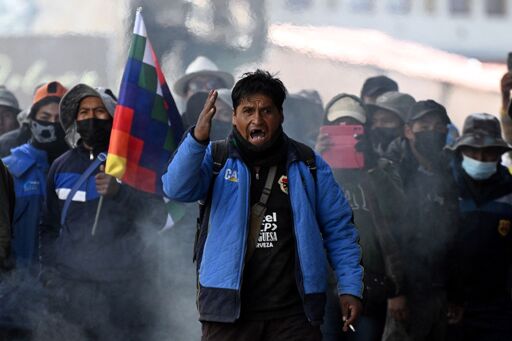
After 50 days of protests and roadblocks, Rodrigo Paz’s government finally managed to turn the situation in its favor. The bureaucracy of Bolivia’s largest trade union confederation, the COB, betrayed both the Federation of the 20 Túpac Katari Provinces and the self-organized committees of the city of El Alto by reneging on its commitments to them. This betrayal paved the way for the government’s crackdown. Just hours later, it issued Decree No. 1740, declaring a state of emergency and militarizing the country’s roads. The retreat of the peasant organizations was confirmed four days later, when the government announced that all roadblocks across the country had been cleared.
However, far from resolving the political crisis, fuel shortages persisted even after the blockades were lifted. Long lines at gas stations continued for days, underscoring not only the Paz administration’s inability to guarantee a reliable fuel supply but also the ongoing risk that the fuel being distributed is “junk” — the term widely used to describe the contaminated fuel that Paz and his officials have distributed in recent months.
This situation further exposes the weakness of a government held together only by precarious support from the middle classes, one that was able to avoid being forced out of office only thanks to the cooperation of COB leaders.
Additionally, it should be noted that Paz also remained in power thanks to U.S. political intervention, primarily in the political arena. Washington openly supported him through the appointment of Minister Justiniano, who has well-known ties to the United States; negotiations with the IMF; and the return of the Drug Enforcement Administration. All of these were signals of support for the Paz administration. We must view this as part of the U.S.’s “Donroe” doctrine, which has entailed U.S. interference in Latin America through support for right-wing and anti-popular regimes. In this sense, Paz must continue to pursue his neoliberal policies if he wishes to curry favor with President Trump. This once again puts anti-imperialist politics on the agenda across the continent.
Far from a resounding victory — as some fervent advocates of a heavy-handed approach have claimed — what we are witnessing is a sort of temporary suspension of the conflict. An analyst from Beni in northeastern Bolivia described the current situation as a “pressure cooker.” While Paz may have scored a point, the reality is that the apparent resolution of the social conflict has exposed another crisis that the government has been unable to resolve: the supply of hydrocarbons.
Another challenge facing the government is the economy, with the World Bank forecasting a 3.2 percent contraction in 2026 — the worst performance in Latin America. This “specter” hangs over the government by limiting its room to maneuver and ability to develop any kind of social pact. On the contrary, it will face greater pressure to implement austerity measures. Some of these elements are already visible in the devaluation of the boliviano. How much more pressure will inflation, devaluation, and other factors exert?
The appearance of normalcy that the Paz administration is trying to project is threatened whenever its allies — from Libre, Tuto Quiroga’s party, or the Civic Committees — demand and press for “punitive measures” against the protesters, calling not only for the arrest of Evo Morales, but also for the militarization of the Chapare and criminal proceedings against the leaders of the COB; the largest peasant and Indigenous trade union in Bolivia, the CSUTCB, Túpac Katari; and Nilton Condori and Evo Morales.
Others, such as Representative Alarcón, are once again promoting the “Anti-Blockade Law” bill, in open defiance of the popular sectors that have taken to the streets. They believe they have shifted the balance of power between the classes enough to impose their entire austerity agenda and imprison union leaders. They are demanding that the government enforce the state of emergency much more aggressively. They support the government while simultaneously undermining what little social base it has left, and are betting on capitalizing on its weakness by turning Rodrigo Paz into a pawn for Quiroga’s far-right agenda.
Beyond these challenges and the Paz administration’s dependence on the Right, it is also necessary to examine the dynamics and pressures coming from the working classes in both rural and urban areas — the very sectors the government has supposedly just defeated. Doing so requires carefully examining the strengths and weaknesses of the recent mobilization, the nature of its demands, and the way these evolved from corporate and industry-specific grievances to ultimately focus on a single demand: the president’s resignation.
Finally, we need to develop a sensible perspective on the balance of power between the social classes in conflict — one that allows us to place the recent conflict within a broader historical context, to see where we’ve come from, and, above all, to formulate some hypotheses about the dynamics of the crisis and the class struggle in the coming period, bearing in mind that neither side in the conflict has been defeated and that the crisis is far from over.
The Strategic Problem Facing the Working Class, and Corporatism as an Obstacle
During the nearly two months of blockades and protests, the burden of the struggle fell primarily on the peasant movement in the west and the precarious workers in the city of El Alto. Unfortunately, the COB leadership refused at every turn to carry out work stoppages at workplaces, as they had declared at the May 1 general assembly. This central issue regarding the mobilization was discussed on multiple occasions with the COB and the FSTMB, a mine workers’ union. For several weeks, as the mobilization continued to grow, the balance of power with the central government became deadlocked, creating a situation we defined as an “unstable equilibrium.”
The government attempted on several occasions to break this equilibrium and shift the balance of power in its favor through repression. It tried this strategy in Parotani, Cochabamba; Río Abajo in La Paz; and San Julián in Santa Cruz, where it did not hesitate to use armed civilians who, alongside the police and the armed forces, attempted to break the blockade. They were defeated.
But from the perspective of the protesters, the only way to tip the balance in favor of the workers and the mobilized masses was to bring the urban and working-class forces into the struggle. It was not enough for the COB to mobilize only union committees. Faced with the government’s attempts to shift the balance through repression, the movement needed a response that brought the working class as a whole into the conflict. This never occurred.
Two days before the COB’s capitulation, the SMTMH, another mine workers’ union, signed an agreement with the government under which each worker would receive a bonus of 5,000 bolivianos for not participating in the protests, according to a congresswoman from Paz’s PDC party. Similarly, the Colquiri miners’ union signed an agreement to allow foreign investment in the mine.
The COB’s National Executive Committee, including its leader, Mario Argollo, saw no need to publicly challenge these agreements. Worse, they entered into dialogue with the government, disregarding the resolutions and agreements signed during the conflict and giving the government carte blanche to declare a state of emergency and militarize the sectors that rejected negotiations. Bringing wage workers in the conflict would have made it possible to directly target agro-industrial and mining businesses, as well as corporate interests in general. San Cristóbal, along with the entire mining sector, continued to export without interruption, while the peasant movement maintained its plan of action. Urban and rural teachers abandoned the mobilization when their leaders signed an agreement for a 2,500-boliviano bonus. The narrow corporatist and unionist mindset of the union leaderships provided fertile ground for the “Peace” policy — which sought to grant privileges to certain sectors and leaders — to take root, facilitating the betrayal by Argollo and other leaders.
Another point worth considering is that, while the focus of our discussion has been on the leadership’s responsibility during the process, it must also be noted that there was no emergence within the workers’ ranks of a “vanguard” from the organized strategic sectors that would have challenged the agreements. Had a current or movement emerged among the ranks of the mining and factory workers affiliated with the COB that questioned the negotiations, Argollo’s betrayal would have been more difficult — or at least more costly.
Future class struggles will require a conscious fight to foster the emergence of anti-bureaucratic and militant sectors among unionized workers as an alternative to the bureaucratic leadership of the COB and its departmental and regional confederations.
The Anti-Bureaucratic Phenomenon, Blockade Committees, and Self-Organization
In just over six months, the Paz administration not only exhausted the political capital it was lent — which had enabled it to win the election — but also found itself confronting two waves of mobilization and struggle by workers, peasants, and the masses. The first took place in December and January in response to DS 5503, and the second began — if we’re to pinpoint a date — on May 1 and resulted in more than 50 days of protests and blockades.
The provocation by Paz and the parliamentary right wing began with an attempt to implement an extremely harsh austerity plan that would not only reshape the entire economic structure but also violate constitutionally guaranteed rights. The response from workers and the people was immediate, and on Christmas Eve 2025, an intense wave of protests began, demanding the repeal of DS 5503. These protests continued until the end of January, at which point the movement was signaling the possibility of a nationwide uprising.
The COB leadership — which had been renewed a couple of months earlier after Juan Carlos Huarachi and the MAS-aligned bureaucracy came under heavy criticism — took advantage of the expectations that had built up among grassroots sectors during the mobilization. It used these expectations to sign an agreement that repealed Decree 5503, but nonetheless preserved the gas price hike with the COB’s approval. This betrayal of the mobilization allowed the Paz administration to buy a few months’ time, during which it attempted to impose further attacks on workers and the people through new and additional decrees, as well as laws that were fast-tracked through the right-wing parliament. At the same time, the betrayal rapidly eroded the new COB leadership’s credibility. It triggered a process among broad sectors of the population and precarious workers characterized by deep mistrust of union and social movement leaderships — a process rooted in anti-bureaucratic sentiment, that, in turn, fueled a wave of self-organization as this new cycle of struggle began in late April.
Among the regulations issued by the government was Law 1720, which provided for the conversion of small agricultural holdings into medium-sized ones, thereby facilitating the development of a land market and opening the door to land grabs by agribusinesses and bankers. The onset of indigenous mobilizations in the lowlands demanding the law’s repeal coincided with protests by healthcare workers, teachers, and transportation workers. This convergence of protests marked the beginning of a growing movement that culminated in the massive public assembly on May 1, called by the COB. Faced with Paz’s refusal to discuss the various lists of demands, the assembly ultimately called for an indefinite general strike, with Paz’s resignation as its sole demand.
From that moment on, as new sectors joined the mobilization alongside rural communities that had begun blocking roads, a profound anti-bureaucratic movement also took shape. Fueled by the mistrust sown by the COB’s betrayal in late January, this movement unfolded with an intensity not seen in previous cycles of struggle. Dozens of blockade and mobilization committees emerged. After rejecting lukewarm or cowardly leaders, these committees began to take charge of the blockades and the struggle.
Thus, after rejecting the leadership FEJUVE, a federation of neighborhood councils, the city of El Alto mobilized under the direction of these committees, which emerged from self-organized neighborhood assemblies and town hall meetings. This launched one of the most significant self-organizing movements in recent years, with an intensity not seen even during the Gas War or the Water War. This phenomenon, fueled by deep mistrust of the leadership, made it possible to incorporate thousands of workers, residents, students, and all those who had felt betrayed by Paz’s attacks into the mobilization process. Those involved pushed forward with demands for his resignation, in many cases bypassing their own organizations and natural leaders.
It was these committees — together with peasant organizations affiliated with Túpac Katari and, to a lesser extent, with the CSUTCB — that sustained the national mobilization for more than 50 days, while the COB, as the formal leadership of the conflict, limited itself to mobilizing union committees without ensuring the implementation of a plan of action in mining centers, factories, and service companies.
It was these committees that repeatedly demanded at national plenary sessions and mass assemblies that the COB and the FSTMB move from words to action and ensure work stoppages — the only way to impact capitalist, state, and private profits. Ultimately, it was these committees that, following the betrayal by Argollo and the COB’s National Executive Committee, issued a statement signed by D8, D7, D5, and D14 condemning the COB’s call for dialogue with the government, declaring that “our dead are not up for negotiation.”
The radicalism expressed by the self-organized committees was a genuine expression of the will to fight among the mobilized rank and file. Driven by their distrust of the union bureaucracy’s methods, these sectors developed mechanisms of direct and participatory democracy through assemblies and town hall meetings. This radicalism also shaped the resolutions adopted by major organizations such as the COB, CSUTCB, and Tupac Katari, which demanded Paz’s resignation and the continuation of mobilization until that objective was achieved. The possibility of dialogue with the government was therefore ruled out from the outset, pushing these organizations toward broader and more sustained mobilization.
These political developments — grassroots self-organization, combined with mistrust of and vigilance toward leaders as an expression of anti-bureaucratic sentiment — are new developments that had not appeared in the same way in previous processes of class struggle.This includes the historic struggles of the Water War and Gas War, although the roots of these developments can clearly be found in those experiences. El Alto, Senkata, and District 8 have long been centers of struggle and resistance, including during the 2019 coup. The accumulation of these experiences, combined with the recent betrayal in January, created the conditions for this rapid development of grassroots democratic organization.
This process had certain limits. We have already noted the absence of an anti-bureaucratic workers’ vanguard. We must also recognize that the anti-bureaucratic phenomena described here developed most strongly in El Alto, where committees emerged that rejected their leadership. The peasantry, by contrast, disciplined itself and followed its leadership even when it decided to call off the mobilizations. This does not mean, however, that there were no challenges to leadership within peasant sectors. There were instances of leaders being confronted through acts of rejection, including accusations of betrayal, claims that they had been bought off, refusal to recognize their authority, and even physical confrontations such as whippings and stone-throwing.
Blockades and Supplying Those on Strike: Territorial Power
Throughout the 50 days of protests, one of the most pressing problems that arose was that of supply, particularly in the cities of La Paz and El Alto. As some Túpac Katari leaders noted, the prolonged nature of the conflict began to exacerbate social and political polarization. Right-wing groups sought to break the deadlock through confrontation, as they tried and failed to do in San Julián. On the other hand, the prolonged nature of the conflict also led to fatigue among the mobilized sectors and a growing need to find a solution to food supply problems.
The peasant leaders lacked a strategy to break the deadlock and, with it, the process of attrition. However, through self-organization efforts in the town councils and assemblies of Senkata, attempts were made to overcome this impasse in the struggle. The D8 committee sought to launch various initiatives to remedy the situation, such as the establishment of supply committees, communal kitchen committees, liaison committees with the Achocalla community, markets organized by the blockade committees, and press committees, among others. All these initiatives were aimed at resolving the various problems that the mobilization had brought to light. Unfortunately, these initiatives never fully materialized due to the defection of Argollo and the COB. Nevertheless, they were beginning to point the way toward strengthening the mobilization, easing the pressure for food, and encouraging urban workers to join the struggle.
The importance of these emerging forms of self-organization — as well as the will expressed in the town hall meetings for these committees to begin taking on tasks such as supply, security, and feeding the protesters — lies in the fact that they take on a strategic character and serve as seeds for dual power. If each roadblock began to objectively express the territorial power of the protesters, then the development of these forms of self-organization and their expansion into urgent tasks such as supply, food distribution, and defense represented the beginning of a process through which that territorial power could acquire conscious agents. These agents would not only strengthen the mobilization itself but, more importantly, begin constructing institutions that, in opposition to state authority, could express the power of those below — the mobilized sectors — and their potential to envision a government of workers and peasants.
This is significant because, while the blockades succeeded in making their political point, as a method they prevented the movement from gaining the social hegemony necessary to bring down the Paz government. Specifically, the blockades took a toll on and exhausted the rural areas and isolated the peasants from the urban population, fostering a politicization that the government sought to exploit in the face of shortages and the daily hardships affecting millions. Had a grassroots supply system been developed, it would have closed this gap by strengthening unity among peasants, the general population, and workers across rural and urban areas.
The Problem of Future Clashes
As we noted above, the conflict is not over; the crisis has not been resolved, nor have any defeats crushed the opposing sides. There is a sort of suspension of the struggle, due to the COB’s betrayal and the retreat of the other mobilized sectors as a result of the state of emergency. This implies — or foreshadows — a return to mobilization stemming from the government’s inability to restore order and stability for capitalist businesses. Nothing prevents the masses from returning to the struggle, driven either by the audacity of the right wing — which wants to see Paz’s neoliberal plan through to the end — or by a new wave of decrees that further undermine the quality of life for rural and urban masses, or by a new wave of repression. Such episodes are “common” in Bolivian history.
This means that, in the face of a new wave of struggle, we must step up our methods of struggle and organization. We cannot start from scratch; we must draw on the experience we have accumulated in self-organization and in the struggle against bureaucracy, expand the committees, and develop them further so that they become bodies that unite everyone who wants to fight and coordinate future struggles.
If we want to break the government’s resistance in an upcoming struggle, we must strengthen and develop Soviet-style organizations, the seeds of which, we hypothesize, may lie in the blockade committees that emerged in El Alto, seeking to coordinate among committees, organizing assemblies and town hall meetings, and participating in expanded meetings of other organizations to unite and add strength to the struggle. If these committees are maintained and developed — even under a state of emergency — they can serve as an important link between the peasants and organizations in the city.
Furthermore, as we have emphasized previously, it is essential to fight for the incorporation of wage workers — especially the large ranks of miners and energy workers — into future struggles; to unite exploited sectors in both rural and urban areas; and to develop a political approach toward the broader masses affected by the crisis, the student movement, and all oppressed sectors of society.
The Role of the Left in a Mass Mobilization that Tended Toward Politicization
During the conflict, the various leftist forces played a shameful role — if they weren’t simply absent. For example, Evo Morales — followed by Evo Pueblo and the other remnants of “Evismo” — said a couple of days ago that the demand for Paz’s resignation was exaggerated. They remained on the sidelines of the “popular rebellion” — the term Evo used to describe the mobilization — and, in response to attacks from the right seeking to hold him responsible, he declared that at no point did his supporters call for Paz’s resignation. In line with this stance, the Communist Party of Bolivia — which initially stood with Morales and later with Arce — only recently, in mid-June, issued a brief statement calling for dialogue while completely ignoring the repression and the popular demand for Paz’s resignation. In doing so, they positioned themselves to the right of Argollo and the entire union bureaucracy.
Special mention goes to the Revolutionary Workers’ Party (POR) and the urban teachers’ union in La Paz, which they lead. In both the first mobilization in January and the second in May and June, the urban teachers’ union mobilized against attempts to defund education, in support of a wage increase, and in support of the COB’s list of demands. Moreover, teachers — both urban and rural — along with healthcare workers and factory workers, had been mobilizing prior to the rally at the Cabildo on May 1. However, as became clear in the first days of May, the mobilization of these sectors always remained within the framework of the labor union struggle. The POR was the organization that most emphatically defended this approach, which, incidentally, was positioned further to the right than Argollo’s bureaucracy.
They systematically opposed the slogan “Paz must resign,” because, as they said, they considered it an electioneering slogan, since his resignation would mean Vice President Edmand Lara’s ascension to power and the calling of new elections. However, reality is different. The slogan “Paz must resign” emerged in town hall meetings, expanded meetings, and assemblies as an expression of rejection of all the measures in Paz’s austerity plan, as well as a response to the government’s refusal to discuss the demands and petitions of the mobilized sectors.This radical slogan had strategic value because it allowed for a bridge to be built between this discontent and the question of what to do once Paz resigned — a provisional government or a constituent assembly? In other words, deciding the country’s future was put on the agenda.
Paz, seeing the mobilization grow, shifted his policy from rejecting all dialogue to attempting to demobilize the movement by calling for dialogue while harshly repressing the protests. At this point, the demand for resignation became an obstacle for Argollo’s union bureaucracy and for all those leaders who had only driven the mobilization to strengthen their positions in potential negotiations. While Argollo, in order to enter into dialogue and betray the mobilization, had to go back on his own word, renege on the agreements he had signed with Túpac Katari, and abandon the demand for resignation, the POR did not need to do so, since from the outset they refused to uphold the demand for resignation and were willing to sit at the negotiating table “if the government invited them.” They stopped mobilizing very early on — just like the rural teachers — after Paz offered a bonus of 2,500 bolivianos.
The POR’s role is even more despicable, given the part that urban teachers could have played had they opened the schools to support the protests, serving as rest centers and hubs for organizing the mobilization. But the POR went into hiding, forgetting its grandiloquent statements about the unity of the working and peasant masses. They did not seek to ensure that the teachers’ union, within the COB, served as a concrete bridge between the peasants and urban workers. Their union positions were used to negotiate a bonus, not to advance the mobilization.
In this sense, the POR are consistent trade unionists, but in terms of the class struggle, they were reformists who acted to the right of Argollo, covering up their capitulation with general slogans about the People’s Assembly or the workers’ and peasants’ government. Within the POR, these statements have no value whatsoever.
From the LOR-CI, part of the Current for Permanent Revolution, we seek — to the best of our ability — to throw ourselves into the mobilization to strengthen it and be a revolutionary force by encouraging all forms of democratic self-organization that the mobilized people have set in motion, fostering coordination, and seeking to help raise awareness of what tens of thousands in the streets were setting in motion. We are referring to the supply committees, self-defense committees, and communal kitchens, which in the final days of the conflict had begun to be discussed in several of the mobilized sectors. In short, we fought not only for the “formal” working class to join the general strike but also for it to do so by uniting with the vanguard of the mobilization — namely, the peasant movement. All of this work constantly sought to build a bridge between the masses’ demand for “Paz’s resignation” and the need for a workers’ government — that is, to build a bridge aimed at achieving, through mobilization, a provisional government of the organizations engaged in the struggle.
At La Izquierda Diario, we were out on the streets from the very beginning, covering the demonstrations and the organizing efforts, giving a voice to the sectors in conflict that were fighting against betrayal, denouncing every move by the government and each of its ties to capitalist interests, and exposing every attempt at dialogue as a trap. Likewise, as part of our international network of publications, we sought to influence those militant sectors in the struggle, but we also fought to break through censorship so that the Bolivian rebellion would have an impact on millions of workers, young people, and activists around the world. This was reflected in an impressive growth in our usual reach, with visits to our website increasing several-fold and, above all, on social media — which was the most widely used communication channel among the mobilized sectors. In this regard, for example, we went from receiving between 100 and 200 visits to our website per day in January to more than 800 during the peak moments of the mobilization; and in May alone, we had 1.7 million views on Facebook and Instagram, reaching hundreds of thousands of people.
In this effort, we paid special attention to District 8 and the development of its committees and councils; our involvement there sought to foster tendencies toward self-organization and anti-bureaucratic tendencies. But our intention was also to break through the media blockade imposed by the press and the racist, anti-Indigenous establishment, which was trying to sway public opinion in favor of the government.
Amid the repression, we promoted ProDHCre, an organization of human rights professionals working against state repression, which today stands on the front lines in defense of those detained and persecuted as a result of the Argollo agreement. ProDHCre has sought to serve as a leading voice in the defense of detainees and in denouncing repression.
From within the university community, we sought to go against the grain through Combate Rojo, where we had to face attacks from the university administration and right-wing factions that were trying to demoralize us, in order to bring the conflict to the university, earning us the reputation of being “the left” at Universidad Mayor de San Andrés in La Paz.
Likewise, as part of our international current, we helped organize the human rights mission that came from Argentina to observe human rights violations under the Paz administration. Furthermore, this conflict was part of the CRP’s internationalist activism, with contributions from comrades in Chile, Brazil, and Argentina, as well as actions in Europe and a campaign that reached around the world, seeking to strengthen the struggle for a revolutionary solution to the rebellion — but also to ensure that the rebellion would have an impact on millions seeking an exemplary alternative to the right that transcends the failed experiences of conciliatory approaches and the betrayals of the bureaucracies. While the government authoritatively accused us of “foreign interference” and asked for money and advice from right-wing politicians in the United States or Argentina, we championed the unity of the peoples of Latin America and the world and internationalist activism in support of our cause.
Based on these lessons, we are preparing to continue organizing throughout the country, recognizing that the government has not managed to defeat the mobilized forces but is instead steering through this state of emergency, while the COB’s mediating role — with this latest betrayal — erodes its legitimacy for future struggles. We are consciously preparing for future clashes; we know this isn’t just around the corner, but the pressure is certainly mounting.
The post Bolivia: Strategic Lessons from the Workers’, Peasants’, and People’s Rebellion appeared first on Left Voice.
From Left Voice via This RSS Feed.