

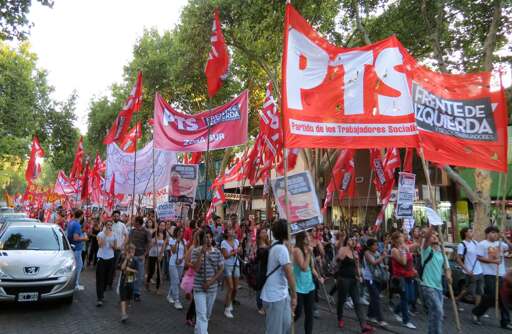
In this interview with Matias Maiello, Emilio Albamonte, a member of the leadership of the PTS (Party of Socialist Workers), the sister organization of Left Voice in Argentina, returns to the question of self-organization and its relationship to revolutionary strategy.
*
On Monday, June 29, the first of the FIT-U (Workers Left Front-Unity) forums was held at the initiative of the PTS (Party of Socialist Workers). During the discussions, the different positions of the FIT-U member organizations were clearly expressed. The Partido Obrero (PO) and Izquierda Socialista advocated for the development of “FIT-U support committees,” without responding to our proposal, which aims to promote the immediate coordination of all sectors of the working class in struggle. The MST (Socialist Workers’ Movement), for its part, expressed its agreement with the idea that FIT-U is insufficient, in and of itself, and that a new stage lies ahead. For us, this new stage involves building a movement that works toward the creation of a party of the new working class. All the organizations that participated in the forum tend to downplay the profound political differences between us, even though these differences clearly emerged during the forum itself. These differences range from the concept of the party that needs to be built to fundamental issues, such as the war in Ukraine, where some organizations are siding with the Ukrainian military as if it were possible to ignore NATO’s role in leading it. Regarding the workers’, peasants’, and people’s rebellion in Bolivia, these organizations argue that by adopting the slogan “All power to the COB,” they are not endorsing a leadership that already betrayed the workers, peasants, and indigenous communities in January and are doing so again today. In your opinion, how should this debate be approached to prevent it from becoming a mere discussion of party politics?
Precisely, to avoid getting bogged down in internal discussions, I’d like to begin by taking a step back and starting with a reflection recently made by Ángel Luis Parras during a recent interview. He is a comrade with extensive experience, who led the LIT (International Workers’ League) for many years and who has just broken with that organization, along with other comrades from Corriente Roja in the Spanish State, with whom we are currently engaged in a process of fusion. Parras recalled that Nahuel Moreno repeatedly stated that revolutionaries have two fundamental and permanent strategies: the mobilization of the masses and the building of the party. However, Parras emphasizes that, in light of the great lessons of the 20th century, this formula lacks a crucial element: the question of self-organization, that is, the creation and development of working-class organizations, not only during the culminating moments of a revolutionary process, but throughout its preparation. He drew a conclusion that seems particularly accurate to me: taken in isolation, “mass mobilization” leads to complete objectivism; as for “party building,” when it is not accompanied by a policy aimed at guiding self-organization, it leads to a conception entirely dominated by a logic of party apparatus. Parras notes that this conception of the role of self-organization constituted a central element of convergence with our international organization, the Current for Permanent Revolution (CPR-FI). His reasoning struck me as particularly relevant because it touches on a question that lies at the heart of possible points of convergence with other currents.
I think this is precisely the heart of the debate that took place at last Monday’s forum, a debate that actually goes back much further. Because when mass mobilization is separated from self-organization, it often ends up being reduced to mere rhetoric. Take, for example, the slogan “Milei out” put forward by the PO (Workers’ Party). Taken in isolation, it amounts either to spontaneously betting that the masses will solve the problem themselves and drive out Milei — which is completely at odds with Engels’ idea that insurrection is an art — or it is a mere phrase. Conversely, building the party without pursuing a systematic policy in favor of self-organization leads to building an apparatus for its own sake, accumulating militant forces and resources — something a bourgeois party can do as well. What distinguishes a revolutionary party from a bourgeois party is that its construction cannot be conceived separately from the objective that Marx famously expressed: the emancipation of the workers will be the work of the workers themselves. The task of revolutionaries is not to “represent” the working class. On the contrary, they must devote all their energies to helping it organize itself, to establishing its own institutions, so that it becomes a hegemonic force. If we do not understand this, we do not understand what Marx meant.
This is, in fact, the only way a vanguard party can work towards organizing the masses. Trade unions and student centers, now mostly devoid of substance, must be wrested from the control of bureaucracies. This is obviously a very important task, but the inherent corporatist limitations of these organizations mean that they cannot, on their own, offer a comprehensive response to the offensive tasks facing the working class — if we are thinking in terms of a revolution and not merely of maintaining the status quo and seeking to “prosper” within the capitalist system and the bourgeois regime. This is why the PTS and our international current, make the permanent struggle for grassroots self-organization one of its defining characteristics, against the fragmentation imposed by bureaucracies, whether they are workers’, students’, or from social movements, and regardless of their political leanings. The struggle for workers’ democracy, for the effective independence of the workers’ movement from the state, and for the coordination of sectors in struggle is crucial to overcoming the passivity and demoralization that bureaucracies seek to impose. It is directly linked to our strategy, which, from a revolutionary perspective, consists of establishing workers’ councils (“soviets”) to overthrow the capitalist state. Without this struggle, it is impossible for the working class to emerge as a hegemonic force.
The FIT-U has played and continues to play a very important role in Argentina as a revolutionary left-wing pole that defends class independence. It is clear that a new situation has arisen due to the newfound popularity of Myriam Bregman and the revolutionary left in the country. How do you envision the struggle for self-organization in this context, also taking into account the profound upheavals in the international situation?
The revolutionary party must be what one might call a strategic multiplier. If it is merely a machine, it risks veering towards trade unionism in even-numbered years and electoralism in odd-numbered years. The essential point is that it serves to coordinate, mobilize, and organize forces that, without it, would remain scattered.
When we were still a small group, after the break with the old MAS (Movimiento al Socialismo), we had to confront the fall of Stalinism and the realization of Trotsky’s most pessimistic hypothesis: the restoration of capitalism in the USSR and the Eastern Bloc countries. At that time, our essential task was not only to defend Trotskyism against Stalinism, but also to preserve the prospect of world revolution and to reclaim Trotsky’s theoretical legacy. If we hadn’t done so, we would have had to start from scratch, going back sixty years. We knew that the situation would eventually, sooner or later, bring about the reappearance of more revolutionary tendencies, even if it took time, because we had just suffered a terrible defeat that would mark an entire era. That is why we called our international organization the “Trotskyist Fraction”: we were a fraction that was fighting to rebuild the Fourth International in the middle of the political desert of the 1990s.
In this context, in 1995, at the height of Menemism1Named after the Peronist president at the time, Carlos Menem., Fredy Lizarrague, Manolo Romano, and I wrote an article titled “Soviet Strategy in the Struggle for the Workers’ Republic.” This title might have seemed anachronistic just a few years after the fall of the Berlin Wall, and in a way, it was. But we wanted to bring back to the forefront what seemed to us to be a crucial question. I don’t want to bore readers by going over historical details, but it seems to me that they are relevant to our thinking. Why did we speak of Soviet strategy and not Soviet tactics? Because, while the united front is a tactic, the soviets are not. Self-organizing bodies are on the same theoretical plane as the revolutionary party because, like it, they are strategic multipliers: they amplify the power of the class, centralize it democratically, and expand it at the same time. That is why every advance of the real movement is worth more than a dozen programs.
Furthermore, the absence of self-organizing bodies is never without consequence: it leads to getting lost in other strategies. This is precisely what we analyze in our book Marxism, Strategy, and the Art of War with regard to the revolutions that followed the end of the Second World War, led by “party-armies” as in China or Vietnam. These revolutions were victorious, but they developed without soviets and without workers’ democracy. They were led by bureaucratic parties that had adopted strategies based on the peasantry and protracted warfare, giving rise to states that were bureaucratized from their inception. The way in which the class seizes power is not without consequence for the type of state that emerges from the revolutionary process. Quite the contrary, in fact. The revolutionary party must also wage an immense battle within these self-organizing bodies so that they effectively contribute to building the hegemony of the working class, without being neutralized by the bourgeois state, as has happened in many revolutionary processes.
However, the situation has changed profoundly compared to the political wilderness of the 1990s, during which we were trying to reclaim Trotsky’s theoretical and political legacy. It is also for this reason that, at our 14th International Conference last year, we renamed our organization from the “Trotskyist Fraction” to the “Current for Permanent Revolution.” Today, the parameters have changed: it is no longer enough to preserve a Trotskyist identity; it must be given concrete weight in the class struggle. We are confronted with wars like those in Ukraine and Iran, the genocide in Gaza, the rise of more radical right-wing forces, new processes of class struggle, and the emergence of left-wing political phenomena in many countries. It is no longer simply a matter of resisting as a “faction” by merely defending our program within a reactionary situation, but of seeking to connect with the phenomena developing in the field of class struggle and to intervene in the situation with a clear strategy. This is why we are also calling, along with organizations from other countries, for the building of a movement that seeks to construct an International of the Socialist Revolution.
It seemed important to recall these points before returning to the discussion on the FIT-U in order to emphasize that this is not a purely circumstantial debate. Throughout the defensive period we have gone through, the PTS was the main force initiating the creation of class-independent fronts. Before the FIT, we spearheaded the “FITAS” with Izquierda Socialista, which had just broken with the MST, and the Nuevo MAS, while the PO was still refusing to participate in the front. Then, in 2011, we formed the FIT with the PO, accepting that Altamira would lead it, before he himself broke with the FIT after his break with the PO. In 2019, when the MST accepted the FIT program, we were among the main proponents of its integration, thus giving birth to the current FIT-U. Even today, we consider it extremely important to have created a political space for the class-independent Left, in a country historically marked by Peronism2Peronism encompasses a wide range of center and center-left political currents in Argentina. It loosely refers to President Juan D. Perón’s bourgeois nationalist developmentalism, but Kirchnerism — first led by Néstor Kirchner, then by by Cristina Fernández de Kirchner — has been Peronism’s dominant wing since the turn of the century. as an expression of class reconciliation.
But the situation has changed, and that is precisely what we are discussing today as we talk about how to capitalize on the newfound popularity of Bregman and the revolutionary left on the national political scene. The fact that the MST deems it necessary to discuss the transformation of the FIT-U is a step forward: it recognizes that a front that merely engages in electoral propaganda while [Argentinian President Javier] Milei deals new blows to the working class every day is insufficient. We are no longer living under the stabilized neoliberalism of the 1990s: the world order itself is cracking. The question is whether the forces we have accumulated serve as strategic multipliers capable of creating institutions that can, in time, challenge state power, or whether we are simply engaging in electoral posturing.
This is a debate that extends far beyond Argentina. In France, for example, our comrades in Révolution Permanente garnered nearly 7 percent of the vote in several municipalities during the last local elections, allowing them to secure two city council seats in Saint-Denis, a working-class suburb of Paris, in their very first electoral contest. How will they combat Mélenchon’s Popular Front strategy? In my view, they should focus on creating institutions that belong exclusively to the workers and youth of Saint-Denis. This is therefore not a local or circumstantial debate, but a central issue that compels us to reflect on the revolutionary Left we must build.
Let’s be clear: we are not at all opposed to the idea of running a major election campaign, quite the contrary. What we are saying is that running a major election campaign without creating these committees and coordinating bodies for the various sectors of the working class will leave us considerably weakened in the face of the major confrontations to come.
You emphasized the need to unite forces that remain scattered today. This fragmentation of the working class is often analyzed as follows: job insecurity, the rise of gig labor, and the decline of unionization have supposedly transformed the working class into a collection of individuals, while simultaneously fostering an individualistic retreat that the Right Wing has been able to capitalize on. Given this diagnosis, what role does self-organization play in rebuilding our collective strength?
That’s a good starting point for revisiting why the issue isn’t about mobilizing the masses “in general,” nor about building just any party. We must understand that self-organization is the key to the situation. As I said in another interview, the bourgeoisie today exercises its domination by possessing an “expanded state,” or what Gramsci calls the “integral state,” that is, dictatorship plus hegemony. Thanks to this expanded state, it seeks to create consensus, relying in particular on the collaboration of the bureaucracies of the trade unions, the student movement, and social movements, etc. Faced with this gigantic apparatus, the working class finds itself reduced to a collection of scattered individuals. This was, in a way, Margaret Thatcher’s ideal when she asserted that society doesn’t exist and that only individuals do. The very essence of the struggle for self-organization lies in preventing the masses from remaining scattered in the face of this expanded state. The problem is that, with the exception of the PTS, the rest of the Argentinian Far Left is not committed in its practice — quite the opposite, in fact — to fighting to create institutions of self-organization. This is our main difference with the other forces of the FIT-U, beyond the major programmatic divergences we mentioned earlier regarding the war in Ukraine, for example, with the MST (Socialist Workers’ Movement) or IS (Socialist Left). And this difference is constantly expressed in practice, in our intervention alongside the labor movement, in the student movement, and so on.
This is a debate that goes beyond the FIT-U and the political phenomenon we are discussing in Argentina. Let’s take the case of Zohran Mamdani and the Democratic Socialists of America (DSA). His victory in the New York mayoral election reflects a leftward shift in the consciousness of significant segments of American youth. What is our fundamental criticism? It’s not limited to the fact that he is reformist and we are revolutionary, which is an obvious difference. The core of our criticism lies in the fact that, even in defending its own program, DSA does not create institutions specific to the mass movement that would allow workers themselves to decide and intervene directly in the situation and fight for the program they voted for. Everything then depends on the goodwill of elected officials and the concessions they manage —or fail — to extract from the Democratic establishment. Bhaskar Sunkara, editor of the Jacobin magazine and a member of DSA, asserted that Mamdani should create people’s assemblies and use them as a counterweight to the pressure of the establishment. Very well. But this had no practical effect, which is hardly surprising since, at the same time, DSA continues to support Democratic Party candidates. And even if such assemblies were established, a crucial question would remain: would they be assemblies intended to exert pressure on the imperialist bourgeois state, or would they be organs of self-organization in the service of the struggle, capable of becoming instruments serving the power of the working class?
Now, we should note bodies of self-organization can very well emerge under a conciliatory leadership, like the soviets of February 1917 during the Russian Revolution, led by Mensheviks and Socialist-Revolutionaries. But even in this case, they represent immense progress because they provide a space where revolutionaries can directly challenge the leadership of the struggle under the watchful eye of the mass movement. It is within this framework that discussions with other FIT-U organizations take place. It is important to remember, as Trotsky recounts, that the soviets did not arise from a pre-established plan. In their beginnings, they were modest struggle organizations, strike committees, which, faced with the crisis triggered by the disastrous Russian defeat against Japan, evolved rapidly and, during the 1905 revolution, transformed into a new form of political organization. This new organization allowed for both the centralization and expansion of the struggle while simultaneously laying the material and potential foundation for a new type of state that would transcend bourgeois democracy. No one “decreed” them, but neither would they have emerged on their own without the conscious intervention of revolutionaries to develop them.
You mentioned the issue of the “expanded state” and the nationalization of mass organizations. This is a phenomenon in which Peronism played a central role in Argentina.
All the organizations of the FIT-U, including the PTS, strongly denounce the role of Peronism, and rightly so. But something fundamental is often forgotten: the consciousness of workers has been shaped for decades by Peronism. Today, it is a trade-unionist consciousness, to use the terms of Lenin’s What Is to Be Done? In the eyes of this trade-unionist consciousness, the only struggle should be for wage increases; often it doesn’t even consider it necessary to fight for better working conditions, especially in workplaces where overtime, holidays, and grueling work rates are exchanged for a halfway decent wage. On this subject, for example, we have engaged in a very important debate with the PO regarding its intervention in the Fate struggle.3A tire factory in northern Buenos Aires that recently closed, leaving 900 workers jobless. One cannot deliver a radical speech on the need for a general strike and then, in practice, never truly coordinate with other sectors, nor seek to radicalize any struggle, but instead constantly seek the “possible” agreement, which always involves concessions. . For example, despite our appeals, there is no ongoing coordination between the workers of Fate and Georgalos, even though these two companies are only a few streets apart, which weakens both struggles. Generally, the PO claims to agree with us, but in practice, it maintains its policy of separate struggles.
This is a long-standing discussion with the other factions within the FIT-U, because the syndicalism of the revolutionary left often ends up resembling that of Peronism, with the difference — not insignificant, but insufficient — that it doesn’t betray the workers. By this I mean that it avoids collective struggles, that it separates union struggles from political struggles: in even years, “we fight”; in odd years, we campaign in elections. This runs counter to everything we learned from Lenin’s critique of trade unionism in What Is to Be Done?, where he contrasted the ideal of a “trade union secretary” — who is content to support the economic struggle against employers and the government — with that of a “tribune of the people,” capable of responding to any manifestation of oppression and linking it to the overall picture of capitalist exploitation by highlighting the historical importance of the proletariat’s emancipatory struggle. Lenin said that trade-union politics is precisely the ideology of the bourgeoisie within the working class. The question that we, who denounce Peronism, must therefore ask ourselves is this: to what extent do we constitute an alternative to Peronism? If we reproduce, through a left-wing stance, the separation between the trade union and the political spheres, it is clear that we do not.
Our response is to view all struggles, however small, as moments linked to a single, overarching strategy that combines union and political dimensions and culminates in the general strike. This strategy also seeks to prepare its militant forces for self-defense, which constitutes a link in Engels’s “art of insurrection.” It’s about giving visibility to our ideas and winning the sympathy of the exploited, as we did during the major confrontations around the Pan-American Highway, or in struggles that sometimes resulted in victories, like those of the Kraft factory in 2009 or the Donnelley factory in 2014, but also in certain defeats which, because the retreat was well-managed and the lessons learned were clearly explained, did not lead to demoralization. The case of the Lear factory in 2014 is a case in point. When the management of SMATA (the automotive workers’ union) wanted the factory’s internal committee4Internal committees are union bodies that operate within the workplace; they are composed of delegates who work there and are elected by the employees. They can be established within a factory or company, but there can also be internal committees in schools, bus lines, the subway, or any other workplace. to sign a document stipulating that new workers would be hired at 30 percent less than permanent employees, our comrades were forced into a very tough six-month struggle, which we ultimately lost. In this case, as in others, we believe it is better to lose control of the internal committee after a hard-fought battle than to retain positions representing the workers by bowing our heads.
Experience also shows that giving in to management’s maneuvers — which aim to gain the support of internal committees and unions in the general assembly to legitimize their attacks on workers and which constantly threaten layoffs — offers no protection whatsoever. If management’s attacks go unanswered, they inevitably end up dismantling the activist forces in the workplace and sometimes lead to site closures or the dismissal of the most combative workers.
In short, the struggle against adaptation to trade unionism and electoralism, against the division between union and political struggles, against unions that have been gutted by bureaucracy, is an integral part of the fight against Peronism. Without this struggle, denouncing Peronism is nothing more than empty rhetoric.
Let us return, then, to the FIT-U forums and the responses that the other forces participating in them have given to our proposal. The PO and IS are proposing “FIT-U support committees.” What, in your view, is the difference between their proposal and ours, which consists of setting up united front institutions or coordinating bodies, while organizing committees to serve the creation of a party of the new working class?
EA: The proposal from the PO and IS is to create FIT-U committees and even a FIT-U congress or national assembly. In my opinion, this is both an electoral and sectarian proposal. Why? Because this proposal amounts to requiring people who want to organize to fight against Milei to first be members of FIT-U or, at least, to support it. Yet there are thousands of workers with Peronist ideas, or independent workers who want to fight against Milei and who, according to this logic, have no other option than to first agree to join FIT-U in order to participate in the struggle. Our approach is precisely the opposite. We want to create united front institutions where Peronists, non-affiliated workers, and even workers who disagree with Bregman, Nico del Caño, the PTS, and the FIT-U, but who are committed to a serious struggle against Milei and the bosses, can all participate. We want to mobilize people who adhere to various ideologies, not select them based on a prior political agreement. This is the heart of the united workers’ front tactic as conceived by the Third International: “Strike together, march separately.” Precisely because it involves fighting alongside those who are not in complete political agreement with our positions. If it were otherwise, this tactic would simply be meaningless.
Regarding the type of party to be built, we may or may not agree with the other forces within the FIT-U, and it is legitimate for each faction to defend its own strategy. What cannot be justified, however, is the FIT-U’s failure to promote forms of united front capable of uniting the various militant sectors and exerting pressure on the bureaucracies of the major unions, on student leaderships, and on mass organizations. If we do not create these united front institutions, designed to forge links between the different militant sectors — such as coordinating bodies, for example.; iIf there are no organs capable of making the bureaucracy pay politically for its passivity, it is impossible for the broad sectors that today sympathize with the revolutionary left to have the necessary strength to curb the government’s attacks, defeat Milei, and for us to be able to convince them of a revolutionary program and strategy.
Numerous examples could be given that illustrate this argument in the negative. In Marxism, Strategy, and the Art of War, we revisited the case of Greece, where Syriza came to power after dozens of days of general strikes. This example clearly shows that when a united front fails to develop within the class struggle, the movement’s energy dissipates into a series of isolated actions that lack continuity. Meanwhile, reformist forces and proponents of class collaboration, ultimately gain strength because they appear as a kind of “lesser evil” in the eyes of the exhausted masses, who can no longer see any other alternatives. Trotsky had already observed this in his analyses of the situation in France in 1922: he explained that reformists gain a foothold among the workers all the more easily when the ideas and practices of a united front against the bourgeoisie are less deeply rooted within the workers’ movement, because reformism thrives on the disorientation and demoralization of the working class when it fails to see that another path exists. The rise of Syriza thus testifies to this dynamic: it represents the electoral manifestation of the impotence to which the bureaucracies have condemned the Greek mass movement.
During the debate forum, the PO asserted that it would be a “political crime” not to establish a FIT-U committee in La Matanza, where Multicolor leads SUTEBA5SUTEBA is the teachers’ union in the Buenos Aires region, and Multicolor is an opposition and combative faction within the union. What we do will depend on how the discussions progress. The central issue, in any case, remains whether or not we create coordinating institutions; and on this point, we should be able to reach an agreement, while maintaining the differences that separate our organizations. In this context, comrades from IS and the PO presented as an alternative the Combative Union Plenum [plenario sindical combativo]. But, at best, this is a meeting of leaders. What we are talking about, for our part, is organizing the vanguard of our class by bringing together the rank and file of the various organizations in coordinating bodies. Not to hold mere meetings among union and party leaders. As Christian Castillo stated at the forum, the question is whether we can mobilize the railway workers of Haedo and the teachers of La Matanza to create a regional coordination capable of confronting Milei and the Peronism of Espinoza and Kicillof. This discussion will need to be explored further in future forums because, as Christian and Laura Liff emphasized, we are still too weak to mobilize the necessary forces to defeat Milei, and that is why establishing these united front institutions is crucial.
This is the heart of the fundamental discussion. We must create a revolutionary party, but because of the differences between our various currents, it is very difficult to begin by creating joint committees. On the other hand, creating self-organizing institutions in every factory, every university, every hospital, applying the tactic of unity of action and, in the direction of the class, that of the united workers’ front — as conceived by the Third International: “Strike together, march separately,” that is, striking the class enemy together without mingling our flags with those of the reformists and centrists — can allow us to articulate and mobilize forces not only defensively, but also offensively.
I am somewhat more pessimistic about the possibility of immediately building a common party, given the depth of the programmatic and strategic differences that separate our organizations. But I am optimistic that our comrades will reflect and that we can establish these kinds of common bodies for struggle; and that, based on this shared practical experience, we can bring our positions closer together. Serious convergences have never arisen from diplomatic agreements, but from shared practice in the class struggle.
Let us consider the relationship between the two proposals that we are formulating within the PTS: promoting united front institutions and building committees for a party of the new working class.
With the proposal of the committees, our goal is to organize the immense sympathy that exists for Bregman, Nicolás del Caño, and Alejandro Vilca in Jujuy, to name just a few of our highly regarded and respected comrades. Among the comrades joining the committees, a number of people are coming because of the electoral strength the polls show us, and of course, we want to integrate them into the committees and discuss with them. At the same time, we have the task of mobilizing those who wish to play a more active role, because we want the committees to be actively involved in the struggles at hand. From this perspective, one of the most important immediate tasks of the committees should be precisely to promote the coordination of the militant sectors and the revolutionary Left; in other words, to bring to life the united front of struggle we have been talking about from the beginning. But, in the committees, we are also debating the program and strategy that a party of the new working class, a revolutionary party, should embody. It is for this purpose that we published the manifesto “How Do We Change History?,” which attempts to satisfy the political and ideological thirst we observed among comrades joining the committees. In many committees, open study and discussion groups are already being established.
We are only at the beginning of this experiment, but the initial results are very encouraging. Between the meetings we organized over the past two months — at Ferro stadium here in Buenos Aires, as well as in the cities of Jujuy and Neuquén — and the first committee meetings, we brought together between 12,000 and 15,000 people, some of whom participated in several activities. The meetings in Jujuy and Neuquén drew 1,000 and 1,500 people respectively, and the one in Buenos Aires, about 6,000. The hundred or so committees, which have formed in approximately ninety cities across the country, brought together nearly 7,000 people at their first meetings. A particularly significant fact is that about 12,000 people contacted us online to join the committees, including from cities and provinces where we don’t have a presence. This is just the beginning compared to the millions of people who say they are ready to vote for Bregman today, but it shows that there is a significant segment ready to organize.
The key lies in the content we will give to the committees. We hold regular meetings because we want to make them militant committees, not electoral committees that meet only once and end up being nothing more than a contact list. We want committees that debate national and international politics, the revolutionary program and strategy, that launch major campaigns in support of the struggles against the Milei government and the bosses, that foster the emergence of new forms of self-organization, broad coordinating bodies for the militant vanguard in every workplace, in every city. In other words, we want the development of these forms of self-organization to be one of the central objectives of every committee. At the same time, we want the committees to expand and for every comrade to be able to play an active role in their development. We are not ultimatists: we do not claim that all this will develop overnight. And the pace at which we move towards building a real party will also depend on the evolution of the class struggle.
To refute the idea that these discussions about committees, self-organization, or the united front are merely circumstantial or secondary debates, I would like us to place them more firmly within the framework of the major strategic debates that have marked the history of Marxism. It is striking, moreover, to see that contemporary academics, who have nothing to do with Marxism — I am thinking, for example, of the military historian Lawrence Freedman — sometimes devote more attention to these questions than the revolutionary Left itself.
I’m glad you mentioned Freedman, because he’s an author we should be discussing much more on the Left. He’s probably the most prestigious historian of military strategy in the English-speaking world, an emeritus professor of military studies at King’s College London, a figure in the British academic establishment, and obviously beyond suspicion of any adherence to Marxism. And yet, in his major work, Strategy: A History, he devotes nearly a quarter of the book to what he calls “strategy from below” and takes seriously the ideas of Marx, Engels, Kautsky, Luxemburg, Lenin, and Gramsci. In other words, a serious bourgeois author understands that Marxism is a first-rate strategic school, whereas many Marxists despise strategic thinking or consider it a secondary issue. In our view, on the contrary, strategic thinking is the central issue of Marxism.
It is worthwhile to revisit Freedman’s understanding of Lenin. According to him, Lenin’s great strategic innovation lies not in transforming Marxism into a military theory, but in making revolutionary strategy a political theory of seizing power, in which organization, consciousness, circumstances, power relations, and insurrection constitute so many moments within the same strategic process. He believes that Lenin fills a gap in Marxist theory that Marx had not fully addressed: Lenin does not modify the theory of class struggle, but rather theorizes, on a strategic level, how to conduct it leading to the conquest of power.
This is remarkably evident in Lenin’s Clausewitz notebooks, the famous 1915 Tetradka, which even Carl Schmitt — another reactionary but serious thinker — considered one of the most extraordinary documents in world history. Lenin begins with Clausewitz’s famous formula that war is the continuation of politics by other means. But this formula raises a preliminary question: what is politics? For liberalism, politics is the administration of the state. For Lenin, following Marx, politics is the concentrated expression of the class struggle for state power. Thus, when Lenin reads Clausewitz, he transforms the very content of this formula. Two major conclusions follow from this. First, a revolution is not simply a spontaneous explosion but the continuation of the political struggle when the crisis of the state leads to a decisive confrontation between classes. Secondly, neither the party nor the insurrection obeys purely military criteria: force only makes sense if it responds to political objectives defined by the class struggle.
The weakness in Freedman’s reading lies in his assumption that the Leninist party is the great strategic multiplier of the revolution — which is true — but without taking into account Trotsky’s reflections, who saw the soviets as another immense strategic multiplier. The soviet fulfills a dual strategic function that no other organization accomplishes: it broadens the struggle — by integrating ever-larger sectors, including unorganized sectors, as well as forces allied with the working class — and, simultaneously, it unifies these different forces against the state. The party and the soviets are the two strategic multipliers: the party concentrates the vanguard around a revolutionary program and strategy; the soviets organize the masses as a political subject. Neither of these strategic multipliers can bring about victory independent of the other: without a party, the councils fall into the hands of conciliators, like the German Räte during the 1918-1919 revolution; without soviets, the party is either powerless, or it substitutes itself for the masses, as in revolutions led by party-armies.
What do you say to the people who have enthusiastically joined the committees because of the electoral prospects opened up by the new location of Bregman and the revolutionary Left, and who feel that we are now talking about something else?
The first thing I would say is that there is absolutely no debate within our ranks about the need to conduct a major election campaign. When the time comes, we will run it to the fullest, as we have done every time we have had to fight on the electoral field.
The elections offer us an exceptional platform to educate millions of people and allow them to identify their class enemies, as we did during the last campaign by denouncing those who are the true masters of the country and affirming the need to break with the IMF. Bregman’s popularity increased enormously during the presidential debate. Journalists very far removed from our views, like Ignacio Zuleta, a columnist for Clarín, even went so far as to say that, during the debate, there were four candidates who all said the same thing… and Bregman.
We will in no way relinquish our ability to use elections as an instrument of class struggle. However, we maintain that if we are also able to mobilize these forces through coordination bodies and united front bodies, then we will have enabled the FIT-U to play a considerably more advanced role than the already very progressive work of programmatic agitation it currently carries out.
How do you fit your point of view into a broader strategic discussion?
This discussion can be linked to the major classic debates on strategy in the history of Marxism — particularly the polemic between the “strategy of attrition” and the “strategy of overthrow” that pitted Karl Kautsky against Rosa Luxemburg from 1910 onward. This was the first major debate in which concepts from military strategy were explicitly introduced into Marxist political discourse. At that time, faced with the rise of struggles and the political crisis of the German Empire, Kautsky advocated a “strategy of attrition,” the main focus of which was to wait for elections and prepare for them. Luxemburg, who considered this approach passive, argued instead for a broad campaign of agitation, organizing all kinds of meetings, in order to promote the prospect of a mass general strike capable of unifying the struggles taking place at the time.
Contrary to the caricature often presented, Luxemburg did not advocate an anti-electoralist position at all. She shared with Kautsky the idea that the crisis opened up immense electoral prospects for the Social Democratic Party. However, she categorically refused to separate these electoral prospects from the need to develop the actual class struggle movement. This is a central point of divergence between the “two strategies.” Ultimately, a line closer to Kautsky’s prevailed, with the well-known results: in 1914, the Social Democracy, which had become a gigantic electoral and trade union machine, was unable to oppose the war; and during the 1918-1919 revolution, the absence of a revolutionary party was a decisive factor in the defeat of the revolutionary process.
Today, this debate demonstrates that there is no solution without defeating Milei and preventing the destruction of the proletariat’s living conditions. And these tasks will not be resolved in the voting booth. As I said at the beginning, we cannot simply “represent” the working class; our task is to help it organize, to establish its own institutions so that it becomes a hegemonic force. But this task does not diminish, either for Rosa Luxemburg in her time or for us today, the immense importance of political activism in the electoral arena.
Do you want to add anything?
I would first like to return to what defines a Trotskyist activist today. Is it defending the self-organization of the working class or managing small, competing apparatuses? Our answer is: defending self-organization. We have significant programmatic and strategic differences with the other forces of the FITU, and we will not conceal them because we want as many comrades as possible to engage in these debates. That is why we proposed organizing these forums. But if we manage to develop together bodies for coordination and united front institutions in every workplace and place of study, I am convinced that this shared practical experience can bring us much closer than any diplomatic agreement.
Alongside this proposal, I believe we should promote open meetings of the FIT-U parliamentary group. An “open parliamentary office,” with Bregman and del Caño present, open to all FIT-U members, and in which intellectuals, labor leaders, and figures from social movements could also participate, would allow us to discuss street politics, parliamentary politics, and their interrelationships. Parliamentary seats, which we always dedicate to the struggles, should also function as deliberative forums open to all who wish to participate in the movement.
If we succeed in implementing everything I’ve outlined during this interview — the committees, the coordinating frameworks, the self-organizing bodies, the united front imposed on the major trade union and political organizations, the open parliamentary office — then the FIT-U will become a far more powerful force than it is today, far more powerful than a mere electoral front. That is our gamble, and that is what we want to discuss in the upcoming forums.
Originally published in Spanish on July 5 in Ideas De Izquierda.
Notes[+]
Notes
| ↑1 | Named after the Peronist president at the time, Carlos Menem. |
| ↑2 | Peronism encompasses a wide range of center and center-left political currents in Argentina. It loosely refers to President Juan D. Perón’s bourgeois nationalist developmentalism, but Kirchnerism — first led by Néstor Kirchner, then by by Cristina Fernández de Kirchner — has been Peronism’s dominant wing since the turn of the century. |
| ↑3 | A tire factory in northern Buenos Aires that recently closed, leaving 900 workers jobless. |
| ↑4 | Internal committees are union bodies that operate within the workplace; they are composed of delegates who work there and are elected by the employees. They can be established within a factory or company, but there can also be internal committees in schools, bus lines, the subway, or any other workplace. |
| ↑5 | SUTEBA is the teachers’ union in the Buenos Aires region, and Multicolor is an opposition and combative faction within the union. |
The post The Revolutionary Left in Argentina and the Question of Self-Organization: An Interview with Emilio Albamonte appeared first on Left Voice.
From Left Voice via This RSS Feed.