

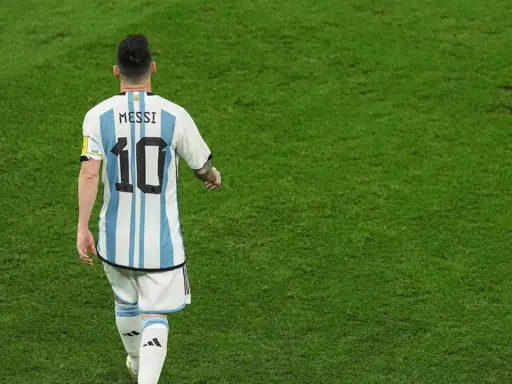
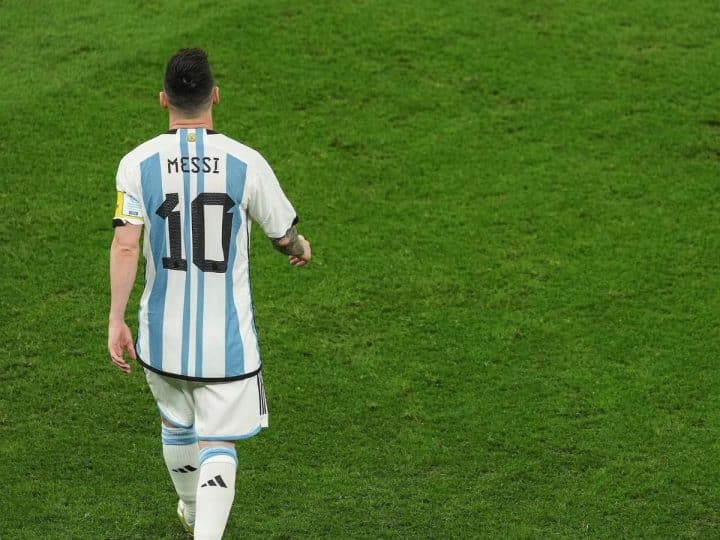
A viewer watching Lionel Messi for the first time might think the Argentine captain has drifted out of the match. He avoids constant pressing and chasing.
Instead, he spends long periods walking or standing to watch his surroundings. This approach defies the high-tempo, continuous pressure demands of modern football.
But behind this image that suggests calmness lies one of the most complex tactical ideas in the game. Walking is no longer just about conserving energy.
It is now part of his philosophy for managing the game. He reads the play carefully before deciding when to act.
This economy of movement allows him to wait for the critical moment where he can make a decisive impact.
FIFA tracking data, featured in a report by The Athletic, shows that Messi walked for 64% of his time during the World Cup.
This was the highest percentage among all outfield players in the tournament. He spent roughly 25% of his time standing or moving very little.
He ran for only 8.6% of the time, compared to the 23% tournament average.
Despite these numbers, the Argentine captain was not far from impact. By the end of the Round of 16, he was a joint-top scorer with eight goals.
He created 15 clear scoring chances and ranked third in touches within the attacking third. He also received the ball 97 times between the opponent’s midfield and defensive lines.
This high rate confirms that low movement does not equate to low effectiveness.
The information gathering phase
In traditional football, walking is seen as being absent from the match events, but Messi deals with it in a completely different way.
When he appears detached from play, he is busy reading defender movements. He monitors gaps between lines to identify players out of position and spaces that will open up later.
Pep Guardiola once noted that Messi spends the match’s opening minutes observing everything. He draws a mental map of opponent movements before he begins exploiting their weaknesses.
Once the ball reaches him, he has already formed a complete picture of everyone’s locations, making the decision-making faster than the defenders’ own reactions.
This philosophy explains why he runs sparingly. He avoids wasting energy chasing the ball, saving it instead for moments when an attack becomes a genuine scoring opportunity.
Many used to explain Messi’s genius by his technical abilities or dribbling skills, but the experiences of the best defenders in the world reveal another side of his superiority.
Raphaël Varane has faced Messi over twenty times. He notes that the hardest part of marking him is not his dribbling, but his positioning where defenders are unsure who should cover him.
He moves calmly between lines into a “gray zone.” Center-backs hesitate to step out, midfielders don’t advance to mark him, and fullbacks refuse to leave their positions.
During these few seconds of hesitation, Messi has already received the ball and started the attack that is difficult to stop.
Former defender William Gallas believes man-to-man marking Messi is a gift. A defender leaving their position simply grants Messi’s teammates the space they need.
Conserving energy
At thirty-nine, Messi no longer has the explosive speed of his early Barcelona days. Instead, he manages his physical effort differently.
Tournament data shows that 71% of his sprints occur in the attacking third. Another 21% end inside the penalty area. He only runs when scoring chances are high.
Every sprint is a calculated decision rather than raw physical effort. Running has become his tool for finishing attacks, not for building them from the start.
This style imposes extra burdens on his teammates, especially during pressing and ball recovery. However, the team seems fully convinced of this trade-off.
Pablo Zabaleta, of the FIFA Technical Study Group, says teammates run more to preserve their captain’s energy. They know his genius can decide a match in a single moment.
That’s why his teammates do not see his lack of running as a burden, but rather as an investment in the player most capable of making the difference.
Messi — Redefining greatness
Modern football long associated the best player with running, pressing, and covering space. Messi presents a completely different model.
Greatness, in his case, is not measured by the number of kilometers he covers, but by the quality of the moment he chooses to move. He doesn’t win matches with a multitude of steps, but with the precision of the single step that changes everything.
Therefore, he might seem, in the eyes of many, outside the match atmosphere, while in reality, he is the player most occupied with the match.
He observes, analyzes, and redraws everyone’s positions in his mind, waiting for the moment to pounce on the appropriate space.
Lionel Messi has turned walking into a smart tactical weapon. This proves that speed of thought is more valuable than foot speed. The calmest player often has the greatest influence.
Featured image via the Canary
By Alaa Shamali
From Canary via This RSS Feed.