

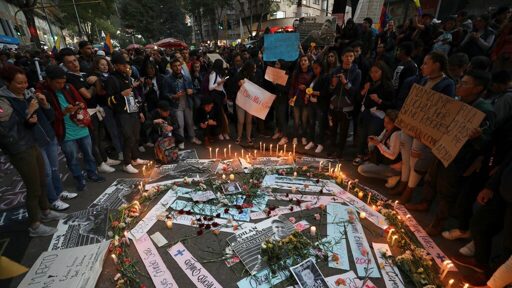
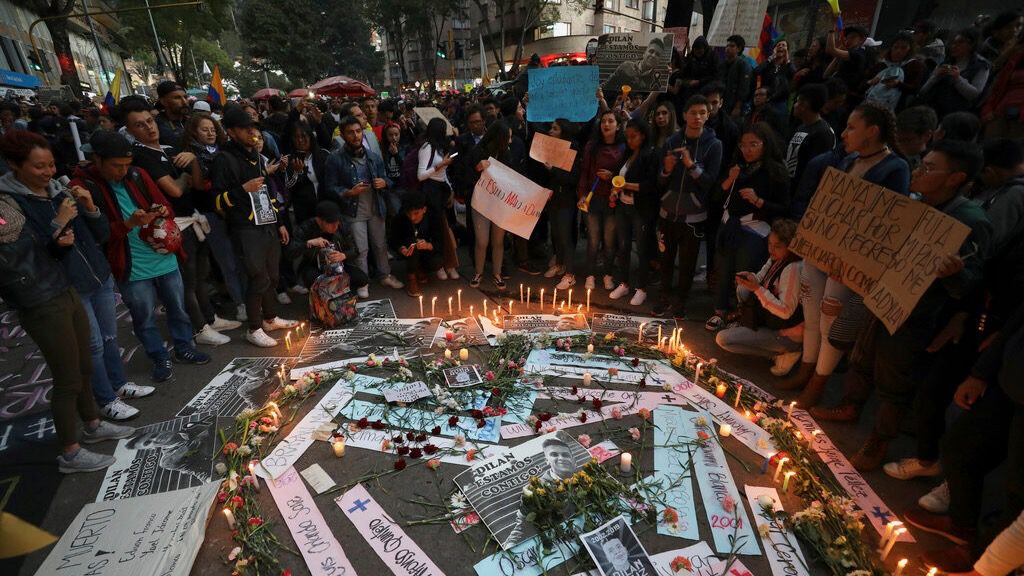
On July 10, the Administrative Court of Cundinamarca in Colombia found the National Police guilty in the death of Dilan Mauricio Cruz Medina, who was 18 years old in 2019 when he was struck in the head during protests in the capital, Bogotá.
The protests, which gained global attention, took place during a national strike between November 2019 and February 2020 against the neoliberal policies of then-President Iván Duque (regarding employment, health care, education, and other issues), as well as the murders of social leaders and various corruption scandals that tarnished the Colombian government.
According to court reports, the ammunition that caused Cruz’s death was a bean bag round fired by an officer of the National Police’s then-Mobile Anti-Riot Squad (ESMAD).
Judge Juan Carlos Garzón stated that there was a serious failure on the part of the ESMAD in the execution of its duties when it told its members that this type of ammunition is “less lethal,” which, the judge said, demonstrated that the police institution had failed. For this reason, the officers were unable to properly assess the use of that weapon.
Furthermore, the court ruled that during the 2019 demonstration (held in accordance with the participants’ legitimate right to protest), in which Cruz was killed, there was no need to use that type of ammunition with “lethal force.” Consequently, the court affirmed that no legitimate protest can ever serve as sufficient justification for violating fundamental human rights, such as the right to life and human dignity.
In addition, the court noted that there are no provable circumstances – as some comments claimed – that would justify such use of violence against the young people, which ultimately cost Cruz his life.
Now, according to the ruling, the Commander General of the National Police, on behalf of his institution, must acknowledge his responsibility in a public ceremony and offer an apology to the family of the deceased young man.
Cruz’s death became one of the most emblematic cases of excessive use of police force during the anti-government protests, in which 3 people died, 250 were injured, and more than 100 protesters were arrested.
During and after these protests, Colombia’s neoliberal model was harshly criticized by various social sectors, which may help explain the victory, years later, of the progressive Gustavo Petro, who proposed a reformist agenda to overhaul a series of neoliberal laws.
Petro’s successor (and political rival), President-elect Abelardo de la Espriella, said during the investigation into Dilan Cruz’s death that his death was “not a murder.” This comes as no surprise, considering that De la Espriella, a renowned lawyer, took on the defense of the police officer under investigation.
Now, De la Espriella, as the future president, has announced that he will dismantle the peace agreements that Petro and his predecessors built to try to end a cycle of violence in Colombia that has lasted for several decades. In contrast, the far-right president has promised a “heavy-handed” approach and to strengthen the neoliberal system to restore the order that he claims was lost under Petro’s government.
BreakThrough News , July 12, 2026
From BT News via This RSS Feed.