

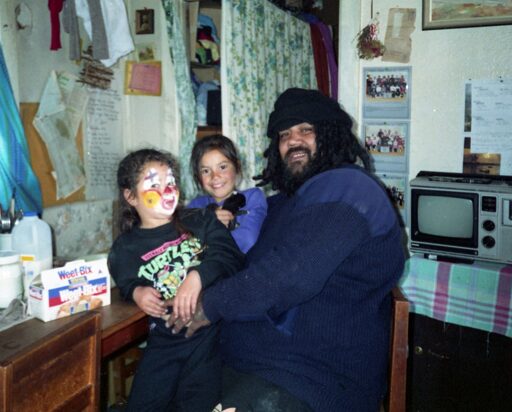

“Matariki was just another ordinary stretch of time where no one spoke about my dad’s death,” writes Haeatarangi Barker, pictured here, on the right, as a child at the family home in Taumarunui. (Supplied)
Learning to celebrate Matariki as an adult brings relief for Haeatarangi Barker.
They say Matariki is a time for reflection, but it never was for me. Matariki used to be a time to gamble with the axe grasped in my eight-year-old hands, splitting wood for a fire that flickered and struggled against the unforgiving cold of a Taumarunui morning.
Back then, it wasn’t called Matariki. It was just winter. Not only the cold, but everything that came with it — runny noses, rosy cheeks, frost that clung to the ground long after sunrise. Trying to brush our teeth with the frozen water tap outside. Huddling around the coal range while waiting while Mum poured hot water from the kettle over the car windscreen so we could actually see where we were going. It was a season that shaped everything without ever being named.
No one gave a shit about the stars in the sky. Matariki was just a constellation on the back of a Subaru. A mere design. I would zone out in traffic, not realising the weight it once held for my ancestors. I didn’t have the language for it. Only the later realisation that it had always been there.
That’s colonisation, I think. The absence. The not knowing. The unspoken loneliness of not being taught to recognise your own world.
Te ao Māori was something I experienced at the marae, but it didn’t come home with me. It came in bits and pieces, not as a way of life but as something we could put on the shelf until the next tangi. I cherished those moments at the marae, it was the one place I felt whole. But te ao Māori sat just beyond the edges of my world. Even as a child, you feel it — the stillness of it all, a quiet that shouldn’t be so quiet, and vibrant colours slightly dulled.

The whānau house, known as “The Bach”, as it looked when Haeatarangi was growing up. It had no running water and was home to five people. (Supplied)
Te reo touched me in fragments — like moments I stepped in and out of. One of the earliest was being cast as Rona’s sister in the Ngakonui school play. But I wasn’t Rona, only her sister. I remember noticing, even then, what it felt like to stand beside a story rather than inside it. And just like that, the curtain closed.
At home, te reo always took effort, as if it belonged more to trying than living. My Pākehā mother tried her best. Making us recite a karakia off a piece of A4 sellotaped on the wall before dinner. One I still know by heart today. At the marae, the nannies would speak to me in te reo, and I’d just smile and hope for the best. It always left me feeling a bit awkward, like I was somehow getting being Māori wrong.
They also say Matariki is a time to remember our loved ones, but it never was for me. Matariki was just another ordinary stretch of time where no one spoke about my dad’s death. A low hum of shared pain no one dared say aloud. We didn’t get to weep outside at the rising of Matariki, and envision his spirit being released by Taramainuku. I didn’t have the safety net of knowing he had become something among the stars. He was just gone.
It might have changed how I learned to carry it.

Haeatarangi (left) with her dad Bill Ellis in the whānau home. (Image supplied)
There was no special hākari, just the grand option of cornflakes or Rice Bubbles in the morning — eaten from plastic bowls that were freshly washed but still tasted like last night’s dinner. Shuffling around in those stupid little loose woolly slippers made by our grandmothers, that seemed like a lot of work for something that could have been solved by wearing two socks instead.
Everything was just so incredibly ordinary.
And honestly, I grew up believing that was just life. I didn’t have time to sit around and think about what was missing. I was busy being a kid, riding my bike up the valley, laughing with my cousins and trying to get out of doing the dishes. I never stopped to question the hollow. But deep down, what felt ordinary to me was just an absence that was inherited.
It was something that was felt, but not truly understood. Not until I had children of my own. Somewhere between my silly woolly slippers and theirs, fresh from the warehouse bargain bin, Matariki had quietly returned. Through their artwork that slowly appeared on the fridge door, the conversations shared over dinner, and the simple fact that this was now just part of their lives.
I still can’t remember the names of the stars without quietly running through that “Macarena” song the kids learn at school. I couldn’t tell you off the top of my head what each star represents. But I can tell you what it felt like to not have the choice. Now I experience it through their eyes. I’m not even envious. I’m relieved.
Relieved they won’t have to make do with bits and pieces and call it enough. Relieved that Matariki won’t just be a Subaru logo to them. Relieved that, to them, the stars aren’t just shiny things in the distance.
Maybe that’s the real gift my children have been given. Not a deeper understanding of Matariki, but the freedom to take it for granted. I think that’s what I’m most relieved about. That, in time, they won’t even realise there was ever anything to miss.
One day, they’ll come home and roll their eyes about having to sing the same songs at the school’s Matariki concert. Throw their crumpled artwork in the bin. Moan about having to get up early for hautapu. Whinge about having to kiss that aunty with the smoker’s breath one extra time a year.
And honestly, I hope they do.
Because it’ll mean Matariki has become wonderfully ordinary.
And maybe that’s enough. Nothing dramatic. Just realising that what I’d been missing all along wasn’t Matariki itself, but the chance for it to follow me home.

“They have a very different upbringing to me,” says Haeaterangi about her children, Wiri (left) and Tarati, who attend Te Wharekura o Rakaumangamanga. (Supplied)
Haeatarangi Barker is a poet, writer and storyteller of Ngāti Maniapoto, Ngāti Tūwharetoa and Te Aupōuri descent who explores Indigenous perspectives through stories of identity, belonging and everyday life.
The post Matariki: Stolen from me but returned to my children appeared first on E-Tangata.
From E-Tangata via This RSS Feed.