


The long-range ballistic missile launched last week from a Chinese nuclear-powered submarine in the South Pacific on July 6, 2026. (CCTV via RNZ)
China’s launch of a missile in the western Pacific last week coincided with the marking of two anniversaries of nuclear testing in the Pacific — events with devastating and ongoing consequences for Pacific Islanders. It was an unwelcome reminder, if any were needed, of how the Pacific continues to bear the brunt of great-power politics, as Jamie Tahana writes.
Last week, a missile was launched from a Chinese submarine somewhere below the western Pacific. A black cylinder pierced the ocean’s surface, trailed by an orange flash as it arced across the skies over Micronesia, before splashing down to the northeast of the Solomon Islands.
The test of a long-range intercontinental ballistic missile was, according to Beijing, routine, with a foreign ministry spokesperson saying other countries should “refrain from overinterpreting them”. That was little comfort for the leaders of the Pacific, a region that has borne the brunt of “routine” military testing for decades.
“China is a good friend of Solomon Islands,” said Solomon Islands prime minister Matthew Wale. “But this is not something a friend does.” The leader of Papua New Guinea, James Marape, said: “Our region has lived through war, nuclear testing and military activities imposed upon us by larger powers. We do not want history repeated.”
Beijing said the missile was fitted with a dummy warhead and there was no detonation. But the intent was clear. The foreign ministry statement may have been muted, but analysts say there’s little doubt that it was a display of China’s growing nuclear capabilities. State media was more braggadocious. “Our national nuclear triad had another upgrade,” wrote the Global Times. “The Liberation Army’s sea-based nuclear force is capable of carrying out stable, reliable strategic counterstrikes from anywhere in the vast open seas of the Pacific Ocean.”

“China is a good friend of Solomon Islands, but this is not something a friend does,” said Matthew Wale, prime minister of the Solomon Islands. (Photo: Pacific Islands Forum)
There’s no hint in these statements that any thought was given to how the people of the Pacific may have felt about the testing of nuclear weapons in their waters, nor any recognition of the history and devastating impact of such testing in the region.
“No nation understands the weight of nuclear testing in our waters better than ours,” said Hilda Heine, the president of the Marshall Islands. “We do not raise this history lightly, nor do we invoke it for rhetorical effect.”
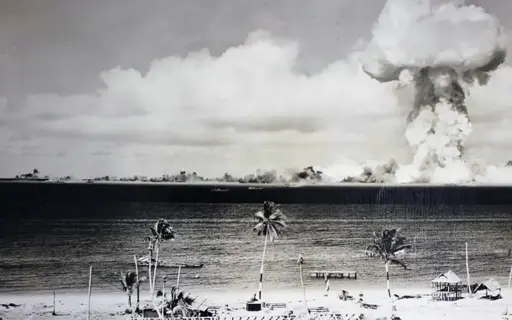
China’s missile test came just days after the 80th anniversary of the first nuclear test in the Marshall Islands, when the US dropped a warhead into the lagoon of Bikini Atoll on July 1, 1946 — an event locals describe as “the day the sun exploded”.
The Americans had appealed to a sense of Christian duty “for the good of mankind” when they asked the people of Bikini to leave their homeland, promising it would only be temporary. The elders still cried as 167 residents boarded the boat and were ripped from the shores of their ancestors, relocated to a small, desolate island where many nearly starved. In 1948, they were moved again, and then again. Eighty years on, the people of Bikini are still ruptured from their home, a once bountiful paradise of breadfruit, coconuts, and watermelon.

The Able US nuclear test at Bikini Atoll on July 1, 1946. (Source: US National Archives)
Between 1946 and 1958, the US would detonate 67 bombs on the atolls of Bikini and Enewetak. The Marshallese leader Tony de Brum, who died in 2017, once described how, as a child, he witnessed the sky turn “completely red”. It was the morning of March 1, 1954. He was nine years old, fishing for mackerel with his grandfather.
“It was not a boom. Atomic and hydrogen bombs don’t do that. They don’t boom. They rumble. Like thunder,” he said. “It was like someone had put me and my grandfather in a glass bowl and poured blood in it. The beach was red, the ocean was red, the fish in my basket was red.”
It was the Castle Bravo test. The most powerful bomb ever developed, it was one thousand times the strength of the bomb dropped on Hiroshima. It vaporised entire islands, and the explosion was visible more than 400 kilometres away, releasing a radioactive plume that spread across many of the surrounding islands. They say the radioactive fallout was so thick that many Marshallese, having never seen snow, thought it was snowing. Children played in it.
The people of nearby Rongelap were evacuated two days after the tests, but it was already too late for those whose hair was falling out and whose skin was burned. Three years later, the people were urged to return to Rongelap, with US government documents weighing the hazards of exposure against “the current low morale of the natives” and a “risk of an onset of indolence”. They decided to go ahead with resettlement so scientists could study the long-term effects of radiation.
“Data of this type has never been available,” Merrill Eisenbud, an official with the Atomic Energy Commission, said in 1956. “While it is true that these people do not live the way that Westerners do, civilized people, it is nonetheless also true that they are more like us than the mice.”
Cancer cases, miscarriages and deformities multiplied on Rongelap. By 1967, 17 of the 19 children who were younger than 10 on the day Bravo exploded had developed thyroid disorders. The rate of miscarriages in the wake of the tests is without parallel. And that is to say nothing of the birth abnormalities that forced Marshallese women to devise a new language for the things they’ve seen. “Jellyfish babies”, for one — babies born without bones and with translucent skin.
The Marshallese poet, Kathy Jetñil-Kijiner, in her 2018 work Monster, wrote:
Sometimes I wonder if Marshallese women are the chosen ones.
I wonder if someone selected us from a stack. Drew us out slow. Methodical. Then, issued the order:
Give birth to nightmares. Show the world what happens. When the sun explodes inside you.
When asked about the effect on the Marshallese, the US Secretary of State Henry Kissinger had this to say: “There are only 90,000 people out there. Who gives a damn?”

In May 1985, the crew of the Rainbow Warrior helped 320 Rongelap Islanders relocate to another island, Mejatto, to escape the ravages of US nuclear testing. Pictured, Rongelap women on arrival in Mejatto with Rainbow Warrior crew member Bunny McDiarmid. (Photo: David Robie)
Arundhati Roy once wrote that nuclear weapons “bury themselves like meathooks in the base of our brains,” pervading our thinking. “They are the ultimate coloniser.”
These sites in the Pacific were chosen as ground zero because of colonial narratives that portrayed them as small, remote, and unimportant.
It was a belittling attitude of irrelevance that ignored the existence of people with thousands of years of traditions, skills and knowledge born from intimate ties to the land and sea. The master navigators of the greatest ocean, the gardeners who could craft a bounty from the most inhospitable of environments, the storytellers who transmitted deep histories, to the lovers and the children who called the isles home. Power cares little for humanity.
It was those same attitudes that led the French to seal off the islands of Moruroa and Fangataufa 60 years ago this month. Not long before dawn, on July 2, 1966, a barge anchored in the middle of the lagoon at Moruroa exploded. With more than 28 kilotons of force, it vaporised the azure lagoon, launching a cloud that rose several kilometres higher than expected, before raining down dead fish and shattered coral.
The president of France, Charles de Gaulle, called the explosion “beautiful”. He farcically claimed the bomb was “very green and very clean”. The southwesterly winds carried the fallout, blowing the radioactive cloud over Mangareva, 450 kilometres away. The French overseas minister was evacuated quietly. None of the locals were told a thing. It was the horses that died first, locals recalled, then the lagoon fish started to go belly up.
In 1990, a Greenpeace researcher, Michael Szabo, published a book called Testimonies, a collection that details how specialists wore protective clothing while locals tasked with collecting dead fish from the beaches were given nothing. There was a local whose son was born without a kidney. Another whose skin peeled like a snake.
The cloud from one test, in July 1974, unexpectedly drifted across Tahiti, some 1,200km away. Some researchers say 90 percent of the population in the 1970s were exposed to high blasts of radiation. The rates of thyroid, breast and lung cancers, as well as leukaemia and lymphoma in Mā’ohi Nui today are unparalleled, and many contend that government records massively undercount the true toll.
Moruroa, in the Pa‘umotu language, means place of great secret, an apt description of the veil of secrecy under which France conducted its 167 tests before they finally ended in 1996. Not long after they began, public health statistics started to disappear from the Journal Officiel. Recently declassified military documents show alarming levels of radiation on many islands, including Mangareva where, two months after the July 1966 detonation, radiation levels in rainwater were 11 million times higher than normal.
Other documents showed that officials worked to minimise the level of fallout, while public reports completely omitted some data. Last year, it was revealed that the French Atomic Energy Commission had spent tens of thousands of euros on a campaign to counter research showing that Paris consistently underestimated the devastating effect of its tests.
The French government maintained that its tests were clean and caused no ill effects until 2010, when it finally instituted a compensation scheme with a burden of proof that was almost impossible to reach. When he visited Tahiti in 2021, Emmanuel Macron said France owed a “debt” to the Polynesians, finally acknowledging that the tests were not clean, and promising to further open the archives and accelerate compensation. Yet after 60 years of lies and gaslighting, no one really believes them.
Today, the golden sand of Bikini Atoll is still laced with plutonium, the water poisoned with strontium, and the crabs riddled with dangerous levels of cesium. Moruroa remains off-limits, a desolate land pockmarked with craters and scorch marks. Studies have shown a fragile atoll that remains at risk of collapse, and there are growing concerns that rising sea levels leave it even more vulnerable.
In the 1970s, the US military scraped plutonium-tainted soil into a 33-foot-deep crater on the island of Runit, before sealing it under a concrete dome the locals call “the tomb”, which sits like a UFO parked at the end of the barren atoll. Now, rising seas nibble ever closer to the dome’s edge, threatening to release its contents into the ocean.
In his 1997 essay The Ocean is Us, Epeli Hau‘ofa wrote that the struggle against “the wall of death driftnetting” solidified a collective identity opposed to great-power games. He pushed back against scholars and diplomats and their belittling notion of the Pacific as a wayward backwater, a disparate group of islands in a distant sea, not of peoples with a proud and deep history that spans the ocean — a body of water that unites rather than separates.
What wasn’t bombed to smithereens was the determined will of people to defend their homes and uphold their inherent right to exist as a people on their islands. But decades after those first tests, Pacific peoples still live with the devastating consequences in their lands, their waters, and their bodies.

“No nation understands the weight of nuclear testing in our waters better than ours,” said Hilda Heine, the president of the Marshall Islands. (Photo: Office of the President and Cabinet of the Marshall Islands)
Whether these anniversaries registered with Beijing last week is unknown, though history suggests great powers care little for our humanity. It’s why the region was so provoked by the test. When Hilda Heine wrote: “We call on China — as we have called on every nuclear power before it — to explain its intentions in language as clear as the harm such tests can cause,” the unresolved history of bearing the brunt of great-power politics rang through.
Both Washington and Paris show little willingness to properly address their legacies. Decades of demands for an apology to the people of the Marshall Islands, Mā‘ohi Nui, and Kiribati, where the British tested their nuclear weapons, have fallen on deaf ears. Many cynically assume they’re holding out for the victims to die off.
Late last year, Donald Trump said the US — which still fires long-range missiles into the Marshall Islands — might look to resume nuclear testing. French president Emmanuel Macron, having proclaimed his “debt” to the Pacific, this year spoke of expanding his arsenal, saying, “the next 50 years will be an era of nuclear weapons”. China’s leader Xi Jinping has proclaimed his determination to build an upgraded suite of nuclear weapons.
With a history that still lingers so powerfully today, it’s little wonder the Pacific sees such a buildup as a threat.
Jamie Tahana (Ngāti Pikiao, Ngāti Makino, Tapuika) is a journalist and broadcaster who has worked in both Aotearoa and the Pacific. He grew up between his Dutch mother in the Hutt Valley, Wellington, and his Te Arawa dad in Rotorua. He has a master’s degree from Te Herenga Waka Victoria University and was the Māori news editor at RNZ until May 2023.
The post This is not what friends do appeared first on E-Tangata.
From E-Tangata via This RSS Feed.