

By William Serafino – Jul 9, 2026
The devastation in the Venezuelan coastal state of La Guaira caused by the June 24 double earthquake seems to be confirming, once again and to almost no one’s surprise, that US “humanitarian aid” always comes with conditions written in fine print—so fine that they often escape public scrutiny. In that fine print, lobbies, economic interests, and projects of resource accumulation are mixed within the framework of disaster capitalism, where catastrophe represents a quick and juicy opportunity for private profit.
The tour by Global Empowerment Mission
The Global Empowerment Mission (GEM), an official partner of the US State Department in disaster response, is based in Doral, Florida, and was founded in the wake of the deadly 2010 earthquake in Haiti. The entity defines itself as a humanitarian aid organization with over 300 missions abroad in disaster contexts and an active presence in Europe and the Caribbean.
The fact that Haiti is GEM’s foundational milestone is not a minor detail, given the extensive evidence that US aid destined for Haiti led to one of the most notorious cases of corruption and influence peddling in disaster management and reconstruction. Now-defunct USAID was at the center of this sinister plot of economic instrumentalization of death and social collapse.
After the earthquakes that shook Venezuela, GEM quickly mobilized and received public endorsement from the Trump administration. In an official document on the response to the earthquakes, the US State Department praised the organization and designated it as one of the key players in US diplomatic efforts, alongside the Walmart corporation.
On June 25 itself, GEM had already begun collecting supplies in Miami and sent a team to Venezuela to settle in La Guaira. Their aim was to channel “resources from the American private sector and donations from the Venezuelan-American diaspora,” according to a report by ShareAmerica.
Entry and presence in Venezuela
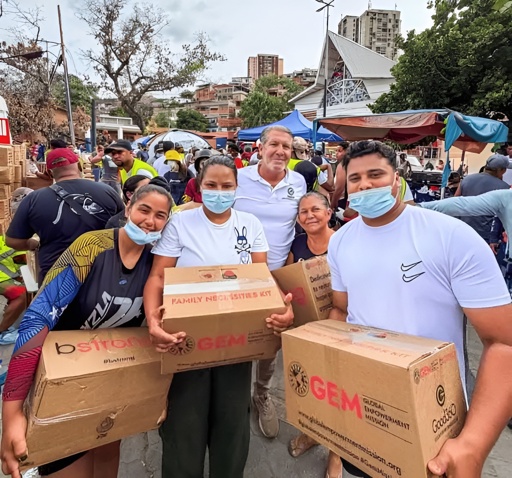
Through an intensive communication and advertising campaign, GEM has sought to establish itself as the main symbol of US aid in Venezuela. Since June 25, the organization has formed alliances with CBS Miami, Neighbors 4 Neighbors, the Inter Miami CF Foundation, the NFL’s Miami Dolphins, Televisa/Univision, and Goya Foods to promote its activities. It has also involved political figures, such as Miami-Dade Mayor Daniela Levine Cava and Florida Republican Senator Ashley Moody, in its collection events.
Moreover, an event to collect donations and supplies was organized by GEM at the iconic El Arepazo in Doral, a Venezuelan restaurant that has served as a meeting center for far-right political conspiracies and that Trump visited in March.
On its social media, GEM has published posts that could easily fall into the genre of misery porn, visually and narratively exploiting the difficult situation faced by the earthquake-affected people in La Guaira. The posts show long lines of people waiting to receive boxes bearing GEM’s seal accompanied by the US flag. They have also shared stories of Venezuelans clearly shaped to create a perception of orphanhood and neglect to which only Washington is responding quickly and effectively via GEM.
The advertising strategy aimed at highlighting the organization’s manufactured heroism and selflessness has also received support and promotion from the State Department’s social media accounts. This promotion is a media materialization of the official association between the two.
On July 6, GEM reported that it had delivered $2.5 million in supplies and claimed to have supported more than 20,000 affected people through its delivery centers in La Guaira in the first days of operations.
However, its activities are not limited to delivering kits containing basic products. The entity is trying to establish a permanent presence in Venezuela under the premise of monopolizing US humanitarian aid and taking advantage of the economic opportunities arising from the tragedy.
Recently, GEM announced that it will establish a permanent headquarters for Latin America in Caracas and will focus on delivering supplies over the next three months, relying on the deployment of US military forces. Thereafter, it will prioritize “long-term recovery,” with “the development of housing solutions for displaced families, the reconstruction of educational centers, and the promotion of community initiatives,” according to a note from Funds Society citing communications from GEM.
From here on, things get ugly
Before GEM announced its long-term goals, what was on the horizon was a classic mix of US soft power and the absorption of donations with corporate overtones.
In the media handling, the situation was not surprising either: being from Doral, GEM’s political bias was to be expected in both the donation advertisements and the narrative framework of the audiovisual recording. These materials were specifically adapted for the media consumption of a far-right diaspora eager to see images of Venezuelans abandoned by the Venezuelan government.
However, the dimension of reconstruction and participation in housing projects is not a matter to be taken lightly. Firstly, this is due to those who lead GEM: Michael Kesti and Michael Capponi, the latter of whom is the founder and president. Kesti is a lobbyist for the Government Relations Group, a company dedicated to lobbying in the US government. According to its own website, the company enables its private-sector clients to obtain licenses from government entities and offers high-level access in Washington as one of its flagship products.
Within GEM, Kesti leads government relations initiatives
Kesti has a photograph with now-US Secretary of State Marco Rubio and uses it on the company’s website to showcase the access and influence peddling that the company claims to provide to businesses.
In 2013, a Miami Herald report characterized Kesti as a lobbyist with “ties to the healthcare industry and a long history of civic involvement in South Miami-Dade.” Additionally, the lobbyist had been an informant for the FBI in a local corruption case during that time.
Throughout his career, Ketsi has led health foundations in Miami, served as a consultant for firms in the healthcare sector, and, according to a Texas lobbyist registry, has lobbied for various companies in the electricity, minerals, and mining sectors. The record also shows that he represents “Nobilia North America, INC before the Texas Legislature,” a company that manufactures home kitchens.
After GEM’s arrival in Venezuela, Kesti declared that “GEM will be the distribution center and coordinator throughout Venezuela.”
As for Capponi, humanitarian initiatives are instrumental to his real estate vocation. The president of GEM belongs to the real estate and nightlife sectors. In 2013, Haute Living magazine placed him among the 100 most powerful people in Miami and described his business profile as follows: “Since 2010, Capponi Construction Group, LLC, has completed multiple building types, including new construction, renovations and the historic rehabilitation of private residences, estates, condominiums, high-end commercial projects, shopping centers and hotels.”
María Corina Machado Tries to Fish in Troubled Waters Following Venezuela Earthquakes
It is evident that by combining a “humanitarian” entrepreneurship initiative with successful lobbying in Washington, Capponi secured a broad window to expand his housing construction businesses, leveraging US geopolitical power and its soft-power devices as a lever of influence. Haiti was the first major boost to his business expansion, operating 3,000 tents and building over 20 homes in the devastated country.
In the context of the war in Ukraine, for example, GEM obtained government contracts to repair streets, schools, and clinics, which shows the strategic links between US imperial geopolitics and the transfer of wealth to US companies. Moreover, Capponi is a partner of Richard Branson, the British entrepreneur who lined his pockets by organizing the “Venezuela Aid Live” concert in Cúcuta in 2019.
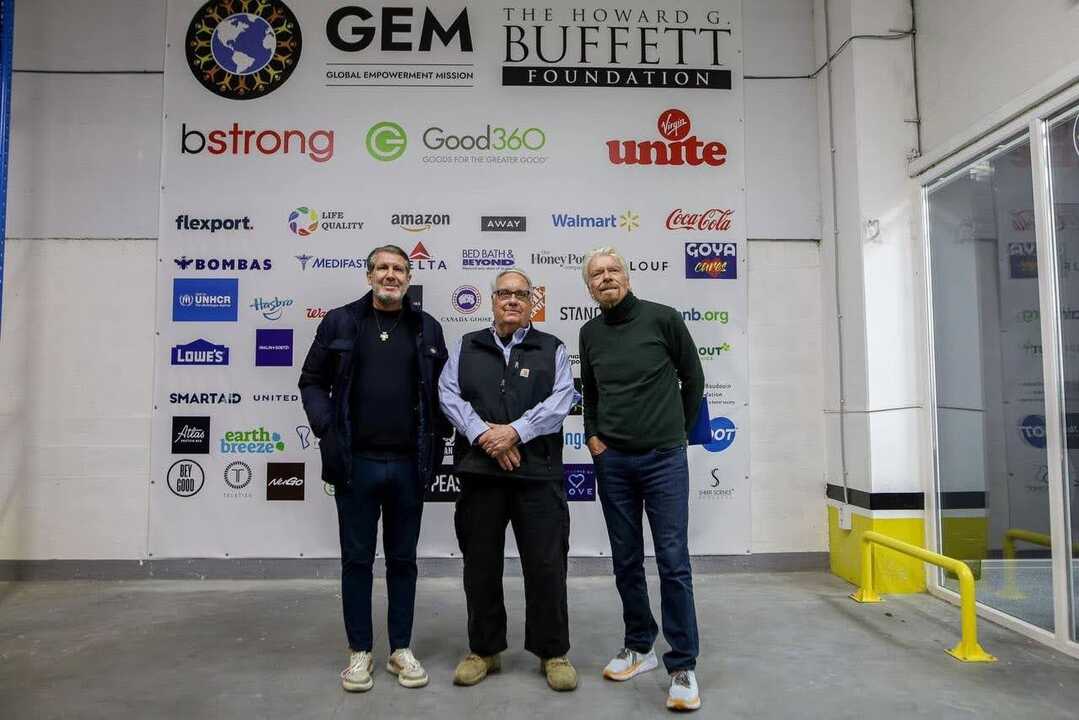
GEM President Michael Capponi with his business partners Howard G. Buffett and Sir Richard Branson. Source: latifundist.com.
Being a real estate entrepreneur focused on nightlife in Miami Beach, the president of GEM was bound to be on the radar in the Epstein case. In an anonymous complaint to the FBI declassified by the US Department of Justice, Capponi is accused of transporting underage models to “casting parties” at Trump’s residence, Mar-A-Lago, in the 1990s.
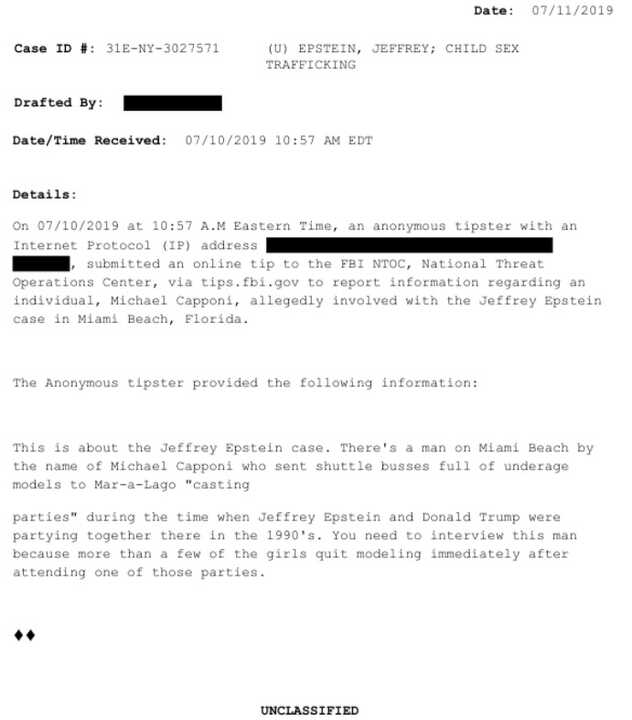
Anonymous complaint against Capponi in the Epstein Files, declassified by the US Department of Justice.
What happens when you combine a longtime lobbyist, a construction businessman who commercially exploits disasters, devastation in a coastal state oriented toward tourism, and a country geopolitically imprisoned by an imperial corollary issued, in turn, by a real estate mogul who holds the presidency of the US?
Logically, the sum concludes in a unique opportunity for capital accumulation through reconstruction and the transfer of wealth from the bottom up. The vulnerabilities of Venezuela, with its sovereignty compromised, represent an incentive that must be seized, and seized quickly.
While Kesti does his job, Capponi appeared in Venezuela, participating in the delivery of boxes of supplies. In every collapsed building, in every mountain of rubble, he was most likely observing an opportunity to turn pain and dispossession into dollars for his bank account.
GEM’s explicit intention to be involved in the reconstruction in Venezuela poses risks of imposing a commercial and extractivist orientation on tourism and real estate on the future (post-disaster) vision of La Guaira. This possibility would economically harm a state and a country whose revenues are being plundered by Trump, who might see in the Venezuelan coastal state and other areas of the country an alternative route to the dystopian tourist complex that he dreams of for Gaza.
Translation: Orinoco Tribune
OT/SC/SF
From Orinoco Tribune via This RSS Feed.