

Venezuela earthquake reconstruction is declared a sovereign task, as Caracas rejects coordination with Colombia’s president‑elect and insists recovery will be led by its own state.
Related: 4 Powerful Lessons teleSUR Venezuela Earthquake Coverage Brings From the Epicenter
Venezuela earthquake reconstruction has become a central political and diplomatic issue after comments by Colombia’s president‑elect Abelardo de la Espriella about rebuilding the Caribbean nation after the recent quakes. The Venezuelan government responded with surprise and firmness, stressing that the recovery, reconstruction and long‑term development of the affected areas are the exclusive responsibility of the Venezuelan state.
Venezuela earthquake reconstruction and the response to Abelardo de la Espriella
The Government of Venezuela expressed its “perplexity” at recent statements by Colombia’s president‑elect, Abelardo de la Espriella, who argued that the reconstruction of Venezuela after the earthquakes “must be carried out by his country with all that this implies.” These remarks were quickly addressed in an official message released in Caracas.
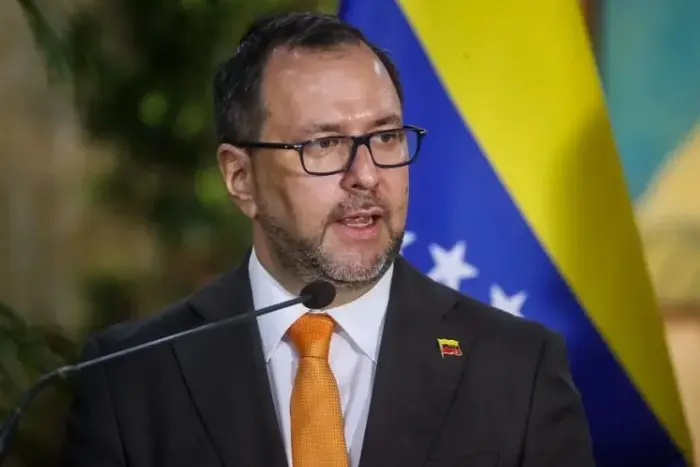
In a communiqué shared via Telegram, Venezuelan Foreign Minister Yván Gil said that “the Venezuelan Government reaffirms that it is exclusively up to the Venezuelan State to lead, plan and execute the process of recovery, reconstruction and integral development of the areas affected by the recent double seismic event in our country.” With this statement, Venezuela earthquake reconstruction is framed as a sovereign process, not one to be externally directed.
The document stresses that the Venezuelan state has activated all its national capacities, including institutions, domestic industry, public and private companies, and the necessary technical and professional talent to carry out the reconstruction effort on its own. The emphasis is on internal resources and structures already mobilized since the quakes of 24 June.
At the same time, the text notes that, “if necessary,” the Bolivarian Government will establish cooperation alliances with international public and private companies that can contribute to recovery and reconstruction work in the country. In other words, Venezuela earthquake reconstruction may involve external partners, but always within a framework clearly led and defined by Venezuelan authorities.
The communiqué then makes a political point: “For this reason, it makes very clear that, as of now, no articulation whatsoever is foreseen with the elected government of Colombia.” This sentence formally rules out, at least for the moment, any structured coordination with De la Espriella’s administration in Bogotá.
The message concludes with thanks to governments, international organizations and sister peoples for the many expressions of solidarity and support received by Venezuelans since 24 June. Here, Venezuela earthquake reconstruction is linked to a broader network of humanitarian and diplomatic backing, while drawing a clear line regarding who directs the process.
- Government of the Bolivarian Republic of Venezuela – Foreign Ministry
- Venezuelan Civil Protection and Risk Management
Venezuela earthquake reconstruction, sovereignty and regional tensions
The official note comes at a time when Venezuela continues to deal with the human and material consequences of the double earthquake of 24 June, which left thousands of dead and injured and severe damage in several states. Venezuela earthquake reconstruction is therefore not only a technical matter but a national priority, tied to social stability and long‑term development.
Within that context, the idea that another country would “do” Venezuela’s reconstruction “with all that this implies” touches sensitive questions of sovereignty. From Caracas’ perspective, allowing an external government to lead or frame the reconstruction process could be interpreted as limiting national authority over territory, institutions and resources.
The statement clarifies that cooperation is welcome, but direction is non‑negotiable. It reaffirms that any foreign support must operate under Venezuelan leadership, whether through multilateral agencies, friendly governments, or private actors, and that Venezuela earthquake reconstruction will not be subordinated to an external agenda.
The same day, regional politics remained tense. In a separate development referenced in local media, Colombian leader Gustavo Petro denounced alleged electoral fraud in polling stations abroad, showing that Colombia’s internal political scene is itself contested. In that climate, Venezuela’s decision to keep distance from De la Espriella on reconstruction issues also reflects caution about anchoring a critical domestic process to a neighbour’s polarized transition.
The closing thanks to “governments, international organizations and brotherly peoples” underscores that Venezuela values global solidarity while insisting that responsibility for rebuilding lies at home. Venezuela earthquake reconstruction is thus presented as both a national undertaking and an international story of support, but not of tutelage.
- United Nations Office for the Coordination of Humanitarian Affairs
- Pan American Health Organization – Disasters
Geopolitical context
Venezuela earthquake reconstruction has immediate humanitarian dimensions and deeper geopolitical implications. Natural disasters often open windows for external intervention, financial schemes or political influence disguised as aid. By reacting firmly to De la Espriella’s statement, Caracas signals that rebuilding will not become a vehicle for reshaping its political order from outside its borders.
This stance also fits into a longer tradition in Latin America of defending non‑interference and self‑determination, even in moments of hardship. Countries may welcome teams, supplies and technical expertise, but they seek to maintain control over planning priorities, legal frameworks and social outcomes. Venezuela earthquake reconstruction becomes a test of that principle under extreme pressure.
At a regional level, the episode may influence how other governments speak about post‑disaster recovery in neighbouring states. If offers of “doing” another country’s reconstruction are perceived as overstepping, future messages may lean more toward supporting nationally led plans rather than proposing externally directed ones. That could reshape the language of solidarity in the Americas, especially in an era of recurring climate‑related emergencies.
Ultimately, how Venezuela earthquake reconstruction unfolds will matter not only for the communities directly affected by the quakes, but also for debates about sovereignty, cooperation and the boundaries of regional leadership. If Venezuelan institutions succeed in steering the process while integrating constructive international assistance, the country will strengthen its argument that even in the face of catastrophe, it can rebuild on its own terms.
From teleSUR English via This RSS Feed.