

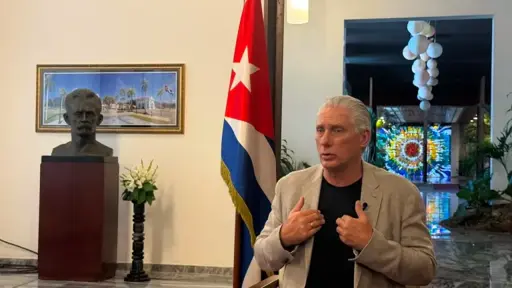
This coversation with the Cuban president is part of the research for a new documentary produced by Brasil de Fato
The hallways of the Palace of the Revolution in Havana, the capital of Cuba, are empty. Outside, the government is touring municipalities and neighborhoods across the island, maintaining direct contact with a population that faces various difficulties in their daily lives.
Today President Miguel Diaz Canel welcomes Brasil de Fato shortly after returning from one of these walks—which are part of his administration’s routine—during which he talks with residents and listens to their demands, concerns, and proposals. As he settles in for the interview—which is part of a documentary that BdF is producing—he explains that, in addition to these engagements in the capital, he visits a remote region in the island’s interior every month.
At the time of the conversation, the Revolution is going through one of the most difficult periods in its history. Since the end of January of this year, Washington has intensified its aggressive measures by threatening any country that sells or supplies oil or fuel to the island and by expanding, in an unprecedented manner, the extraterritorial reach of the blockade. These measures have exacerbated the economic war that Cuba has been facing for more than 60 years.
“You can see how the Cuban people are reacting. No blackout can extinguish our will, nor can any shortage destroy our hope,” he says.
“And the people, at the community level, organize themselves. So, even though there is no transportation, every day doctors, nurses, and other health professionals arrive at their workplaces and, even without electricity, treat their patients. Teachers give classes even without electricity, and farmers plant and produce food even without fuel. This is the image of this heroic and creative resistance of the Cuban people.”
Devoid of any legal basis, the energy blockade imposed by the United States has a devastating impact on every aspect of daily life for the Cuban people and causes incalculable damage to the country’s economy.
Prevented from importing oil and fuel, the island has been forced to rely on its limited domestic production. In this context, energy supplies have had to be rationed to ensure the functioning of the most critical sectors, such as healthcare and food production. At the same time, the country is accelerating its transition to renewable energy sources, particularly solar photovoltaics, as a strategy to mitigate the effects of the aggression perpetrated by the White House.
Regarding relations with the U.S., Díaz-Canel was emphatic in stating that he intends to keep the door open for dialogue, but stressed that the country’s sovereignty is a principle that the Cuban government is not willing to yield or negotiate.
“Dialogue and conversation are one thing; negotiation is another. We have always defended this; this is the history of the revolution. Throughout the revolution, we have always advocated for the possibility of having a civilized relationship with the United States and for resolving our bilateral differences through dialogue, while acknowledging that we will have ideological differences,” stated the president, emphasizing what he intends to pursue in any future talks with Donald Trump.
“But always under the principle that our political system, our sovereignty, and our self-determination are non-negotiable—not even at the negotiating table. And it must be on equal terms. You cannot talk, engage in dialogue, or negotiate under pressure. We are not a nation in dispute; we are not a colony, nor are we a possession for anyone to take over. We are a sovereign, independent, and free nation that, by a majority decision, has embarked on a process of socialist construction amid such adverse conditions,” says the Cuban leader.
The Accumulation of the RevolutionAfter 13 days in the Caribbean country, the Brasil de Fato report documented pot-banging protests on two nights of blackouts. People’s exhaustion is evident. The power outages, combined with the economic stranglehold, affect daily life, forcing the population to make real efforts just to meet their most basic needs.
On the streets, the overwhelming number of Cubans say the country’s situation is the result of the blockade imposed by the U.S. government. For Díaz-Canel, this view stems from the legacy of the socialist revolution in the country.
“The immense social achievements of the revolution have opened new horizons for the people. Therefore, they know what is lost when the revolution is lost. And that is why these convictions are expressed in such a popular way—where you meet a farmer and he says, ‘I’d give my life for the revolution; I’ll do it,’” the president comments.
Finally, Díaz-Canel says he will seek peace with the U.S. and called for an end to military threats. “What we should strive for is a better world—a world where multilateralism prevails, where the philosophy of plunder, the philosophy of war, threats, sanctions, and unilateral and coercive blockades are eliminated.”
(Resumen Latinoamericano – English) by Gabriel Vera Lopes, Igor Carvalho and Rodrigo Chagas
From Orinoco Tribune via This RSS Feed.