

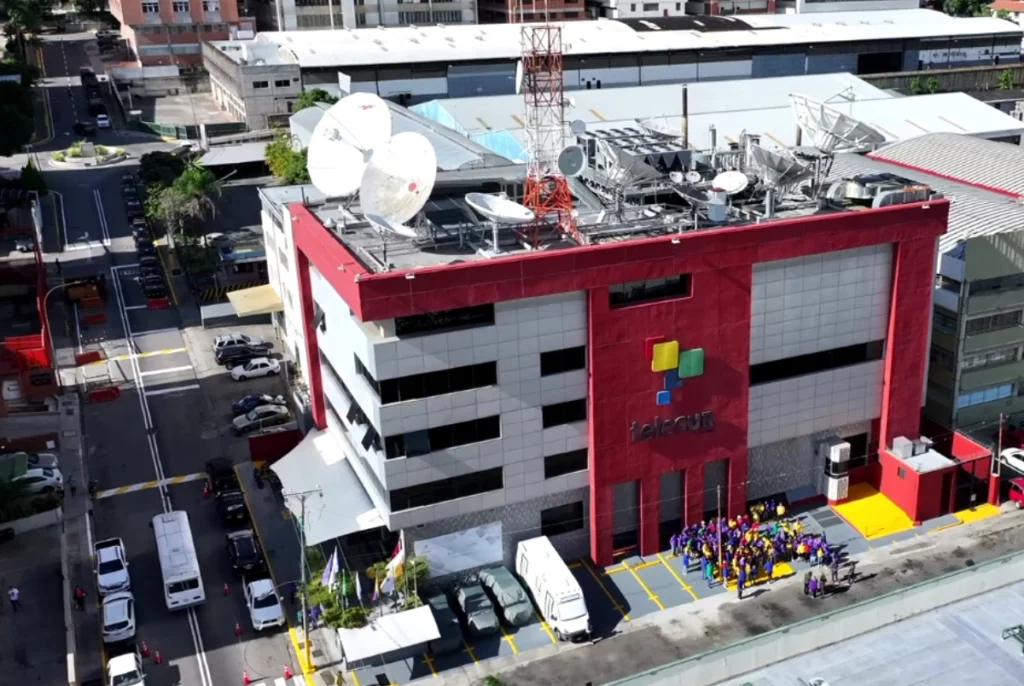
teleSUR Venezuela earthquake coverage follows reporters living the double quake in Caracas, fighting disinformation while telling stories of pain, rescue and national reconstruction.
Related: Venezuela Launches Housing Census for Quake-affected to Guarantee Solutions
teleSUR Venezuela earthquake coverage began in the very moment the double earthquake shook the channel’s headquarters in Caracas, turning the newsroom itself into part of the story. The report “Rigor at the Epicenter” describes how journalists, camera operators and correspondents had to process fear, personal loss and professional duty at the same time, as the country faced one of the most devastating seismic events in its history.
teleSUR Venezuela earthquake coverage: reporting from a shaken newsroom
The double earthquake struck teleSUR’s Caracas offices not only physically, but professionally, as staff realised a complex live operation would begin minutes after the first tremor at 18:04 on Wednesday, 24 June. Cameras were switched on and correspondents activated with the instinct of those who know that information does not wait, even when their own families may be at risk.
This time, the story was not distant. The epicenter was at home, and the news had crossed the threshold to sit with journalists in the newsroom. Presenter Paola Pérez remembers that “once the two earthquakes passed — at first we did not know they were two — fear undoubtedly took hold of most colleagues. Something natural, something normal. But we had to get a live broadcast out. The first thing we did was send a camera outside.”
The feature “Rigor at the Epicenter” recounts how teleSUR Venezuela earthquake coverage unfolded after the quakes on 24 June 2026. Journalist Emily Caro tells in first person how those who were informing and narrating stories were themselves living through the disaster, walking streets filled with rubble while trying to keep the signal on air.
From that moment, the special coverage titled “Venezuela Will Be Reborn” took shape. It deliberately went beyond casualty figures and material losses, focusing instead on stories of families, survivors and those who assumed the task of embracing, in every sense, the people affected. teleSUR Venezuela earthquake coverage thus shifted from pure statistics to a deeply human perspective.
teleSUR Venezuela earthquake coverage: pain, disinformation and a united country
Reporter Madeleín García admits that the first image that came to her mind when she felt the quake was teleSUR’s coverage in Haiti and Türkiye. She recalled stories of truncated dreams and lives cut short by nature, and asked herself how to tell that same kind of story now that the disaster had reached Venezuela. The mirror had turned back towards the network and its own people.
Even as everyone remained tense and tried to process what had happened in those seconds, teleSUR launched a special coverage that is still active. Journalist Yunarkis Páez, described as having nerves of steel, never left the station. “My family is calling me,” she recalls telling operations staff. “Tell my family that I am fine, that nothing has happened to me.” Together with colleagues, she helped open the signal for a coverage that continues today.
Presenter Aaron Romero tried to reach his wife without success. “When she saw me on television, that was when she found out I was fine,” he recounts, followed by a silence that holds back tears. Jean Puente, Director of Information, remembers asking himself whether his family was safe and deciding that if they were, they would call. When the call finally came, it gave him the balance needed to keep working.
For teleSUR, the pain was not abstract. Pablo Guerrero’s case represented one of the deepest wounds for the Caracas team: his family had been trapped under the rubble. This was no longer just a story to cover; it was a personal tragedy felt across the channel. Reporters had to pause to cry, lower their cameras for a second, wipe their faces and embrace relatives of those trapped, even if they did not know them. Their tears were shared – those of the victims and those of the journalists.
In places such as La Guaira, teleSUR teams spent dozens of hours on the ground. Journalist Luis Guillermo García describes that the most difficult part was seeing relatives crying and desperate as they searched for loved ones, and recognising the moment when people began to grasp the full gravity of what had occurred.
The other quake: disinformation, and the force of Venezuela’s reaction
Alongside the physical disaster, teleSUR reporters faced another “earthquake”: disinformation. While rescue teams intensified their work, social networks amplified rumours that sowed panic and obstructed emergency operations.
The most serious rumour was that of a supposed tsunami. At one point, a rush of security forces and survivors turned La Guaira into a funnel, blocking circulation and forcing search‑and‑rescue efforts to be temporarily suspended. teleSUR Venezuela earthquake coverage documented how misleading messages can directly endanger lives in the middle of a crisis.
Vice‑presidential sector head Diosdado Cabello publicly denied the rumour and condemned those who, “unscrupulously, sought to harm the people of La Guaira.” Once official information reached the population, rescue work resumed immediately.
From Chile, teleSUR correspondent Paola Dragnic, with broad experience covering earthquakes, described manipulation of tragedy as a crime. “Using that pain as a tool, as a weapon, should be a crime,” she argued. “You generate public alarm, you generate re‑victimization, you break the social fabric. And when social ties are torn, countries cannot face situations like this.” Her reflection illuminated the long‑term damage that disinformation can cause in disaster‑stricken societies.
Despite the scale of destruction, correspondents from Chile, Cuba, El Salvador and Colombia who travelled to reinforce the coverage agreed on one point: “Venezuela is now a single fist.” The states affected by the double quake—Yaracuy (epicenter), Falcón, Miranda, Trujillo, Carabobo, Aragua, Caracas and La Guaira (epicenter of the tragedy)—form the territorial map of pain. Yet they also show the strength and clarity of Venezuelans who repeat the phrase chosen for the special coverage: Venezuela will be reborn.
Acting president Delcy Rodríguez sent a message to all: “In national unity we will overcome this situation.” In that context, teleSUR Venezuela earthquake coverage assumes a specific challenge: to narrate the story of pain without erasing the story of reconstruction, of a people that lifts itself up amid difficulties.
Geopolitical context
teleSUR Venezuela earthquake coverage sits at the crossroads of media, sovereignty and humanitarian narratives in Latin America. By choosing to highlight local voices, rescue workers and the emotional journeys of reporters on the ground, teleSUR positions itself against a model of coverage that reduces disasters to numbers and distant spectacle. The network’s approach underscores the idea that information is itself a tool of solidarity and national resilience.
In regional terms, the coverage also responds to attempts to exploit tragedy for political or destabilizing purposes. Disinformation about tsunamis and unverified figures can undermine trust in institutions and fragment social cohesion. teleSUR’s insistence on verified data and lived testimonies aims to strengthen a sovereign information space, where Venezuelans see their own reality reflected by voices who share their pain.
More broadly, the earthquake and its coverage remind neighbouring countries that communication is part of disaster management. As Latin America faces recurring seismic and climatic shocks, the role of public broadcasters, community media and responsible journalism becomes a strategic asset. teleSUR Venezuela earthquake coverage illustrates a model that combines technical reporting with human stories, offering a reference point for how regional media can accompany societies through trauma and reconstruction.
From teleSUR English via This RSS Feed.