

Venezuela–Mexico earthquake aid grows as Caracas thanks Claudia Sheinbaum’s government and the Yumare unit for rescue work, supplies and long‑term humanitarian support.
Related: Cuba Confirms Bilateral Talks with U.S. Amid Oil Blockade and Fuel Shortages
Venezuela–Mexico earthquake aid has become a central pillar of the international response to the devastating quakes that struck Venezuela on 24 June, leaving thousands dead, injured and displaced. The Venezuelan embassy in Mexico publicly thanked President Claudia Sheinbaum’s government and the Mexican Army’s Yumare unit for their rapid deployment, search‑and‑rescue work, and continued shipment of essential supplies to affected communities.
Venezuela–Mexico earthquake aid and the Yumare rescue mission
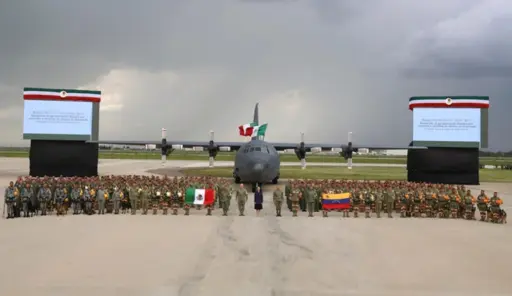
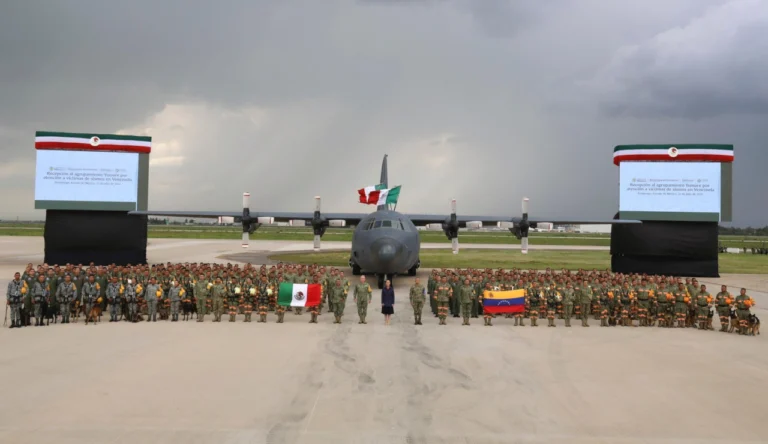
Laid out in detail by Venezuelan ambassador Stella Marina Lugo Betancourt, the message of thanks focuses on the “immediate response” from Mexico after the twin earthquakes. In a ceremony in Mexico City, President Sheinbaum honored the Yumare detachment of the Mexican Army, which returned home after 15 days of rescue operations in the Bolivarian Republic. Lugo Betancourt took part in this event and used it to convey Venezuela’s official gratitude.
In a statement shared on social media, the ambassador explained that she spoke on behalf of acting president Delcy Rodríguez, the Venezuelan government and the entire Venezuelan people, to thank Mexico’s head of state for quickly supporting the emergency response. This acknowledgement placed Venezuela–Mexico earthquake aid within a broader framework of diplomatic recognition and people‑to‑people solidarity.
She highlighted the work of 264 men and women and 18 canine search‑and‑rescue teams from the Yumare group, describing their mission as an effort to “embrace life” and to work shoulder to shoulder with Venezuelan personnel in the noble task of saving lives and reuniting families. The presence of specialized dogs was crucial in locating survivors and victims under collapsed structures, a standard practice in major disaster zones.
Lugo Betancourt also underscored the words of President Sheinbaum, who praised the solidarity and professionalism of Mexico’s Armed Forces, and noted the importance of international cooperation as well as the formal recognition granted by the Venezuelan government to Yumare’s members. Venezuela–Mexico earthquake aid thus appears not only as a technical operation, but as a symbolic act of friendship between the two countries.
- Government of Venezuela – Foreign Ministry
- Government of Mexico – Security and Civil Protection
- UN Office for the Coordination of Humanitarian Affairs
Venezuela–Mexico earthquake aid: awards, supplies and ongoing cooperation
During the ceremony, the commander of the Yumare grouping delivered a letter of thanks from acting president Delcy Rodríguez to President Sheinbaum, along with the highest distinction that Venezuela grants to those whose noble and heroic actions, undertaken despite all difficulties, are devoted to assistance and humanitarian aid in the country. This decoration formalizes the gratitude expressed by Venezuelan institutions.
The ambassador closed her message with an emotional tribute: “To the people and the Government of Mexico, thank you, a thousand thanks. Your dedication, heroism and spirit of service will live forever in the memory and in the heart of the Venezuelan people.” With this phrase, Venezuela–Mexico earthquake aid is framed as a lasting bond rather than a fleeting emergency gesture.
In her regular press conference, President Sheinbaum reaffirmed the Mexican government’s full willingness to expand support in other specialized areas, should a formal request be made to deepen cooperation. This commitment means that Mexico remains prepared to send additional experts, equipment or logistical backing as recovery needs evolve.
She also confirmed the upcoming arrival by sea of vessels loaded with essential supplies to reinforce assistance for affected populations. These maritime shipments include major donations of food collected by citizens through various state‑level government initiatives and through the Venezuelan embassy in Mexico, reflecting a mix of official and grassroots solidarity within Venezuela–Mexico earthquake aid.
In addition, the cargo will transport large‑scale emergency power plants, which will join seven or eight smaller units already previously airlifted to help restore electricity in critical zones. Reliable power is vital for hospitals, shelters, water systems and communications, making these plants a cornerstone of the humanitarian response.
According to the latest official figures, the 24 June earthquakes have left 4,118 people dead and more than 16,000 injured, along with thousands of families who have lost their homes. Against this backdrop, Venezuela–Mexico earthquake aid stands out as one of the most structured international support efforts arriving in the country.
Geopolitical context
Venezuela–Mexico earthquake aid carries important geopolitical weight in Latin America’s evolving landscape of solidarity and regional cooperation. At a time when many countries face overlapping crises—economic, climatic and seismic—Mexico’s rapid deployment and sustained assistance underscore the role of South‑South cooperation in disaster management, outside the traditional frameworks dominated by Northern powers.
The episode also highlights how humanitarian diplomacy can deepen political ties. By honoring Mexican rescue teams, granting national awards and publicly thanking Mexico’s government and people, Caracas is reinforcing a relationship that extends beyond trade or political alignment. Venezuela–Mexico earthquake aid becomes a reference point for how states can build trust through concrete, life‑saving actions.
In a broader sense, the tragedy and the response show that disaster risk and resilience are now central themes of regional policy debates. If Latin American countries continue to strengthen mutual aid mechanisms—sharing expertise, equipment and logistical capacities—events like the June earthquakes could push the region toward more integrated civil protection systems. For Venezuela, Mexico’s support signals that it is not alone in confronting one of the deadliest seismic episodes in its recent history.
From teleSUR English via This RSS Feed.