

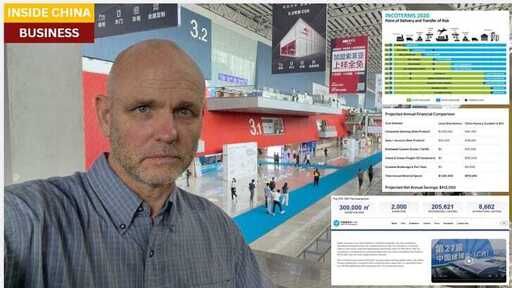
Bullets:
The International Building Fair attracts tens of thousands of homebuilders and property developers to Guangzhou, along with thousands more sourcing agents.
Building materials and supplies are in shortage in most global markets. Soaring costs for land transport, and for warehouse services, mean that even small building companies can save hundreds of thousands of dollars per year, by directly sourcing their materials from Chinese factories.
Eliminating local distributors and box stores cuts product costs by up to half, including freight. It also eliminates the stockouts problem that is such a challenge to builders.
We run the numbers on three small- and medium-sized businesses. Should they source their products directly from Chinese factories? And should they use their own trucks to pick up containers at the nearest port of entry? Or should they outsource freight operations completely?
Inside China / Business is a reader-supported publication. To receive new posts and support my work, consider becoming a free or paid subscriber.
Report:
Good morning.
This week we are at the International Building Fair in Guangzhou, which is the biggest show in Asia for the construction and building industry.
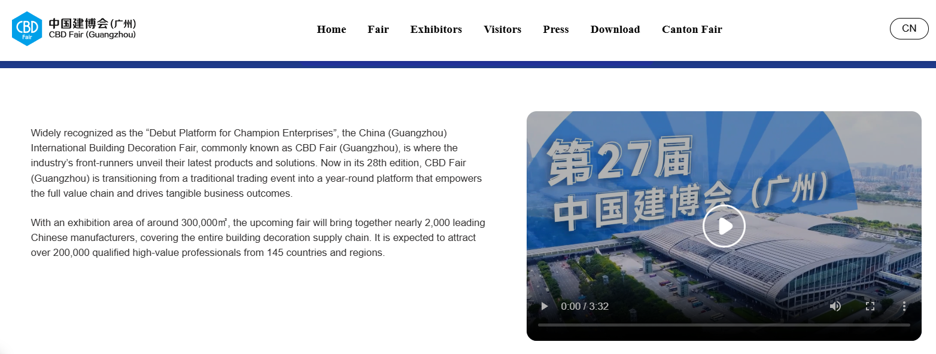

There are 200,000 visitors overall, including 8,000 buyers from across the world from over a hundred countries. We’re all here to buy direct, from these Chinese companies, most of whom in turn have large manufacturing facilities nearby, here in Guangdong province. It’s convenient, then, for visitors here to visit the factories personally.
This is yet another feature of China’s industrial clustering policy—companies are deliberately grouped together, to share the same labor pools, raw materials supply chains, and logistics systems—inbound and for export.
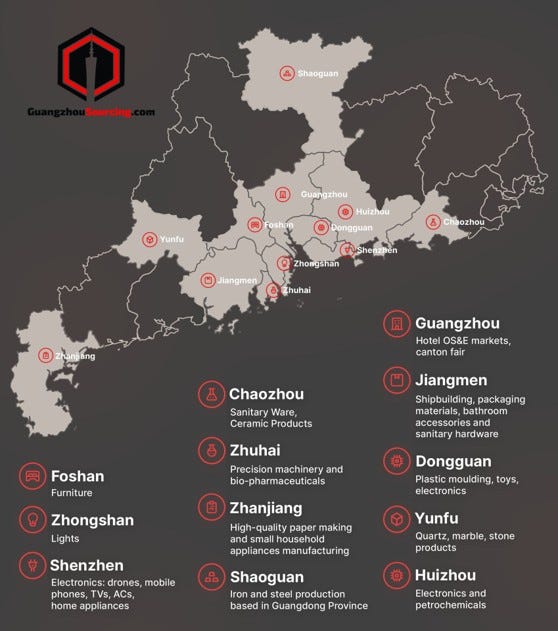
So thousands of foreign visitors flew in to attend, and tens of thousands more companies are sending their China-based sourcing agents to the fair. This is Alexander, he’s from Brazil, and lives in Zhongshan, about 90 minutes away. That puts him next door to the factories that build half the furniture in the world in Foshan, and 80% of the world’s consumer electronics.

He also knows our channel, and told us that all the business his group does is in local currencies only—companies in Brazil deal in real, companies here in Chinese RMB, no US banks, no US dollars. Millions of dollars a month going through financial networks and systems that did not exist three years ago.
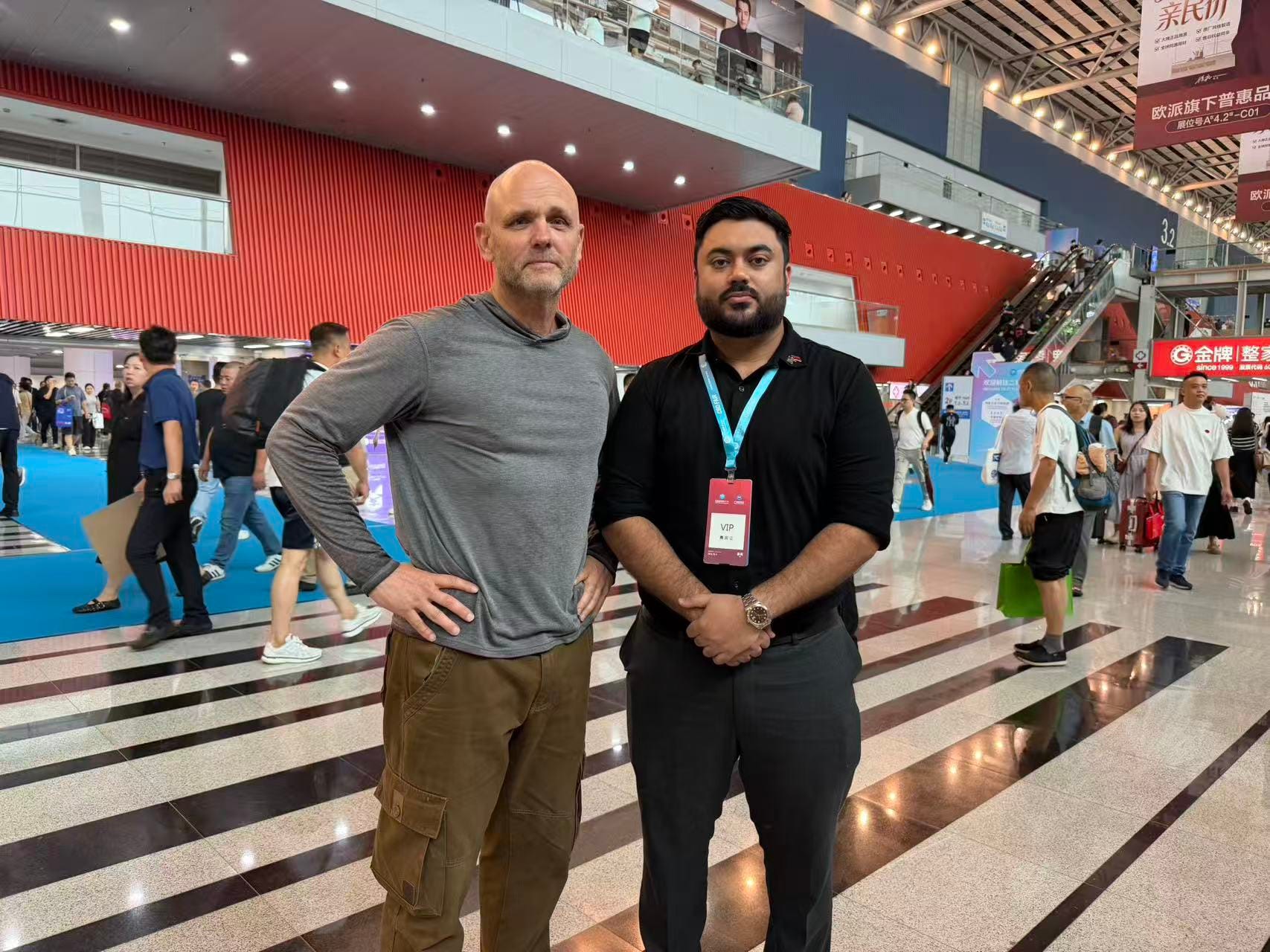
Kamal is back and forth between California and Foshan, and his team works with major developers in the United States and India. They build hotels, hospitals, restaurants, even amusement parks—turnkey, for the biggest hospitality brands in the world. They source everything from China, including the furniture and signage, put them in containers, and ship them to local construction crews.
And that’s why that 8,000+ number is misleading. Just in the cases of Alex and Kamal, they are just two guys, but represent dozens of companies, buying hundreds of millions of dollars in products every year.
Their careers exist because companies in their home countries need people here on the ground, who can do sourcing and quality control, and who live and work here in China full-time. They exist, in the case of this particular trade fair, because when construction companies and property developers across the world grow to a certain size, they make a lot more money by sourcing their materials directly from the factories who are here.
Let’s use three examples of typical small- to medium-sized businesses in the United States. We’ll go to Google and use their AI to help us. Example one: A company in Arkansas installs air conditioning units. Average home size is 1800 square feet, and they install 4 systems a week. Right now they’re buying the units from local suppliers, or a box store, and they want an estimate on what cost savings there may be, to buy directly from China, and whether they should consider a change to their supply chain:
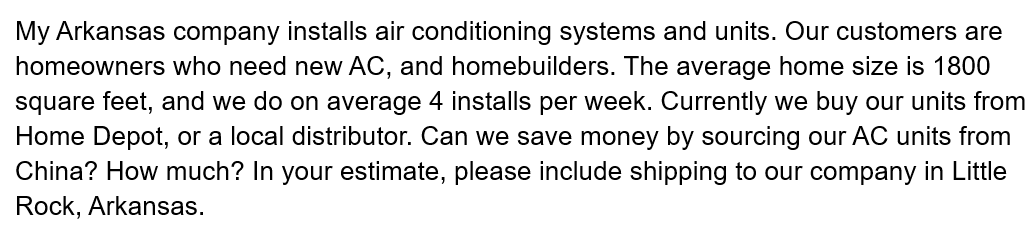
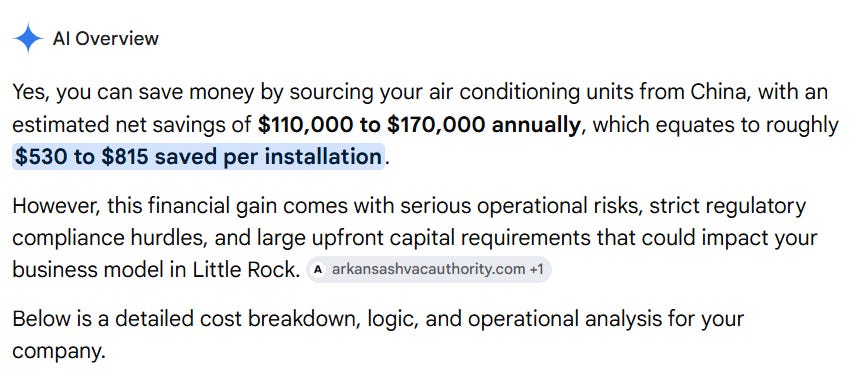
Answer: Yes, probably. Estimated net savings are over $100,000 per year, and over $500 per installation. The company is doing 200 units a year, and buying directly from Chinese manufacturers means big cost savings at the manufacturer level, but of course now the company is paying for the transportation and tariffs that right now are paid by their wholesaler.
There are some other considerations—buying their AC units by container allows for 11 weeks of inventory for each shipping container, so they’ll need warehouse space available for that. And there are documents they will need from the Chinese factory, so they will be approved for the Arkansas market.
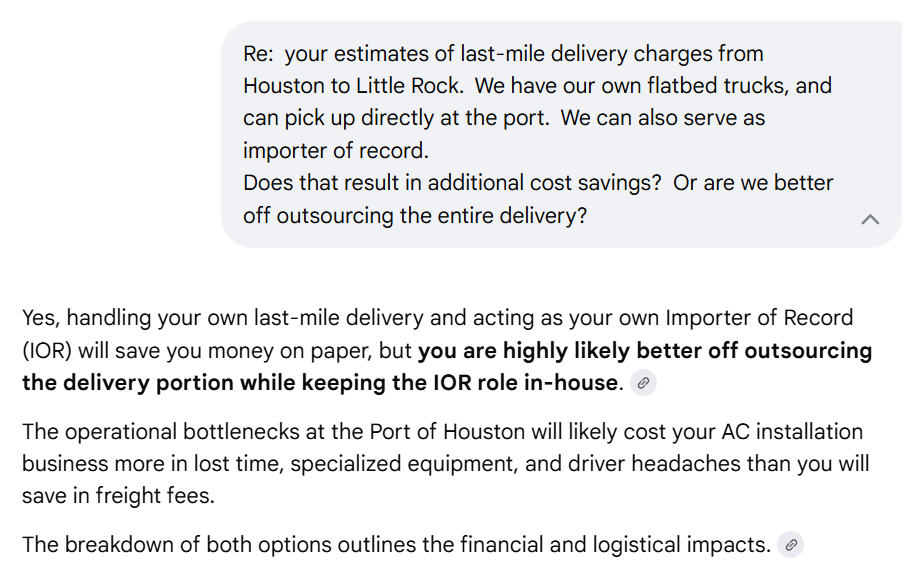
I added this question above to the AI agent, and shared it onscreen and it will save you time, because it breaks out the same, every single time we run the numbers. Most construction companies have their own trucks, and they ask us if they can save money by picking up their containers at the port when they come off the ship. This company has its own trucks, should they drive to Houston themselves, and pick up their shipment? Answer. On paper you might save some money. In the real world, you will not. We’re coming back to this later.
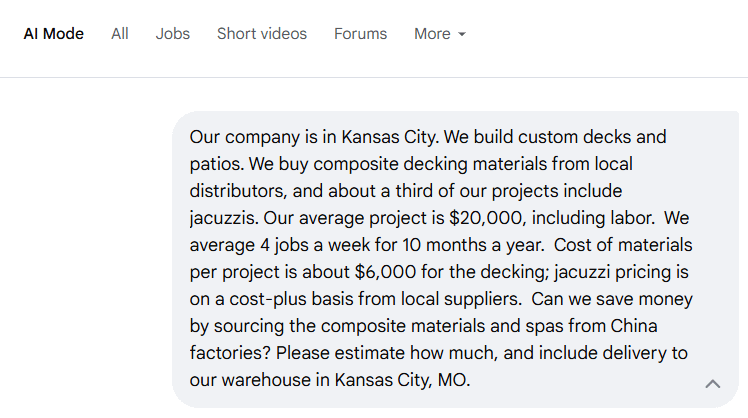
Scenario two. A company in Kansas City builds decks and patios. They use composite decking materials, do about 170 jobs a year, and a third of those include jacuzzis. The projects involving spas they price on a cost-plus basis. Average base project of $20,000, with a materials cost of $6,000. Should they consider sourcing those materials from China, yes or no?
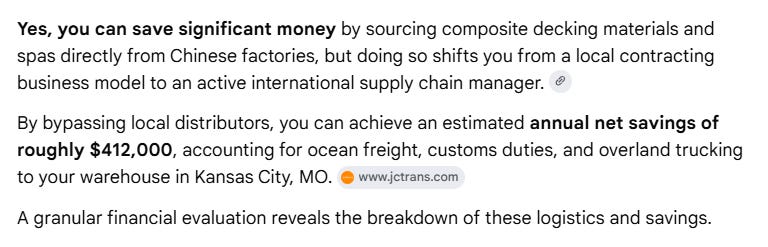
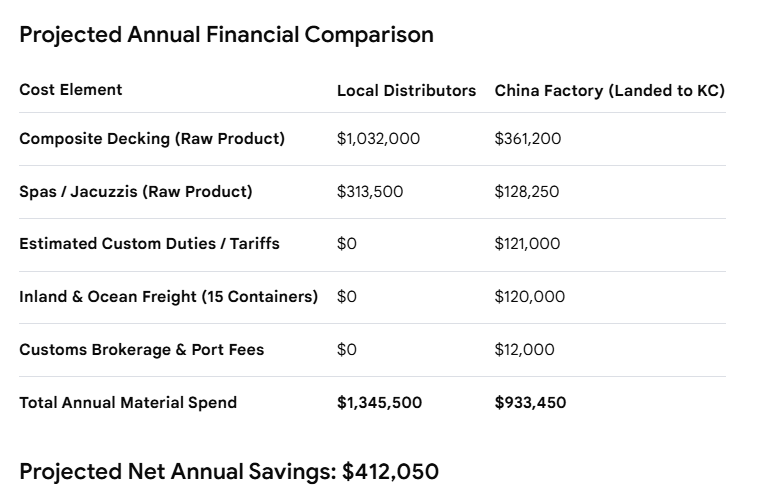
Answer here is unequivocal, and they need to be here in Guangzhou right now. At those business volumes, they will put over $400,000 a year directly to their bottom line, by sourcing their decking materials and spas from factories here.
Those cost savings can go to profits, by maintaining present sales volumes and pricing to their customers, or they can serve as a key competitive advantage in competing for other work in the Kansas City market, by lowering their price.
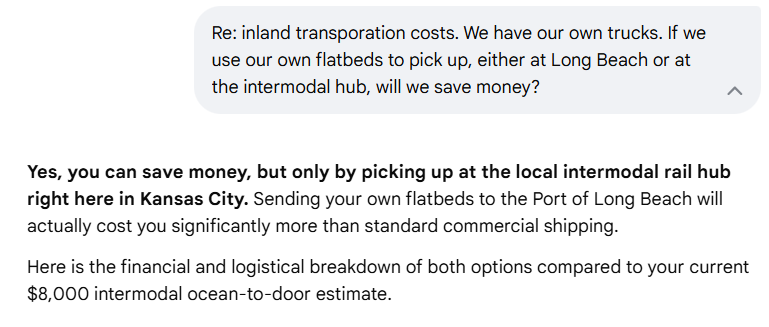
I asked the same question as before: This company has their own trucks, should they go to the Port of Long Beach to pick up their containers? Answer to that one is a hard no, but they should look carefully into sending their trucks to the intermodal transportation yard to pick up there. Using their company trucks for that leg, back and forth to the railroad yard, might save over a thousand dollars a month, and $500 to $800 per container. That assumes the drivers and trucks aren’t otherwise committed doing something else more valuable, but we have an idea of what that number is.
That’s a good rule to remember for inland transportation and logistics—you never want to use your own trucks for ocean port pickups—don’t even think about trying to get into the Port of LA or Newark or Houston. But if there is an intermodal shipment by rail, if your trucks are compliant, then the math changes completely.
Scenario 3: a builder of apartments and hotels in Florida. Next year they will build 800 1- and 2-bedroom units in 10 locations, and want to know about direct sourcing of cabinets, flooring materials, and windows.
So we have another example of a company that is not a huge developer, building thousands of homes. They’re also not too small, and doing one-off builds. They have a standard bill of materials across most of their business:
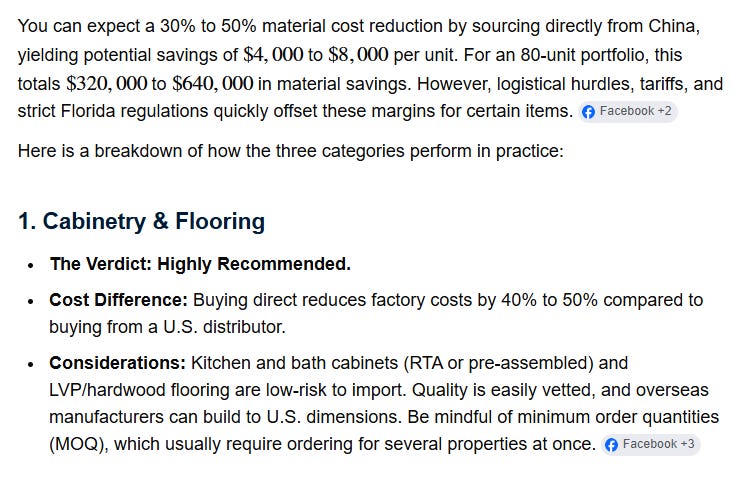
Answer: Overall, sourcing from China will result in cost savings of $4,000 to $8,000 per unit, and at 800 units that is over half a million dollars in cost savings. So it is a firm “yes” on the cabinetry and flooring materials. Savings of 40-50% there by buying direct from China.
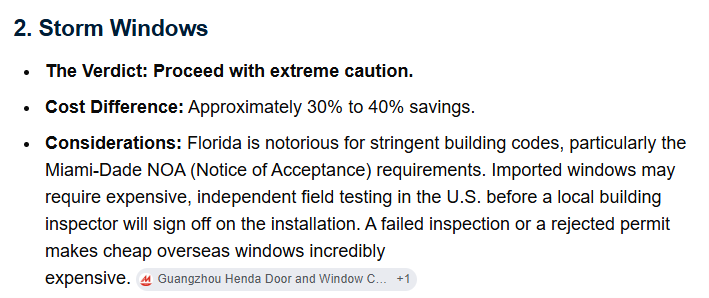
On the windows, they will realize a savings of 30-40%, but “proceed with extreme caution”. Florida has some of the toughest building codes in the country, and the windows and doors and the roofs need to survive major hurricanes.
Guangzhou is in South China, and hurricanes are called typhoons here, and these factories build millions of windows a year for climates that are just like Florida’s. The trick is to work with factories here who have the documentation, in English in this case, that can be shown to local building inspectors.
So in the case of this company, they should be here looking at the flooring and cabinet suppliers, and talking very closely with the factories here who have export experience in South Florida.
A few more important points. Building contractors and homebuilders already know the local building codes and regulations that need to be followed, to get projects approved by inspectors. And the factories here in Guangdong have deep experience building for developers across the world, and in compliance with all those building codes.
And they are already supplying materials to your market, right now. These are factories your company is already buying from, but via middle men and the big box stores. And the companies that are here, buying direct, faced the same math problems we just ran earlier. The economics of supply chain management argue hard against using distributors for products that your business buys and consumes in bulk.
For what we mean, consider these charges from Amazon, for their stores. Amazon runs a program called Fulfillment By Amazon, or FBA. It’s an end-to-end system of logistics and delivery, order fulfillment, and warehousing. Amazon has one of the most efficient inventory management systems in the world, and millions of sellers are on the FBA platform, who use Amazon to handle their product inventories.
This is their fee schedule, to do that work for e-commerce companies. And there are very high fees for large and bulky items. There are also high handling fees for heavy items.
Bulky products take up a lot of shelf space, which is an opportunity cost problem, and Amazon charges their stores for that, which are passed along again to the end buyer.
Heavy products need special equipment to move them off one truck, on a shelf, and then to another to ship it to the final customer, and the end buyer pays for that. Lowe’s and Home Depot have those same problems, and so do specialty distributors. They unload a container, break open the pallets, store the products in their warehouse, wait for orders to come in, load them onto trucks—either theirs or yours—and pass along their costs for all that, with a high markup.
Building materials are heavy, they are bulky, and need to be handled carefully, often by two or more people, or even equipment. Your company is doing that work, now, in your own warehouse. And that is where those savings come from, when just sourcing these materials yourself. Your shipping costs are going higher, as a line item—you’re paying to send them from China, instead of from down the street. But your product costs overall drop by between 30 and 50%, including the shipping.
This show is for the building trades, and for companies across the world who source directly from the factories here in China who manufacture the construction materials and supplies. But those same inventory management and supply chain economics that inform homebuilders and property developers in their businesses, are also applied by companies in other industries, and explains why those executives head to other trade shows here in China, and arrange for direct sourcing and shipping.
And that leads to a final point, which is that some of the most important people you work with are the shipping agents. When your company moves to sourcing products directly from China, you’re likely making these decisions for the first time, and it’s a steep learning curve to buy customs bonds, for example, or to know whether CIF or DDP shipping terms are most appropriate for your company, and why.
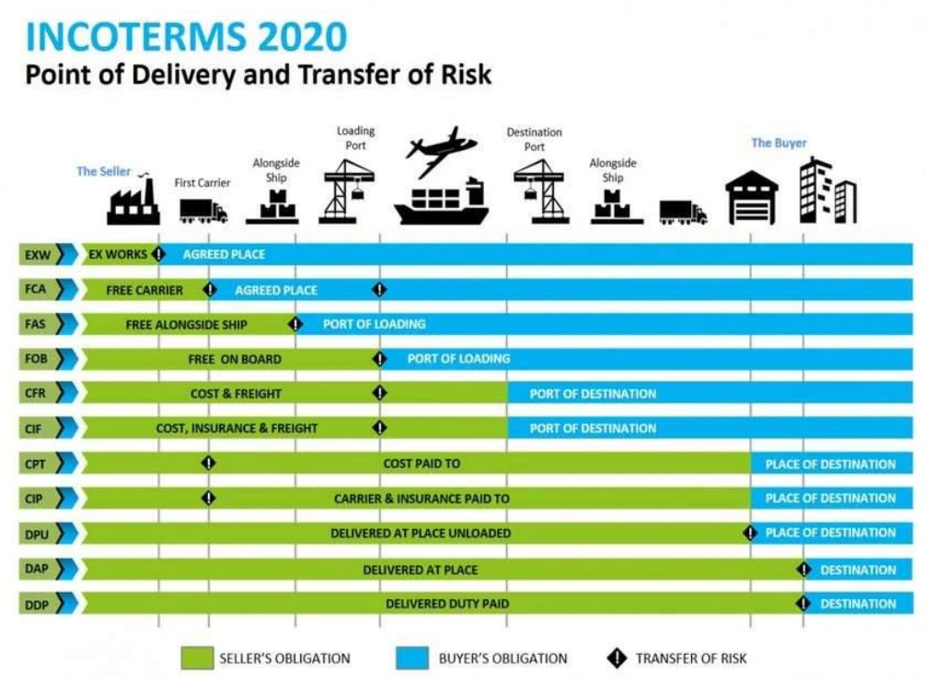
Answering those questions intelligently involves a deep understanding of shipping costs, customs procedures, tariff schedules—and few companies have those resources in-house to know the answers. There are teams of people at every single one of these trade shows, and in every single industrial zone in China, who handle all that business for dozens of factories, and for thousands of foreign companies who buy from them.
We used an example earlier, of how sending your own company trucks to the port to pick up your own containers is a lousy idea, a hundred times out of a hundred. I feel the same way about this—especially in the beginning of that process for your company, use people here in China to figure out the best way to get your materials to you, and prepare all the documentation for the government agencies between here and there.
You will not save money, or time, doing that yourself until several inventory turns in, so don’t try it until later. By buying direct, your cost savings are hundreds of thousands of dollars a year, IF the customs paperwork is right at the point of entry, and IF the logistics run smoothly from the back door of the factory here to the front door of your company.
Let these guys here focus on those things, and your guys there can focus on building decks and apartments.
Be Good.
Resources and links:
International Building Show
https://www.cbdfair-gz.com/en
Production locations in Guangdong
https://www.guangzhousourcing.com/blog/procurement-services-2/production-locations-in-guangdong-which-kind-of-products-are-being-made-where-10
2026 US FBA fulfillment fee changes
https://sellercentral.amazon.com/help/hub/reference/external/GABBX6GZPA8MSZGW?locale=en-US
Graphics: Typhoons in China over past 70 years
https://news.cgtn.com/news/2019-07-12/Typhoons-in-China-IfupsSShaw/index.html
Urbanization and industrial clustering power China’s rise in innovation
A Guide to Understanding International Trade Incoterms
https://www.accb.nyc/single-post/demystifying-incoterms-a-guide-to-understanding-international-trade
Contact info:
Alexander (Brazil-China)
WeChat is +86 173 2242 1357
WhatsApp +55 37 99868 2032
Kamal (US-India-China)
Kamalwalia@abssupplychain.com
+17078584711
Inside China / Business is a reader-supported publication. To receive new posts and support my work, consider becoming a free or paid subscriber.
From Inside China / Business via This RSS Feed.