

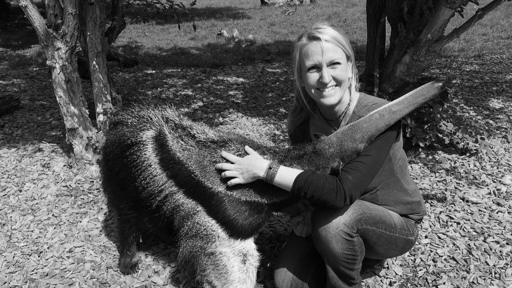
The giant anteater is easy to turn into a curiosity. Its head narrows into a long tube. It sees poorly. It opens termite mounds with strong claws and gathers insects with a tongue that can reach far beyond its mouth. Its life can appear simple until someone tries to study it. Then it becomes a set of hard questions: where it feeds, how far it ranges, what cover it needs, and how roads, fire, drought, and ranching change its chances of survival. These were the questions that drew Lydia Möcklinghoff into the Pantanal, the vast wetland in western Brazil and neighboring countries. She died on July 3, 2026, aged 45, in a plane crash near Campo Grande, Brazil, during a flight connected to Pantanal fieldwork. The cause of the crash was still under investigation. For her colleagues, students, readers, listeners, and the many children who knew her through radio reports from Brazil, the news carried a particular cruelty. She had made a difficult, overlooked animal visible. She had done so with humor, discipline, and a rare gift for explanation. Lydia Möcklinghoff in the Pantanal. From her social media. She did not begin with anteaters. Born in Wilhelmshaven, Germany, she studied biology in Giessen and Würzburg, with an interest in tropical ecology and animal behavior. Earlier, she had imagined becoming a wildlife filmmaker. Work experience in film companies changed her direction. The image mattered less to her than the animal in front of the camera. What was it doing? Why was…This article was originally published on Mongabay
From Conservation news via This RSS Feed.