

Venezuela’s Acting President Delcy Rodriguez announced this Friday the creation of the Unique Housing Registry to assist vulnerable families displaced by the devastating June 24 earthquakes.
The national census, which will begin on July 11 under a progressive schedule, using biometric fingerprint devices to consolidate the state database.
This mechanism will help to detail knowledge of the housing conditions of every citizen currently residing in emergency shelter structures across the affected regions.
RELATED: Venezuelan Acting President Inspects Caracas Housing Reconstruction
“We will be carrying out in the temporary camps, in accordance with a progressive schedule, the single registration of housing to know in detail the situation of each person”, the Acting President Delcy Rodriguez detailed.
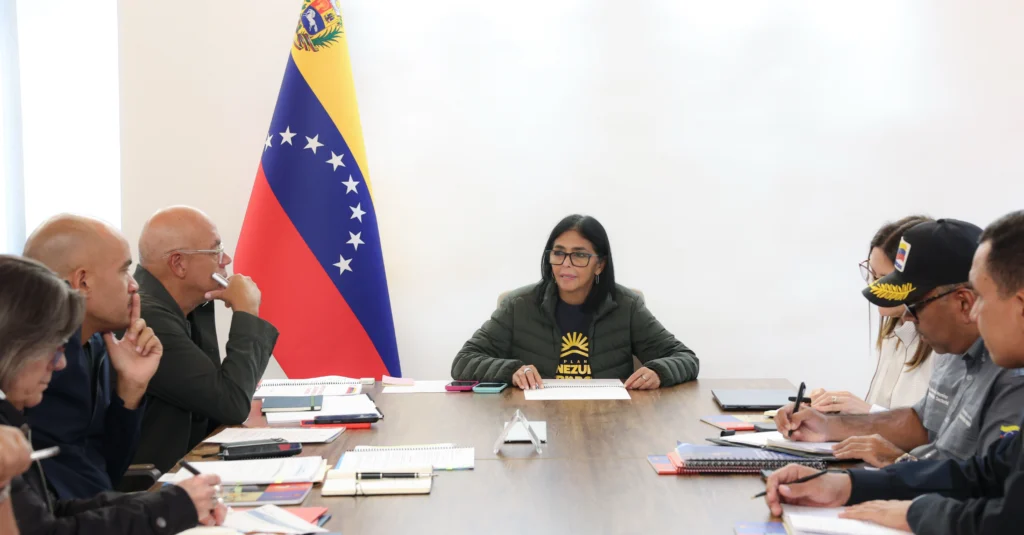
During a high-level meeting with the General Staff, Government officials evaluated the national deployment, operation, and assistance schemes. Vice-presidents and ministers confirmed that national shelter capacity successfully expanded to 24,280 beds distributed across 89 authorized structures nationwide. The governmental committee also reviewed relocation balances for more than 17,120 citizens in Caracas, La Guaira and Miranda.
Text reads: “From the General Staff, we continue to improve care in the 89 transitional camps. This Saturday we will start the single housing register to serve more than 17 thousand people and provide a peremptory response to their housing situation.”
The Acting President Delcy Rodriguez demanded strict institutional order to guarantee an efficient, comprehensive social response for all affected families. Through the Venezuela Borned Plan (Venezuela Renace), state authorities execute rehabilitation works to ensure that citizens whose homes are classified under yellow traffic light status (moderate damage) can return to their residences as soon as possible.
The Bolivarian Government presented an official balance detailing the humanitarian assistance deployed after the seismic events. This coordinated effort between public security forces, medical units and civil volunteers reached 86,794 affected families in the prioritized zones.
Shelter Capacity Expansion
During the strategic meeting, officials evaluated the overall deployment, operational functionality, and assistance schemes of all existing protection spaces. Jorge Rodríguez, head of the General Staff, together with executive secretary Héctor Rodríguez, sectoral vice-presidents, and ministers, confirmed the expansion of installed capacity to 24,280 beds distributed across 89 authorized structures nationwide.
Authorities reviewed relocation balances confirming that more than 17,120 citizens are currently accommodated in Caracas, La Guaira, and Miranda states. The government continues to monitor the relocation process to ensure that every displaced family receives adequate temporary shelter while permanent solutions are developed.
The Venezuelan Government examined strategic coordination with local communes, community self-governing bodies and solidarity brigades. These grassroots organizations will maintain permanent social monitoring and humanitarian support until the state guarantees a definitive, dignified housing solution for every family.
Communal Articulation Strategy
The acting president examined coordination strategies with communes, self-government rooms, and solidarity brigades to maintain permanent social accompaniment for affected families until the government finalizes a definitive housing solution for each household.
The Venezuelan executive emphasized that community-based organizations play a fundamental role in the humanitarian response. These grassroots structures facilitate communication between state institutions and affected families, ensuring that emergency supplies, medical attention, and logistical support reach every vulnerable sector.
The General Staff continues to monitor the seismic aftershock situation and coordinate the national response network. Government authorities remain deployed in the prioritized zones to accelerate housing rehabilitation, strengthen temporary shelter infrastructure, and guarantee uninterrupted humanitarian assistance for all citizens affected by the natural disaster.
The Bolivarian Government reaffirms its commitment to a comprehensive, state-led recovery process that prioritizes human dignity and social protection for every Venezuelan family. The Unique Housing Registry will serve as the foundational tool for designing tailored housing solutions based on each family’s specific needs and structural conditions.
Humanitarian Aid Balance
Large-scale logistics and healthcare operations guaranteed the distribution of 9,766 tons of food and 13,902,828 liters of drinking water. Furthermore, public medical teams provided direct healthcare and emergency treatments to 29,966 patients on the ground.
The Venezuelan state deployed 30,076 security and prevention officers, registered 29,843 national volunteers, and coordinated with 3,454 international rescuers, which provide continuous technical and operational support in all affected territories.
Official seismic monitoring registries indicate that emergency services successfully rescued 6,462 people amid 1,171 active aftershocks. Official records quantify 17,907 citizens without homes, 17,266 sheltered persons, 16,740 injured citizens, and 4,118 fatalities, according to the last report of this Friday.
The Venezuelan Government continues to coordinate efforts with regional governors and municipal mayors to accelerate reconstruction. This comprehensive deployment ensures that emergency response teams remain active in all vulnerable sectors until the housing crisis is fully resolved.
From teleSUR English via This RSS Feed.