

A review of publicly available government records for this story did not find documentation confirming whether the approved financial assistance was eventually released or the final amount, if any, that reached Eala.
By Kasheena Camacho
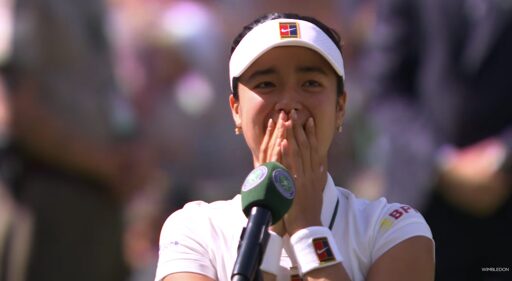
MANILA – Filipina tennis sensation Alex Eala’s historic Wimbledon campaign drew congratulations from Ferdinand Marcos Jr., senators, and other public officials, who hailed her breakthrough as a source of national pride.Yet beyond the outpouring of praise, questions remain over how much government support helped shape one of the country’s greatest tennis players.
Tennis has been part of Eala’s life for as long as she can remember. “I started at four, and it’s always kind of been in my family. It just made me love the sport more. In my mind, I always knew that this is what I wanted to do,” Eala said in an interview.
Coached first by her grandfather, Roberto “Lolo Bob” Maniego, Eala trained in the Philippines before winning the prestigious Les Petits As tournament in France in 2018, earning a full scholarship to the Rafa Nadal Academy in Spain. She later won three junior Grand Slam titles before defeating defending champion Iga ?wi?tek at Wimbledon to become the first Filipina in the Open Era to reach the second week of a Grand Slam singles tournament.
Behind the celebration, however, the documentary record tells a more nuanced story. While Eala’s rise reflects years of disciplined training and international competition, publicly available records provide little clarity on how much government support reached her throughout that journey.
The Philippine government supports athletes primarily through the Philippine Sports Commission (PSC) and the National Sports Development Fund (NSDF). However, budget documents and transparency reports do not provide a clear breakdown of funding allocated to individual sports such as tennis or to specific athletes like Eala.
Government support for sports is coursed through the PSC, which received P1.275 billion ($20.73 million) under the 2025 General Appropriations Act. The proposed 2026 National Expenditure Program increases the agency’s budget to P1.30 billion ($21.16 million).
Through the NSDP, the PSC finances athlete training, international competitions, grassroots development, sports science programs, and assistance to National Sports Associations (NSA), including the Philippine Tennis Association (PHILTA).
Yet despite these appropriations, the national budget does not contain a separate allocation for tennis. Publicly available transparency reports likewise do not specify how much funding has been released to PHILTA or directly to individual athletes such as Eala. Although the budget funds athlete training, international competitions, grassroots sports, and assistance to National Sports Associations, it does not identify allocations for tennis or disclose releases made to individual athletes.
Questions over Eala’s government support first surfaced in 2020 after the PSC announced that it had provided P3 million ($48,832) in financial assistance following her successful French Open junior campaign.
The claim was immediately disputed by the Eala family.
“In the wake of a great run of Alex at Roland Garros, the French Open, it is sad to see that agencies claim to support athletes with millions of pesos in spite of not having given a single centavo,” her father, Michael Eala, posted on Facebook, said in an article published by Philstar.
Her mother, Rizza Maniego-Eala, likewise denied receiving the assistance, saying reimbursement requests for Alex’s travel expenses had remained pending despite the submission of extensive documentation. Alex’s uncle, Noli Eala, also said the young tennis player’s training at the Rafa Nadal Academy and international campaign had been financed by the family and private sponsors.
The PSC later issued a public apology, explaining that while the financial assistance had already been approved by its board, it had not yet been released when the agency announced that support had been provided. The commission described its earlier statement as “unintended misinformation.”
A review of publicly available government records for this story did not find documentation confirming whether the approved financial assistance was eventually released or the final amount, if any, that reached Eala.
Six years later, Eala’s Wimbledon breakthrough once again placed Philippine tennis in the national spotlight, prompting congratulatory messages from Marcos Jr., lawmakers, and other public officials.
While her achievement has united Filipinos in celebration, the available public record offers only a limited picture of the government’s long-term financial support for one of the country’s most accomplished tennis players. As Eala created history on the international stage, her journey also raises broader questions about how public investment in elite athletes is documented, sustained, and made transparent long before they become national icons. (RTS, RVO)
The post As praises pour in for Alex Eala, questions remain over government support appeared first on Bulatlat.
From Bulatlat via This RSS Feed.