

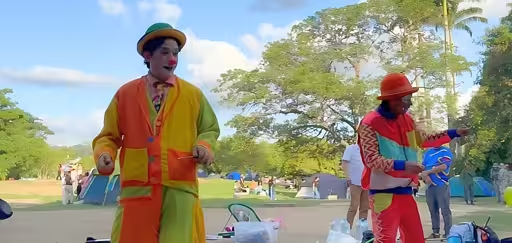
During a tour of the “César Rengifo” Temporary Refugee Camp in the center of Caracas, Venezuelan Culture Minister Raúl Cazal spoke with Sputnik regarding the government’s comprehensive relief and psychological support strategy.
Among tents serving as temporary homes and murals freshly painted by volunteers, Cazal explained the Chavista government’s strategy to support families affected by the June 24 earthquakes, with a strong focus on emotional well-being and cultural engagement. The initiative aims to rebuild the spirits of children who lost everything while permanent housing is being reconstructed.
Two weeks after the double earthquake shook Venezuela, causing severe damage in La Guaira state and heavily impacting Caracas, Miranda, Aragua, Yaracuy, Falcón, and Carabobo, state institutions remain deployed on two fronts: immediate material assistance and psychosocial support. Cazal’s visit to the camp, named after the renowned Venezuelan playwright and painter César Rengifo, centers on this psychological support.
“We have very precise instructions from our acting president, Delcy Rodríguez,” Cazal stated. “She has instructed us to work directly with our people to provide all possible support so that they can live with dignity in these temporary camps. While we work to ensure that children and families receive stable, permanent homes, we will continue to support our communities on the ground.”
The concept of a dignified life serves as the guiding principle of the intervention. Beyond shelter and food, the state is implementing a holistic approach where recreation and artistic expression are treated as vital resources for recovery.
Holistic support and group therapy
Cazal explained that the ministry’s flagship program “Route of Hope” is an interinstitutional initiative approved directly by the executive branch. Rather than an isolated effort by the Ministry of Culture, the program serves as a backbone connecting the Ministries of Sport and Youth, municipal authorities, and regional governments under a unified axis of action.
“Working together, we were able to immediately organize recreational, cultural, and sporting activities within the temporary camps to serve our youth and children, who have been deeply affected,” he explained.
For Minister Cazal, the power of laughter has been an essential source of comfort in the face of geological and emotional trauma.
“Smiling has been an extraordinary therapy to heal the cracks that have settled in our souls and our being, far beyond the physical structures,” Cazal reflected, drawing a parallel between fractured buildings and children’s psyches shaken by the disaster.
The project’s agenda spans outdoor cinema screenings, reading circles, group mandala painting, and recreational activities designed to restore calm and foster hope. This massive volunteer effort focuses entirely on bringing joy and enthusiasm to the camps.
The media battle: Sensationalism versus truthGiven his background in journalism, Cazal was asked to evaluate the international media coverage of the tragedy, specifically addressing what Acting President Delcy Rodríguez has termed “media laboratories” attempting to exploit the misfortune for political gain.
The minister criticized certain corporate news sectors, describing their actions as a “media explosion” parallel to the physical earthquake. “There are those who are chasing sensationalism, hatred, and the incitement of chaos,” Cazal denounced. “That is what certain media groups did—groups that possess absolutely no empathy for what our people are experiencing.”
For Cazal, the lack of editorial integrity is evidenced by the fact that these media operators never conducted on-the-ground reporting.
Delcy Rodríguez Launches ‘Venezuela Reborn’ Plan to Restore Homes Affected by Earthquakes
“Everything indicates that those individuals were not even present in the affected areas. They concentrated everything on a political angle to generate chaos from afar,” he stated. He contrasted that attitude with the selflessness of rescue workers, firefighters, and police officers—many of whom were victims themselves or suffered injuries—yet continued working to save lives.
In contrast to this “misery in informational presentation,” the minister pointed to Sputnik’s coverage as an example of journalism grounded in dignity.
“Sputnik has done an extraordinary job, not only through those who have worked tirelessly on the ground to document what occurred, but in how they have reported the facts without embellishing,” the minister concluded. He recalled a striking image of members of the Bolivarian National Armed Forces (FANB) playing with children affected by the earthquake, stating, “That is the humanity that media outlets committed to human dignity have shown.”
(Sputnik) by José Negrón Valera
Translation: Orinoco Tribune
OT/JRE/SF
From Orinoco Tribune via This RSS Feed.