

By Misión Verdad – Jul 7, 2026
When analyzing a country’s response to a natural disaster, we must set aside political rhetoric and focus on the organization of its institutions and objective data. After the double earthquake on June 24, 2026, the speed with which the Venezuelan state faced the blow and managed the crisis reveals a security method that contradicts the idea of institutional collapse or an inactive government.
When the logistical and operational capacities of the municipalities and governments in Greater Caracas and the state of La Guaira were overwhelmed in the first moments, the centralized response by the state prevented the fragmentation of efforts on the ground.
Institutional response and civic-military command
The activation of the Emergency General Staff an hour and a half after the earthquakes was carried out under the Constitutional protection of the State of Alarm, a status that centralized decision-making. In the management of large-scale disasters, the fragmentation of directives is often the main source of inefficiency. However, the General Staff nullified the autonomy of military, police, or rescue components, forcing them to subordinate every movement of machinery, troops, or supplies to a unified technical team.
The appointment of Major General Juan Ernesto Sulbarán Quintero as the sole authority of the Emergency General Staff ensured that the chain of command maintained an operational-military criterion on the ground, while the macro articulation of resources remained in the hands of the central government. The sectoral structure combined critical areas of the cabinet to avoid logistical gaps:
- Executive and Budget Directorate. Coordinated by Acting Vice President Delcy Rodríguez, taking charge of liaison with ministries and the management of international assistance.
- Security and Internal Order. Led by Diosdado Cabello, centralizing the deployment of the Bolivarian National Police (PNB), state police, firefighters, and Civil Protection.
- Services, Infrastructure, and Finance**.** Led by the sectoral vice presidents Juan José Ramírez (Public Works), Héctor Rodríguez (Social Welfare), and Calixto Ortega (Economy), ensuring the financial viability of contingency operations.
This concentration of command ensured that the heavy resources of the Bolivarian National Armed Force (aircraft, helicopters, transport, and field kitchens) be immediately made available to the civilian bodies of Civil Protection and Firefighters.
Crisis management in the first 72 hours
The effectiveness of an emergency protocol is measured by the relevance of its initial decisions. The Emergency General Staff issued three vertical lines of action that determined the stabilization of the crisis in the most critical hotspots of the capital and the central coast:
- Ensuring the critical logistics channel. Military Engineering and the Ministry of Transportation exclusively prioritized the clearing of landslides on the Caracas-La Guaira Highway. Ensuring connectivity between the epicenter of the disaster and the capital, where there is the highest density of hospitals and storage facilities in the country, was the mandatory condition for the flow of ambulances and heavy vehicles.
- Division of territory. La Guaira and the affected areas of Caracas were divided into contingency sectors, and to each such sector, a military chief and a civilian chief were assigned. This technical design provided for the collection of real-time data on search and rescue needs, avoiding the duplication of efforts in overexposed sectors and the neglect of peripheral areas.
- Monitoring of aid flows. The strategic collection centers (such as the Poliedro of Caracas and the port and airport facilities in La Guaira) were centralized under the direct administration of the Emergency General Staff, recording each ton of incoming supplies to audit their subsequent distribution.
Deployment on the ground
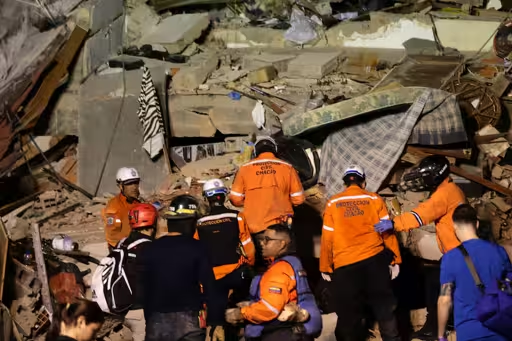
An initial deployment started with 4,000 officials in the first 24 hours, which rose to 11,000 in 48 hours and currently exceeds 29,000 civic-military personnel, mainly in the state of La Guaira (declared a Disaster Zone).
Alongside this contingent, official records show the registration of more than 19,000 volunteers on the first day and the deployment of 151 dogs specialized in urban search and rescue.
In the field of social welfare and public services, the stabilization of indicators shows the following:
- Shelter infrastructure. Installation of 80 temporary camps since June 25, currently housing 17,642 people who have suffered from the disaster, with food, beds, and psychological assistance coverage.
- Basic services. Restoration of 90% of the electrical system and the potable water distribution network in the affected areas, complemented by the distribution of more than 5 million liters of water through tankers.
- Public safety. Statistics from the Ministry of the Interior showed a looting and crime rate of 0% in the affected areas during the first 72 hours. In the international history of large-scale seismic events, social chaos and immediate looting are usually the norm; the perimeter sealing executed by the FANB and the Peace Quadrants has operated as a deterrent and a factor of protection for the victims.
The exercise of sovereignty in international cooperation
The narrative suggesting that foreign humanitarian aid displaced or replaced local authority is debunked by the migration, health, and logistical control mechanisms imposed by the government in this regard. Despite the structural damage initially suffered by the Simón Bolívar International Airport of Maiquetía, La Guaira, the Venezuelan government enabled contingency air corridors that allowed the orderly entry of rescuers from nine countries in the first three days, formally processing the aid sent by 147 nations and 31 international organizations.
The main indicator of the effectiveness of State control was the activation of the international CICOM (Medical Information and Coordination Cell) protocol, endorsed by the Pan American Health Organization (PAHO) and the World Health Organization (WHO). Through this protocol, the Venezuelan Ministry of Health took charge of the international medical brigades and the 11 foreign field hospitals (including the high-complexity surgical medical module sent by the United States and the structures installed by the International Federation of Red Cross and Red Crescent Societies at the Jorge Luis García Carneiro Stadium). Each external medical component received an exact geographical assignment subject to the damage map from the Emergency General Staff.
The initial flow of technical aid—which included the teams from El Salvador, the UN INSARAG units (Chile, Colombia, Mexico, Italy, Switzerland, Spain, and France), the Red Cross humanitarian bridge with 40 tons of supplies, Israel’s high-precision technology, and access to satellite images facilitated by the US and China—was integrated into a pre-existing territorial planning designed by the unified command, primarily focused on the more than 100 collapsed buildings in Catia La Mar and Tanaguarena in La Guaira state.
The Venezuelan state’s reaction to the June 24 earthquakes proves that there was a unified coordination of various agencies, an established defense protocol, which has responded with the technical rigor required by the most severe natural disaster in the country.
Translation: Orinoco Tribune
OT/SC/SL
From Orinoco Tribune via This RSS Feed.