

Perhaps the sentiments contained in the following pages are not yet sufficiently fashionable to procure them general favor; a long habit of not thinking a thing wrong gives it a superficial appearance of being right, and raises at first a formidable outcry in defense of custom. But the tumult soon subsides. Time makes more converts than reason.
– Thomas Paine, Common Sense
This year marks the 250th anniversary of the Declaration of Independence. The ideas promoted within—that all men are created equal, and have a right to establish or alter a government to secure their fundamental rights—were not new in the 18th century. But their inclusion in a statement of national founding, a public declaration for all the world to read, was novel. These ideals had incredible staying power, especially among movements that sought to go far beyond the Founders’ intentions. In his 1963 “I Have a Dream” speech, Martin Luther King called the Declaration a “promissory note to which every American was to fall heir,” and condemned the U.S. government for defaulting on that promise. Four years later, Huey Newton and Bobby Seale included almost all of the Declaration’s preamble in the conclusion of the Black Panther Party’s Ten Point Program .
This year also marks the 250th anniversary of the publication of Common Sense, a rousing call to revolution written by Thomas Paine. Paine was a man who gave his heart and mind to democratic struggles across the Atlantic world. In life, he was attacked by defenders of traditional authority, and by proponents of conservative republicanism like John Adams, who won out in the immediate debate over the structure of American government. In death, his ideas influenced Radical Republicans like Thaddeus Stevens and civil rights leaders like MLK. He also influenced Socialists like Eugene Debs, who famously declared himself:
A patriot, but in the sense that I love all countries. I love the sentiment of William L. Garrison: ‘All the world is my country and all mankind are my countrymen.’ Thomas Jefferson once said: ‘Where liberty is, is my country.’ That is good. Thomas Paine said: ‘Where liberty is honored, that is my country.’ That is better. Where liberty is not, socialism has a mission, and, therefore, the mission of socialism is as wide as the world.
In Common Sense, Paine planted the flag of unconditional independence and won people to that position on a mass scale, helping to transform diffuse radicalism into a broad popular consensus. He wrote Common Sense not to echo ideas that were already popular, but to express what he believed was necessary to resolve the ongoing crisis. Ideologically, Paine was a democratic republican who fought for a constitution based on unicameralism and universal and equal suffrage as a means to alleviate economic inequality. In his eyes, the inability to participate fully and equally in government was tantamount to slavery. Paine’s story can inspire us, but it also throws into sharper relief the absence of a sustained demand for a democratic constitution coming from today’s Left. The more we draw from Paine and the people he inspired, the farther we will go.
Defining a Majority
The first edition of Common Sense appeared in all the major colonial cities. Translations made their way north to Quebec, south to colonial Spanish America, and as far east as Russia. How did it spread so far, and so fast? For one thing, Paine knew how to connect with his audience. He spoke in “plain English,” and Common Sense reads like an intelligent conversation one might have at the pub (no coincidence considering where Paine loved to spend his time). Timing was another factor. Paine had his finger on America’s pulse, and the general ferment of the 1770s helped colonists digest his arguments. But a third factor was also decisive: Paine was not afraid to push forward bold minority positions. When Common Sense appeared, most colonists were searching for a resolution to the conflict that didn’t involve independence. They believed that the time wasn’t right. Paine disagreed. He argued instead that the colony was “ripe for revolution and republicanism,” and chided naysayers for falling prey to “chimeras” and “empty and unreal fancies of excited minds.” The people, he insisted, had it in their power to make the world over again.
At its core, Common Sense was a work of consensus-building. It “not only divined but also defined [the] readers’ views, strengthening their beliefs, detonating their prejudices, touching their hearts, changing their minds, convincing them that they must speak out and act.” Paine’s goal was both informative and emancipatory. He worked to “redefine” his audience by “pressing a more egalitarian republicanism upon them.” In an era before modern mass political parties, Paine, sensing that the time for revolutionary action was at hand, stood at the vanguard of the struggle for independence. He had no interest in being a “consensus leader”—a pejorative coined by MLK—who gained followers by saying what was already popular or widely accepted. If he had, Common Sense would have been a tepid call for reconciliation with the Crown.
The idea that new majorities are built by standing for principles that aren’t yet popular is unfortunately not always the common sense of our movement. Many socialists dismiss demands for a democratic government because they aren’t “widely felt.” Last year, some DSA chapters in California even used the national debate about gerrymandering, not to agitate for universal and equal suffrage and proportional representation, but to support Proposition 50, the Democratic Party’s scheme to go toe-to-toe with Republicans in stripping what little representation exists in the House of Representatives. Opposing Prop 50 was deemed sectarian and abstentionist. Supporters argued that the only way the masses would listen to socialists was if we told them what they already wanted to hear—consciousness-raising, therefore, was off the table.
If Paine had this vision of politics, he wouldn’t have written Common Sense, and the independence movement would have lost its greatest champion. If MLK had been a consensus leader and tailed the Vietnam War, he would have died with higher national approval ratings, but the anti-war movement—not to mention his own principles—would have been greatly damaged. Political leadership often means pushing the envelope and staying ahead of the curve. As Wayne Gretzky once said, “I skate to where the puck is going to be, not where it has been.”
Political leadership also means recognizing that not every demand provides immediate returns. An astute reader of the political moment, Paine was confident that casting his voice into the fray of competing ideas would bear fruit. He didn’t wait for proof of success before demanding independence. He grasped what Russian revolutionary Vladimir Lenin would later argue: chasing “palpable results” instead of advancing necessary political principles—even if they are not yet popular—is a dereliction of duty.
Radical Republicanism
Paine was instrumental in drafting the Pennsylvania state constitution in 1776, which, before it was replaced in 1790, was the most radical charter for government of its time. It included a unicameral legislature based on broad suffrage for taxpaying white men, a weak judiciary, a twelve-man executive, and short terms in office. But radical democrats were in the minority before and after independence. Most of Paine’s powerful contemporaries, a venerated pantheon of “Founding Fathers” like Madison, Hamilton, and Adams, disagreed with his constitutional ideas. Drafted behind closed doors and in the shadow of Shays’s Rebellion, the Constitution of 1787 was one of the most conservative constitutional outcomes possible for the American Revolution. The slave-owning South was overrepresented thanks to equal state representation in the Senate and the ability to count all enslaved people as three-fifths of a voter when allocating House seats. Slave states also played an outsized role in choosing the President through the Electoral College, and when selecting and appointing Supreme Court Justices.
Faced with an increasingly hostile political climate, Paine sailed to Britain in 1787 and soon became embroiled in debates over the French Revolution. Emerging from the Estates-General convened in May 1789, the Constituent Assembly split on precisely the issues that Paine had debated in America: unicameralism versus bicameralism, legislative authority versus royal power, and equal political rights among propertied white men (and perhaps some of the non-white colonial subjects in the Caribbean) versus an even more restricted suffrage.
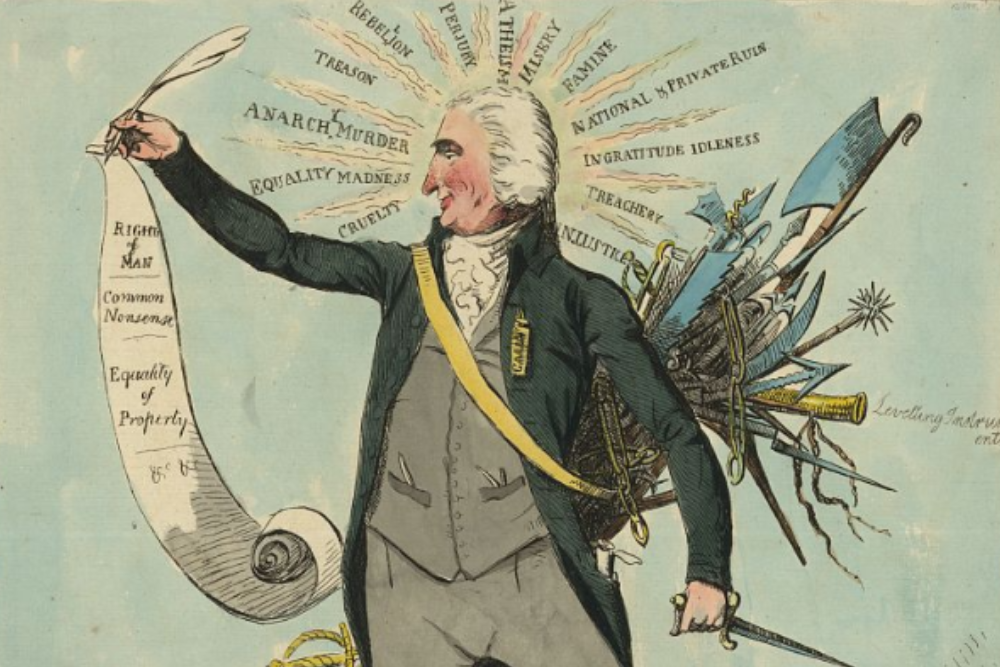
Paine published Rights of Man in two parts between 1791-92 in response to Edmund Burke’s Reflections on the Revolution in France, which condemned the French for daring to assault the traditional authority of Church and King. In response, Paine defended the principles of universal and equal rights, arguing that political regimes and the constitutions that make them are legitimate only to the extent to which they protect those principles, and that no generation can permanently bind another to any one form of government. Along with the 1797 pamphlet Agrarian Justice, Rights of Man advocated a state-sponsored social welfare scheme with progressive taxation, old-age pensions, and abolition of the English Poor Laws.
This was too much for the British authorities. Paine was forced to flee to France, where he was welcomed by the revolutionary government before being thrown in prison and nearly executed after the Jacobins took power in 1793. Freed after the overthrow of Robespierre, he published his Dissertation on the First Principles of Government in 1795 in response to the overturning of the radically democratic (but never implemented) French Constitution of 1793. First Principles makes two important interventions. First, the right to an equal vote is the foundational right of a democratic political system. The “only true basis of representative government,” Paine argued, is the equality of rights. Without universal and equal suffrage, all other rights are jeopardized, and citizens are reduced to a state of political servitude, since “slavery consists in being subject to the will of another.” Paine further argued that “the influence of property” should never be allowed to infringe on these rights, which appeared increasingly common as the rising bourgeoisie asserted its own right to the unlimited accumulation of capital.
Bolstered by the French Revolution, the newly christened “Left” would forever be defined by opposition to powerful monarchs and presidents, support for a single-chamber legislature and legislative supremacy, elected judiciaries, and, of course, universal and equal suffrage. First Principles reminds us how radicals in the American and French Revolutions defined democracy: not in vague and abstract terms, but in clear language that directly translated into concrete demands about the structure of government.
Other demands were added to the Left’s repertoire during the French Revolution’s more radical phase, including a people’s militia in place of a standing army and progressive taxation. The rise of Marxist socialism over the course of the 19th century introduced a maximum goal to the democratic movement: the abolition of private property and all social classes with it. Until World War I, Social Democratic parties and thinkers from Marx and Engels down to Lenin and Luxemburg retained the democratic constitutional structure defended by Thomas Paine and radical French revolutionaries as the necessary form of working-class political rule and a precondition for socialism. Engels made clear that for him and Marx, the democratic republic forged in the French Revolution was the “only political form in which the struggle between the working class and the capitalist class can first be universalised and then culminate in the decisive victory of the proletariat.” For Lenin and the Russian Social Democrats, democracy meant “supreme state power” in a unicameral legislature with representatives elected through universal, equal, and direct suffrage.
Our Own Declaration
Paine argued that republican government is a dead letter without universal and equal suffrage, where “citizens are reduced to a state of political servitude.” Lenin used similar language, arguing that a central task of the Russian Social Democrats was to connect the workers’ economic demands to their “condition of political slavery.” MLK, who was familiar with Paine’s work, also drew parallels between the denial of equal rights and a more general loss of freedom when discussing the struggle for suffrage in the South. Without the right to vote, he argued, “I do not possess myself. I cannot make up my mind—it is made up for me. I cannot live as a democratic citizen, observing the laws I have helped to enact—I can only submit to the edict of others.”
King’s words are striking. But today, socialists talk more about wage slavery than about our lack of political freedom. Much is said about the tyranny of the boss, but far less about the domination of the imperial executive, the malapportioned Senate, or the unelected judiciary. Yet, it is the undemocratic political system that ensures Americans will never have durable power in the workplace, let alone hold the power to socialize the means of production. The framework of government outlined in our Constitution enables racist voting laws, low minimum wages, poor healthcare, abysmal environmental protections, and imperialist foreign policy. Socialists have kept Paine’s interest in economic solutions to social ills, but discarded his focus on political democracy as a means to resolve social problems. In doing so, we have fallen back into the trap of economism—the belief that “the economic struggle is the most widely applicable method of drawing the masses into active political struggle,” and forgetting Lenin’s enduring contribution that the “class point of view” means pushing forward “every democratic movement.”
This point has been made before. Somewhere between the beginning of World War I and the end of World War II, socialists stopped agitating for a democratic republic. Without that demand—and, more importantly, the ideological commitments that make it possible—Paine appears less relevant to us today. Absent concrete and positive constitutional proposals, socialists have also lost the ability to communicate to a mass audience. America has a long history of fighting for democracy and equality, from the abolitionist movement to the Civil War and Reconstruction, from women’s suffrage to Civil Rights. But socialists have little to say about this history, and are generally averse to the rights discourse that was central to the French Revolution and came across so clearly in Paine and his successors. Lenin called for “abolishing the whole system of police tyranny and denial of the people’s rights.” Debs advocated a constitution based on equality of rights, duties, privileges, and opportunities. Where is this language today? The Declaration’s proclamation of equal rightsand equal liberty—the values that Paine struggled for all of his life—was and still is a revolutionary departure from our actually existing government.
Paine asserts that a country can boast of its constitution only when “my poor are happy; neither ignorance nor distress is to be found among them; my jails are empty of prisoners, my streets of beggars; the aged are not in want, [and] the taxes are not oppressive.” Today, the jails are full of prisoners, the streets are crowded with beggars, and the young and old alike lack the necessities of a decent life. The Constitution has always protected the interests of a minority of Americans—first slaveholders, then Jim Crow Southerners, and now industrial and financial capitalists. The method of wealth extraction has changed over time, but the political system that keeps the wealthy in power has stayed the same.
250 years after the signing of the Declaration of Independence, Americans are still not independent from the tyranny of a minority. This anniversary is an opportunity to learn from Thomas Paine and agitate for a political and social system grounded in universal and equal rights. We have it in our power to make this country—and by extension the world—over again.
Light & Air / Marxist Unity Group
Liked what you read? Subscribe to stay plugged in.
From Marxist Unity Group via This RSS Feed.