

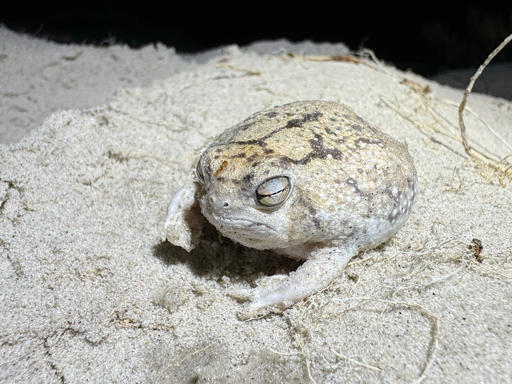
The survival of a unique frog species that lives in the coastal sand dunes of South Africa and Namibia is under threat from diamond mining, the proposed Boegoebaai Green Hydrogen Project and climate change. The desert rain frog (Breviceps macrops) has been moved to a higher threat category, from near threatened to vulnerable, on the IUCN’s Red List. The change in the frog’s conservation status is based on assessments carried out by scientists from various Southern African universities and organizations. “[The species] has already experienced loss of its habitat from strip mining and these projected impacts don’t bode well for the species and the other unique biodiversity that occurs only in these coastal dune systems,” Jeanne Tarrant, executive director of Anura Africa, which supports amphibian conservation, and regional co-chair of the IUCN Amphibian Specialist Group for Southern Africa, told Mongabay via email. The desert rain frog grows to just 4 to 6 centimeters (1.6 to 2.4 inches) in length. It’s range is also very small, limited to the white coastal sand dunes of northern South Africa and southern Namibia within 10 to 12 kilometers (6 to 7 miles) of the coast. It survives without a permanent source of freshwater by absorbing moisture from coastal fog and spends most of its life buried beneath moist sand, emerging when conditions are just right. Scientists identified six distinct habitat locations of the frog within the Succulent Karoo biome, a recognized hotspot for biodiversity, all threatened with mining, energy and infrastructure development. “The proposed…This article was originally published on Mongabay
From Conservation news via This RSS Feed.