

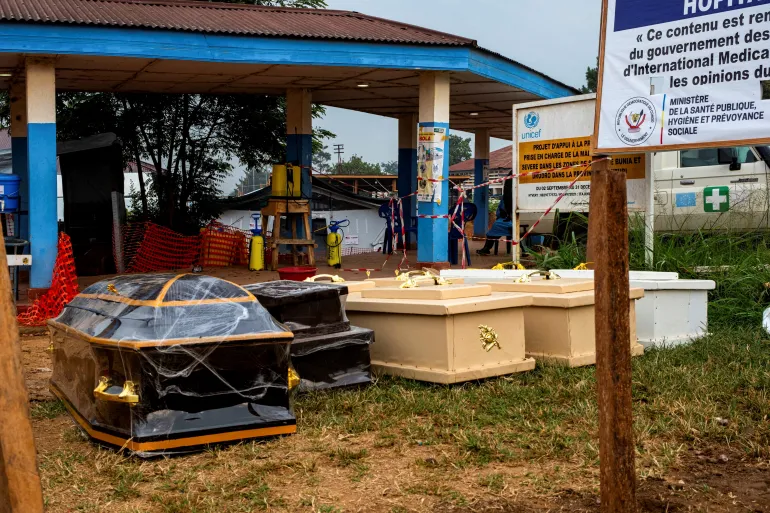
Outbreak reaches a fourth province while hospitals face mounting pressure and health authorities intensify surveillance.
The Democratic Republic of the Congo (DRC) has confirmed 625 deaths from the Ebola outbreak in the country’s east, as the virus continues to spread beyond its original epicenter.
RELATED: New DRC Zone Affected by Ebola Outbreak as Death Toll Surpasses 580
According to the latest bulletin issued by the Ministry of Communication, with data through July 7, authorities have recorded 1,792 confirmed cases across the provinces of Ituri, North Kivu and South Kivu. Two new infections detected in Kisangani, in Tshopo province, mark the outbreak’s expansion into a fourth region.
The case fatality rate stands at 34.1 percent. A total of 750 patients have recovered, while 285 remain hospitalized or in isolation. Authorities reported that contact tracing currently covers 80 percent of identified contacts as surveillance efforts continue to detect new chains of transmission.
POINT DE SITUATION EBOLA – 9 JUILLET 2026
La riposte contre Ebola se poursuit en Ituri, au Nord-Kivu et au Sud-Kivu, avec un renforcement des opérations de coordination, de surveillance et de prise en charge.
1 792 cas confirmés
— Ministère de la Communication et Médias/RDC (@Com_mediasRDC) July 9, 2026
One of the confirmed cases in Tshopo has been linked to the Nia-Nia health zone in Ituri, where the outbreak was officially declared on May 15.
Hospitals under strain
The outbreak has also spread beyond the DRC’s borders. Uganda has confirmed 20 cases, including two deaths, while France reported its first case in a physician returning from a medical mission in the DRC.
The World Health Organization (WHO) identified the circulating virus as the Bundibugyo strain, for which no approved vaccine or specific treatment exists. The agency continues to classify the outbreak as a Public Health Emergency of International Concern.
The African Union’s public health agency reported that 112 healthcare workers have been infected during the outbreak, including 35 who have died. Hospitals are facing increasing pressure, with bed occupancy reaching 95 percent nationwide and 113 percent in North Kivu province.
“To be able to say that the situation is under control, our goal is for more than 90 percent of reported cases to come from those contact lists. Unfortunately, we are far below that target. Only 32 percent of cases come from the contact lists,” said Wesam Mankulla, director of the Incident Management Support Team (IMST) for the Africa CDC Ebola Response.
“The virus continues to stay one step ahead of our response. It is moving faster than the resources we are deploying to bring the situation under control,” Mankulla added.
Third-largest Ebola outbreak on record
The outbreak was officially declared on May 15 in Ituri, a province bordering Uganda and South Sudan, before spreading to North Kivu and South Kivu.
According to the WHO, the virus had been circulating in Ituri for approximately two months before the outbreak was formally declared. In the absence of an approved vaccine or specific treatment for the Bundibugyo strain, containment efforts depend on isolating infected patients, tracing contacts and protecting healthcare workers from a virus transmitted through bodily fluids that causes severe hemorrhagic fever.
The current outbreak is the third-largest Ebola epidemic on record, surpassed only by the 2014–2016 West Africa outbreak and the 2018–2020 epidemic in eastern Democratic Republic of the Congo.
From teleSUR English via This RSS Feed.