

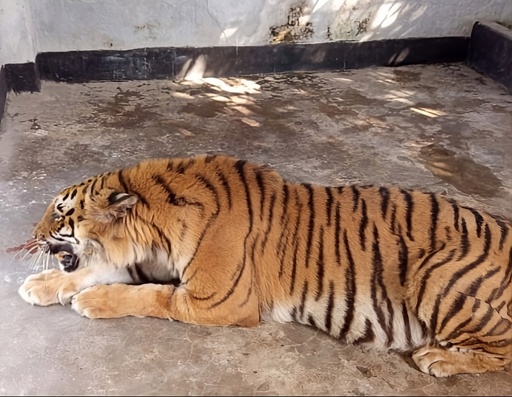
In a first, Bangladesh is preparing to release a tiger back into the wild after it was rescued from a poacher’s trap and provided with medical treatment. On Jan. 4 this year, the Forest Department rescued the female tiger (Panthera tigris), estimated to be around 10 years old, from the Chandpai and Sarankhola forest range in the Sundarbans East division. The critically injured tiger was taken to the Khulna Wildlife Rescue and Rehabilitation Center, a facility of the Bangladesh Forest Department, for treatment. “We rescued the tiger from a snare set for deer poaching. After receiving adequate care, the tiger is now ready to return to the wild. We are planning to release her in a few days,” said Md Rezaul Karim Chowdhury, divisional forest officer, Sundarbans East division. According to the latest tiger census, conducted in 2024, Bangladesh is home to 125 globally endangered Bengal tigers living in the Sundarbans mangrove forest. The rescued tiger’s left foreleg, which was caught in the snare, was severely injured. Image courtesy of the Bangladesh Forest Department. Covering 6,017 square kilometers (2,323 square miles), the mangrove forest is administratively divided into Sundarbans East and Sundarbans West. It is also divided into three blocks — Chandpai-Sarankhola, Khulna and Satkhira. As per the census, the highest number of Bengal tigers is found in the Chandpai-Sarankhola block. “This indicates that the density of other wildlife, including deer and wild boars, is also higher in this block because the forest’s top predators are more concentrated here,” Chowdhury…This article was originally published on Mongabay
From Conservation news via This RSS Feed.