

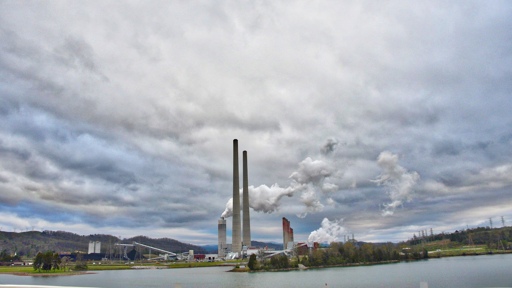
For the past four years, Angie Mummaw has been told the gas-fired electrical plant the Tennessee Valley Authority is building a few miles from her home in rural Tennessee was a necessary stop on its move away from coal. But recent directives from the Trump administration mean the coal-fired plant that was slated for closure is most likely staying – and so is the planned gas plant next door. She lives right down the road from both.
“To hear that they just decided to continue burning coal indefinitely was kind of a slap in the face,” said Mummaw, a resident of Cumberland County and an organizer for the environmental nonprofit Appalachian Voices.
But for America’s largest public utility, keeping fossil fuel-powered plants running might be the wave of the future.
The Tennessee Valley Authority is at a pivotal moment, one driven by new direction from above as the Trump administration eliminates renewable incentives, rearranges the utility’s leadership, and encourages extending the lives of coal- and gas-fired plants. As the utility plans its next quarter-century of energy production, those who run it insist they’re doing the best they can to meet the demands of the times, even as environmental organizations and community members protest its backtracking on the energy transition.
The agency’s comprehensive Integrated Resource Plan, or IRP, evaluates the future power needs of the 10 million residents of the seven states the TVA serves – all of Tennessee, and parts of North Carolina, Alabama, Mississippi, Kentucky, Georgia, and Virginia – through 2050. The utility completed its last plan in 2019, and says changing market and political trends prompted the start of a revision last year. Now, there’s yet another draft, with significant departures from the last iteration – many of which abandon an earlier, if limited, emphasis on expanding renewable energy and instead prioritize nuclear, gas, and coal.
The latest plan is something of a reboot, given changes in the utility’s and the Trump administration’s priorities. These changes reflect the turmoil that has roiled the Tennessee Valley Authority since President Trump’s second inauguration. The plan drafted in 2025 had gone through several drafts and rounds of public comment, only to stall when the agency’s board lost its quorum last year after Trump summarily fired three of its members. That delayed any decision-making for more than nine months. The utility’s CEO, Don Moul, stepped down and was replaced by Mike Skaggs, the former vice president of operations and construction at the Watts Bar Nuclear Plant. When Trump appointed three new board members over the winter, IRP discussions began anew.
TVA spokesperson Scott Brooks says the changes represent practical priorities. “It’s all a reflection of what’s happening in the market,” he said.
The updated plan is based on three economic assumptions.
The first is a reduction of federal tax incentives for renewable energy. Because of rollbacks in the One Big Beautiful Bill Act of 2025, new utility-scale solar construction must break ground by 2027 to benefit. While the 2025 plan predicted up to 20 gigawatts of potential solar generation, the latest iteration expects no more than 5. Wind energy is off the table entirely, though Brooks said the utility will continue to consider offers from wind and solar developers.
Read Next
Trump is keeping coal on life support. How long can it last?
The second assumption revolves around federal deregulation of nuclear, gas, and coal power, which the utility defends as necessary to manage reliability. The Trump administration has lifted what it termed “burdensome” Environmental Protection Agency restrictions on coal plant emissions, and encouraged utilities to keep coal plants open beyond their expected lifetimes and reopen those that have been closed. It has even offered federal support to upgrade some of them. The utility now hopes to retain its coal fleet through 2039, and may nearly double, to as much as 26 GW, its previous estimated investment in gas. The TVA also plans to pursue licenses to extend the lifetimes of its three nuclear plants.
The plan also assumes data centers will continue to pressure the region’s grid infrastructure and increase demand for energy. The TVA is exploring the possibility of establishing a rate specifically for these energy-intensive operations, which currently account for as much as 20 percent of the utility’s industrial load, an amount the board expects to double by 2030.
From these assumptions, TVA has developed three scenarios: One based on the utility’s current economic and political realities, another pegged to mounting energy demand from population growth and data centers, and a third based on the possibility of future legislation to reduce carbon emissions. However, not everyone is convinced the TVA’s plans are sensible – not only for the climate, but for its financial health.
Dennis Wamstead, an energy analyst at the Institute for Energy Economics and Financial Analysis, said that any decision, such as keeping coal-fired plants open, based on changes in politics don’t reflect reality.
“Their decision or their endorsement of a pretty concrete retirement date scenario in 2021 has been upended perhaps by political events, but that does not change the economics,” Wamstead said. “Those plants are no longer economic and increasingly unreliable.”
Angie Mummaw and other grassroots environmentalists in the region are gearing up for a fight around the Cumberland Fossil Plant, which was slated for closure in 2028 until the current board approved keeping it open.
On June 25, the Southern Environmental Law Center, representing Appalachian Voices, the Center for Biological Diversity, and the Sierra Club, sent a letter to the new TVA leadership threatening lawsuit over what it called a flagrant violation of the Clean Air Act. It calls the TVA’s permits for the new gas plant insufficient because it was sought under the auspices of ending the use of coal at the Cumberland site, which is the largest and most-polluting in Tennessee.
Brooks defended the TVA’s decision to retain coal and gas power and said the facilities comply with current federal rules regarding air quality. “We’re always going to comply with the regulations to protect the environment,” Brooks said. “And that’s been true with every administration for 90 years.”
The Tennessee Valley Authority is accepting public comment on the latest Integrated Resource Plan through July 22nd. A final recommendation is expected August 6.
This story was originally published by Grist with the headline The nation’s biggest public utility just doubled down on coal, gas, and nuclear on Jul 10, 2026.
From Grist via This RSS Feed.