

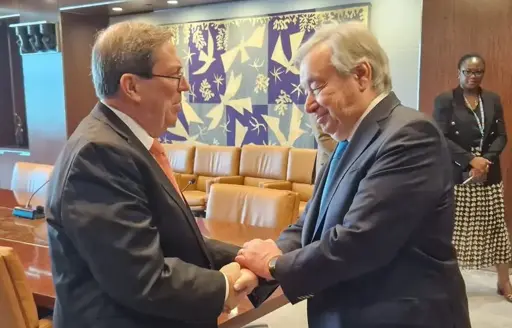
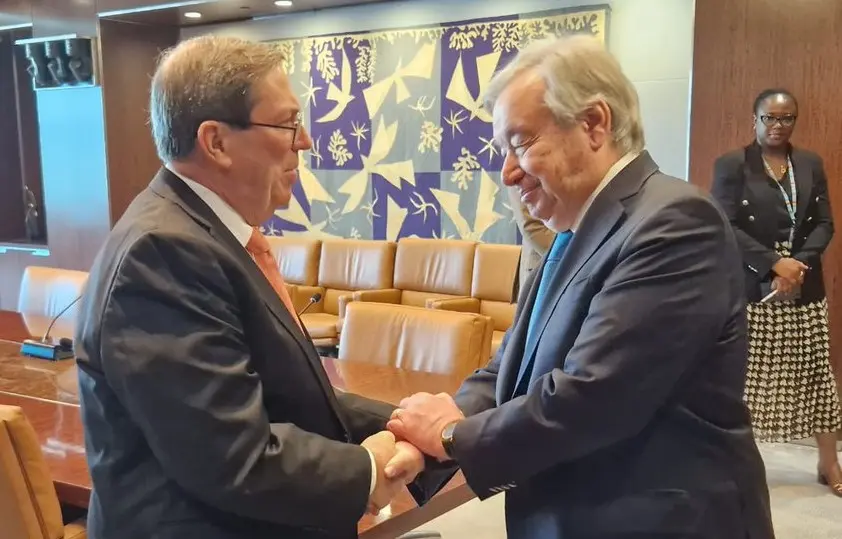
Cuba’s FM Bruno Rodriguez held a meeting in New York with UN Secretary-General António Guterres on Thursday, during which he detailed the daily reality facing the people under U.S. coercive unilateral measures.
The meeting took place ahead of the UN General Assembly debate titled “Necessity of ending the economic, commercial and financial blockade imposed by the United States of America against Cuba,” where Rodríguez delivered a comprehensive indictment of U.S. policy.
Rodriguez reported that damages caused by the blockade between March 2025 and February 2026 reached $8.103 billion, raising the accumulated cost to $178.7 billion at current prices.
RELATED: UN General Assembly Demands End to U.S. Blockade Against Cuba
“Cuba does not represent a threat to the national security of the United States“, Rodríguez reiterated before the Assembly, presenting evidence of the policy’s devastating human toll. The blockade has produced unbearable blackouts affecting access to potable water, food shortages and a deterioration in health indicators that has raised infant mortality to 9.9 per 1,000 live births.
The Cuban Foreign Minister highlighted that the survival probability for children with cancer has dropped from 85% to 65%. “The trend coincides with the harshest moments of the U.S. siege,” Rodríguez stated, adding bluntly: “The blockade suffocates and kills.“
Me reuní con el Secretario General de @ONU_es, @antonioguterres, durante mi visita a Nueva York.
Le agradecí por esta nueva oportunidad de saludarlo y compartir la realidad que enfrenta a diario el pueblo de #Cuba, debido al criminal cerco energético, el bloqueo recrudecido y… pic.twitter.com/YPKhxOmDv7
— Bruno Rodríguez P (@BrunoRguezP) July 9, 2026
Text reads: “I met with the Secretary-General of @ONU_es, @antonioguterres, during my visit to New York. I thanked him for this new opportunity to greet him and share the reality that faces daily the people of Cuba, due to the criminal energy blockade, the tightened blockade and the secondary sanctions imposed by the U.S. Government.”
Multidimensional War Denounced
FM Bruno Rodriguez described Washington’s actions as a “multidimensional war” against Cuba that has become increasingly brutal over the last seven months. He denounced a comprehensive escalation including an energy siege, naval blockade, harassment of oil tankers by U.S. military vessels near the island, and threats of military intervention.
“The Government of the United States is waging a multidimensional war against Cuba that has become more cruel in the last seven months“, Rodríguez declared. “An energy siege and a naval blockade have been added, which is an act of war.”
The Cuban diplomat detailed how the energy blockade specifically targets fuel shipments to the island, causing prolonged blackouts that cripple daily life and economic activity. Hospitals, water pumping stations and food preservation systems have been severely impacted by the fuel restrictions, compounding the humanitarian consequences of the long-standing blockade.
Rodriguez thanked Guterres for the opportunity to present Cuba’s case and reiterated the island’s willingness to engage in dialogue with Washington on equal terms, without conditions and with full respect for Cuba’s sovereignty.
“I welcome the opportunity to once again express our gratitude to Secretary-General Guterres for his principled position in favor of the legitimate demands of the Cuban people”, Rodríguez stated.
The General Assembly session on the blockade saw overwhelming international support for Cuba, with 136 votes in favor of examining the issue, surpassing procedural objections and maneuvers presented by the US delegation. Only nine countries voted against and 30 abstained, demonstrating near-universal rejection of Washington’s decades-long policy.
The debate marks another chapter in the annual UN ritual where the vast majority of nations call for an end to the blockade, though Washington has historically ignored these resolutions. The vote count reflects the growing isolation of U.S. policy on Cuba within the international community, even as the administration of President Donald Trump has intensified sanctions and secondary penalties targeting third countries that engage economically with the island.
From teleSUR English via This RSS Feed.