

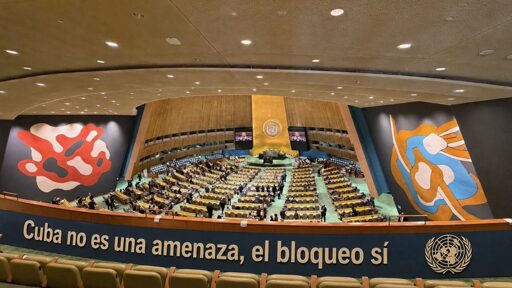
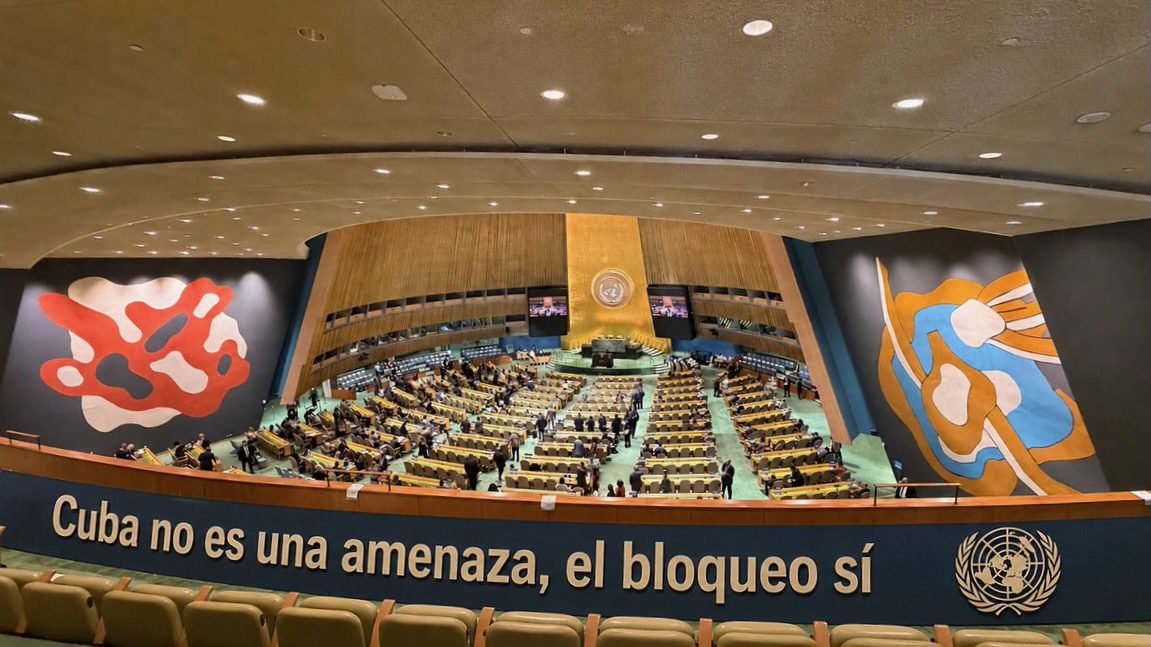
Last week, Cuban Foreign Minister Bruno Rodríguez announced that the island nation was bringing a pressing debate to the floor of the United Nations General Assembly. Cuba proposed that a debate be opened so that the world could have a better sense of the crippling impacts of the energy blockade on the island that the US has de-facto imposed beginning in December and then formally imposed through presidential decree in late January. The prohibition on the export of fuel to Cuba has provoked a serious energy, economic, and humanitarian crisis on the island.
However, Washington and its allies had openly opposed holding such a discussion in the UN’s highest deliberative body. An article in The Nation cited a leaked cable allegedly sent by Marco Rubio himself to all US embassies wherein Rubio called on US diplomatic personnel to pressure their host countries’ governments to prevent the debate on the recent sanctions against Cuba from taking place.
If this document is authentic, it would confirm the accusations made by the Cuban government, which has been asserting for several months that the US State Department has launched a fierce campaign to undermine the historic support Cuba has received from the international community – a community that, year after year, condemns the blockade imposed on Cuba more than sixty years ago to destroy the revolutionary process that began in 1959.
According to Foreign Minister Bruno Rodríguez, it is not surprising that the number of countries that voted against the resolution and abstained has grown, given the diplomatic pressure Washington is said to have exerted. “There is a brutal campaign of political and diplomatic pressure,” Rodríguez stated, carried out by high-ranking US officials, including Secretary of State Marco Rubio. “They have tried to impose their twisted and unjust will on sovereign governments, especially in Europe, through a toxic offensive on social media and official State Department channels,” said the head of Cuban diplomacy.
Thus, The Nation reports that the cable warns Washington’s allies to be “extremely careful” in their statements on this issue and cautions against possible “friction” with Washington if they support Cuba’s right not to be subject to economic, commercial, or energy blockades.
And undoubtedly, the pressure exerted on several countries that are staunchly aligned with Washington’s foreign policy would have had some effect on the vote regarding whether or not to open the debate on the situation in Cuba. In total, 9 countries voted against the motion (including Argentina, Israel, and the US itself), and 30 abstained, almost all of them strong allies of Washington.
In total, 39 countries – which lagged far behind the 136 countries that approved the opening of a collective debate marked by accusations from the United States and Cuba, and calls from the overwhelming majority of the international community to lift US sanctions that are causing a “humanitarian crisis,” according to a special UN panel.
Cuban President Miguel Díaz-Canel thanked the international community for opening the debate: “On behalf of the people of Cuba, I thank the 136 nations of the world that voted in favor of bringing the issue of the genocidal blockade against an entire nation and the threats of military aggression to the floor of the UN General Assembly.”
A debate between rhetoric and concrete figures
The United States, for its part, asserted that the embargo is not directed against the Cuban people, but only against the Communist Party government: “Ask the people of Cuba whether or not they suffer from the embargo. Ask even the diplomats, correspondents, and other foreigners living in Cuba,” said the US delegate, to the outrage of the Cuban delegation.
For his part, Cuban Foreign Minister Bruno Rodríguez asserted that “Cuba is not a threat. ‘The blockade is,’” he said in response to US accusations, adding that the economic, social, and political impact of the blockade has been brutal. Washington’s unilateral actions have caused annual losses of more than 7,556 million dollars, and since the beginning of the blockade – which was intended to overthrow the revolutionary process launched in 1959 – it has caused a cumulative economic loss of more than $2.1 trillion.
Added to this exorbitant figure are not only the recent sanctions imposed by the Trump administration, but also the brutal energy stranglehold that Washington has imposed on the island since January 2026, when US troops attacked Venezuela and thereby cut off the oil supply from Havana’s main energy ally. According to official data, Cuba’s GDP has fallen by 24% in 2026 alone as a result of the economic blockade.
In response, the Russian representative said: “The only crude oil received: 100,000 metric tons from the Russian oil tanker Anatoli Kolobki. Power outages lasting up to 30 hours. Bread rationed to 60 grams per person. These are not government failures; this is the brutality of the blockade.”
Not content with that, the Trump administration also threatened to impose tariff sanctions on any country that sells oil to Cuba, which has caused the Cuban economic situation to worsen; as of today, practically at a standstill and paralyzed, with power outages lasting many hours that have brought medical operations, water supply, cancer treatments, children’s education, and food production – among other things – to a halt.
In this regard, the representative of the Mexican delegation said: “The impact can no longer be measured in mere numbers but must be measured in lives: children are dying because doctors lack access to supplies; mortality rates are rising, and survival rates are falling.”
The UN itself has declared that Cuba is undergoing a “humanitarian crisis caused” by geopolitical decisions. For his part, Bruno Rodríguez has described Washington’s measures at the United Nations General Assembly as “genocidal,” contrary to international law and the most basic human rights.
In this regard, and despite pressure from US diplomats, Cuba – a country with a population of roughly 10 million – has once again scored a symbolic victory against the economic pressure exerted by the world’s most powerful nation.
As if that weren’t enough, Cuba must now brace for Hurricane Melissa, which is expected to batter the eastern region of the country, without the necessary supplies and lacking the power needed to operate an infrastructure already severely damaged by decades of trade embargo.
Furthermore, Rodríguez said that the decision to maintain its independence will be defended to the very end: “We are a nation committed to and a defender of peace, international law, multilateralism, truth, and justice; a people that has been fighting for its freedom and independence for more than 150 years … The Cubans’ decision will always be: Homeland or Death! We shall prevail!” said the Cuban foreign minister.
Zoe. , July 9, 2026
From BT News via This RSS Feed.
Nobody’s taking America seriously enough anymore for any “diplomacy” to have much effect.