

On July 7, Lorenzo Salgado Araujo, a Mexican construction worker and father, was shot and killed by Immigration and Customs Enforcement (ICE) officers in Houston, Texas, during a vehicle stop as he was on his way to work.
“My father was a simple man. A family man. A man of routine,” said Ronaldo Salgado, oldest son of Salgado Araujo, during an emotional press conference in response to the incident.
Ronaldo detailed how he scrambled for information the morning of the incident. He drove an hour away to his father’s work site to find neither he nor his workers there. After seeing news of an ICE incident on Canal St, he drove there just to confirm it wasn’t his father. At the scene, he saw a work van but was given no answers by police or authorities on site. Then he saw a video on Facebook that his father had been shot.
“I recognized him immediately, not from his appearance but from his voice, crying for help as he lay on the street bleeding out.”
He demanded a “full investigation into the events” that led to his father’s death.
Houston fights for justice for Salgado Araujo
The official account of the killing differs sharply from the account presented by Salgado Araujo’s family and community members.
The Department of Homeland Security (DHS) reportedly released a statement claiming that Salgado Araujo “attempted to ram an officer” with his vehicle. The ICE officer then shot the man in self-defense.
“We have heard it before,” said Juan Proaño, CEO of the League of United Latin American Citizens (LULAC), at a press conference in response to the killing. He outlined DHS’ narrative: “A driver who attempted to evade. A vehicle weaponized to run over an officer. An officer who fired in self-defense.”
Speakers emphasized that the same story was told “nearly word-for-word” by the federal government after the killing of Renee Nicole Good in Minneapolis. Video of that incident would later emerge, with widespread criticism arguing it showed an ICE agent standing clear of the vehicle’s path when he opened fire on the mother of three at point-blank range.
Read more: ICE killing in Minneapolis sparks mass outrage
The coalition of organizations and community members in Houston pointed to what they described as a pattern of killings across the country, arguing that Salgado Araujo’s death is part of a broader “open season” on Latinos by federal agents.
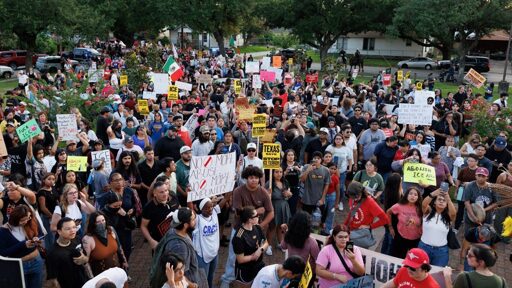
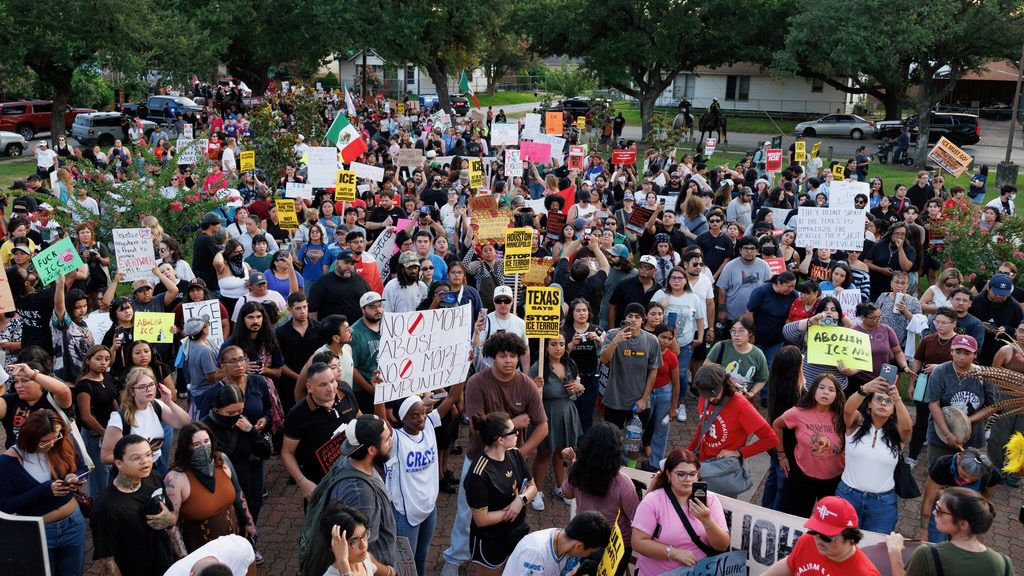
Thousands gathered for an emergency protest on Wednesday, July 8, at the site of the killing. The community is demanding a full, transparent, and independent investigation, as well as for ICE to leave the city.
Vivek Venkatraman, an organizer with the Houston branch of the Party for Socialism and Liberation, told BreakThrough News that the tragedy has reignited the local immigrant rights movement. The Houston community feels like “this could happen to any of us.”
“ICE’s unsubstantiated claim – and one that is frequently used – that Lorenzo was ‘weaponizing his vehicle’ only proves that the Trump administration and federal agents are able to kill with total impunity,” says Venkatraman.
Mayor John Whitmire has publicly rejected the community’s demand for a local investigation independent of federal agencies. However, protests are already being organized at City Hall this Tuesday to reinforce these demands.
Arrests spike across the US as ICE shifts tactics
The Houston killing comes amid a sharp surge in ICE operations across the United States. A reported 10,000 people have been arrested by ICE in just 5 days. The increased activity has targeted several major cities, with residents describing a shift toward smaller, “silent” operations rather than the militarized occupations and raids that characterized the early months of Trump’s second term.
Despite the massive resistance to “Operation Metro Surge” in Minnesota, dozens of arrests have taken place recently in different parts of the state that are “less visible” and “quieter.”
Phoenix and Tucson, Arizona, are also reporting a spike in arrests. Local organizer Salvador Reza told NBC News that things are worse than before “since they have a much bigger budget, and more agents.” He says their inflated capacity allows ICE to conduct a higher quantity of individual operations that are less public.
The recent spike in ICE operations was preceded by a major increase in the resources available to the agency, including new surveillance and data systems.
A report called “The Tech Behind ICE,” jointly produced by immigrant rights groups Mijente, the National Immigration Project of the National Lawyers Guild, and the Immigrant Defense Project, details billions of dollars in additional contract spending over the last several months.
This spending includes massive new contracts with “Palantir for ICE’s data analytics, people-tracking apps, and Anduril for autonomous border towers, drones, sensors, and related AI surveillance systems for CBP.”
As funding and resources expand, DHS has continued to use public safety as its main justification.
“Since Day One, DHS law enforcement has been delivering on President Trump’s promise to the American people to arrest and deport criminal illegal aliens including murderers, rapists, pedophiles, gang members, and terrorists,” said DHS in a statement, as reported by ABC News.
ICE operations spark backlash in Salt Lake City
In Salt Lake City, Utah, a series of shocking ICE operations have sparked renewed outrage, with the community fiercely denouncing the federal rhetoric that the immigrants they are arresting are “terrorists.”
One viral video from July 7, shows multiple ICE officers inside a family’s home violently arresting the father and appearing to handcuff the family’s teenage son. A woman can be heard screaming in Spanish that the father has diabetes as he appears to lose consciousness. His limp body is dragged into a vehicle by the officers.
“They did not have a warrant or nothing they just followed me and my father home,” said Elizabeth Garcia, daughter of the arrested man in the video, on social media. “They came into our home and grabbed him like he was the worst criminal.”
This incident comes less than a week after prominent community member, activist, and father Julio Irungaray was detained outside of his home after his night shift as a janitor.
“My father is not a criminal, he is a working-class man through and through,” Julio Jr told BreakThrough News after his father’s detention. His father was subsequently deported to Mexico after being in the US for 35 years.
Protests have been planned in Salt Lake City, outside a warehouse site that ICE had purchased to convert into a detention center. ICE now says it intends to sell the massive facility, equivalent to 14 football fields under one roof. Organizers, however, say they will continue protesting until the facility is officially sold, and ICE completely withdraws from the state of Utah.
Resistance builds in the US
As ICE escalates in cities across the country, communities are organizing to resist the normalization of violent immigration enforcement. Under the Trump administration, Congress has significantly expanded ICE’s budget, manpower, and technological capacity as the agency adopts new enforcement strategies. But for families who have lost loved ones, and organizers building resistance networks, the demands remain the same: accountability for federal agents and an end to ICE presence in their communities.
Zoe. , July 9, 2026
From BT News via This RSS Feed.